Tag: politics

  • Rethinking Feminism in Ireland

    Professor Camilla Fitzsimons
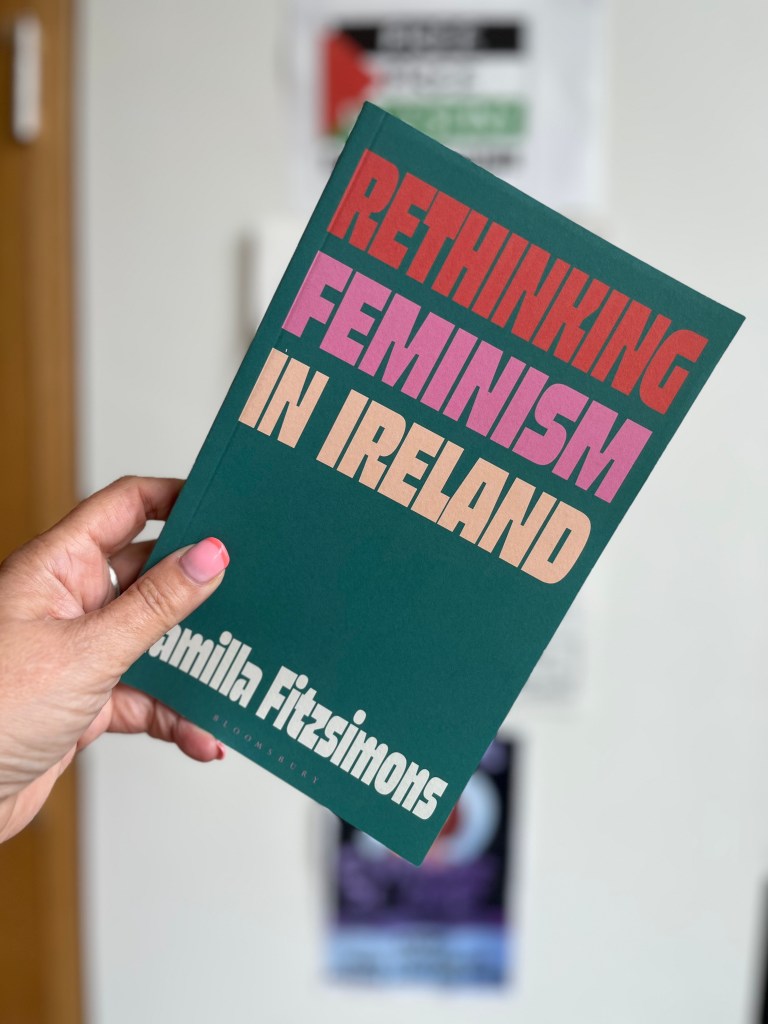
    Last Friday, the 27th June, my fourth book Rethinking Feminism in Ireland was published. This one has been a labour of love and, perhaps with all my books, a case of me seeking to write what I think the students that I meet and the people that I share activist interests with would benefit from reading. In other words, I wrote this book because I couldn’t’ find anything to recommend that would complement the conversations I found myself in when talking about feminism in Ireland.  

    What I particularly like about this book is how I brought the words of some important activists in Ireland to the fore. I interviewed people across the spectrum of politics including Brid Smith the former TD for People before Profit and Senator Lynn Ruanne. Lynn is a former community worker who does amazing work in, as she puts it, ‘equality proofing’ as many laws as she can when they cross her desk. She’s not the only community worker who features. Rita Fagan took the time to sit down with me and share stories of feminism from the vantage point of St Michael’s estate Family Resource Centre and Amel Yacef also shared insights from activism that spans a range of communities and equality-based causes. I also talked to trade unionists, including Therese Caherty, people who were active in Ireland’s pro-abortion movement like the formidable Sinéad Kennedy and Orla O’Connor from the National Women’s Council of Ireland. And thanks to Mary McDermott of Safe Ireland who also took time out to share her insights with me. You’ll have to read the book to find out who else features, but the good news is that it is freely available, right here thanks to my wonderful publishers Bloomsbury Press but especially Olive Dellow.

    So, what am I asking people to ‘rethink’? I contend that there are two souls of feminism – something I also write about here. The first and often most dominant is neoliberal feminism which is an extension of liberal feminism in that it focuses on empowerment and equality of participation in an otherwise largely unchanged world. The second, and the one that I argue for is radical, or anti-capitalist feminism. I object to neoliberal feminism’s hyper emphasis on individual success within today’s capitalist logic and argue instead for a version of feminism that recognizes our ability to control our lives is extremely limited. Our gender identity helps set these parameters, but so does our social class, perceived ability, sexual orientation, ethnicity, exposure to poverty, and our proximity to the catastrophic impacts of climate change, none of which are mutually exclusive.

    My thinking has been influenced my many amazing writers and activists who have come before me. As Sara Ahmed puts it, I am a Feminist Killjoy and proudly so even when it can make me unpopular. Given the current expansion of settler colonialism, I must also acknowledge the work of Rafia Zakharia and her book Against White Feminism within which she speaks so clearly about the current practice of using feminism as the justification for imperialism. I draw from others too across the spectrum of socialism (including Marnie Holborow’s excellent Homes in Crisis Capitalism), critical education and radical feminism and spread these ideas across seven chapters – The trouble with feminism, Feminism and electoral politics, Feminism, work and trade unions, Feminism and trams liberation, Confronting gender-based violence, Reframing reproductive rights, and Doing feminism.

    And if you like my writing, why not also check out my blogs where I write about a range of topics across trans liberation, electoral politics and feminism, but also Love Island and Taylor Swift

    Camilla Fitzsimons is a Professor of Adult and Community Education and the current Head of Department here in the Department of Adult and Community Education at Maynooth. This is Camilla’s fourth book – you can read a full list of her publications here

  • Rethinking Feminism in Ireland

    Professor Camilla Fitzsimons

    Last Friday, the 27th June, my fourth book Rethinking Feminism in Ireland was published. This one has been a labour of love and, perhaps with all my books, a case of me seeking to write what I think the students that I meet and the people that I share activist interests with would benefit from reading. In other words, I wrote this book because I couldn’t’ find anything to recommend that would complement the conversations I found myself in when talking about feminism in Ireland.  

    What I particularly like about this book is how I brought the words of some important activists in Ireland to the fore. I interviewed people across the spectrum of politics including Brid Smith the former TD for People before Profit and Senator Lynn Ruanne. Lynn is a former community worker who does amazing work in, as she puts it, ‘equality proofing’ as many laws as she can when they cross her desk. She’s not the only community worker who features. Rita Fagan took the time to sit down with me and share stories of feminism from the vantage point of St Michael’s estate Family Resource Centre and Amel Yacef also shared insights from activism that spans a range of communities and equality-based causes. I also talked to trade unionists, including Therese Caherty, people who were active in Ireland’s pro-abortion movement like the formidable Sinéad Kennedy and Orla O’Connor from the National Women’s Council of Ireland. And thanks to Mary McDermott of Safe Ireland who also took time out to share her insights with me. You’ll have to read the book to find out who else features, but the good news is that it is freely available, right here thanks to my wonderful publishers Bloomsbury Press but especially Olive Dellow.

    So, what am I asking people to ‘rethink’? I contend that there are two souls of feminism – something I also write about here. The first and often most dominant is neoliberal feminism which is an extension of liberal feminism in that it focuses on empowerment and equality of participation in an otherwise largely unchanged world. The second, and the one that I argue for is radical, or anti-capitalist feminism. I object to neoliberal feminism’s hyper emphasis on individual success within today’s capitalist logic and argue instead for a version of feminism that recognizes our ability to control our lives is extremely limited. Our gender identity helps set these parameters, but so does our social class, perceived ability, sexual orientation, ethnicity, exposure to poverty, and our proximity to the catastrophic impacts of climate change, none of which are mutually exclusive.

    My thinking has been influenced my many amazing writers and activists who have come before me. As Sara Ahmed puts it, I am a Feminist Killjoy and proudly so even when it can make me unpopular. Given the current expansion of settler colonialism, I must also acknowledge the work of Rafia Zakharia and her book Against White Feminism within which she speaks so clearly about the current practice of using feminism as the justification for imperialism. I draw from others too across the spectrum of socialism (including Marnie Holborow’s excellent Homes in Crisis Capitalism), critical education and radical feminism and spread these ideas across seven chapters – The trouble with feminism, Feminism and electoral politics, Feminism, work and trade unions, Feminism and trams liberation, Confronting gender-based violence, Reframing reproductive rights, and Doing feminism.

    And if you like my writing, why not also check out my blogs where I write about a range of topics across trans liberation, electoral politics and feminism, but also Love Island and Taylor Swift

    Camilla Fitzsimons is a Professor of Adult and Community Education and the current Head of Department here in the Department of Adult and Community Education at Maynooth. This is Camilla’s fourth book – you can read a full list of her publications here