Tag: Maynooth University

  • TUTOR Webinar Series in Review: Empowering Every Student – Reimagining Inclusive Education

    AuthorSinead Matson

    As we head into the summer month and get a small reprieve from the year’s workload, it gives us an opportunity to catch up on events or information we may have missed out on during a busy academic year.

    The TUTOR project’s second webinar from the Facebook Live series, “Empowering every student: reimagining inclusive education” is one to put on your watch list.

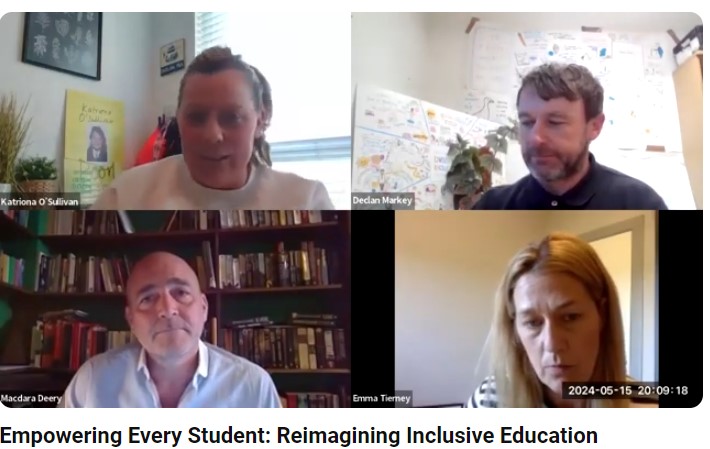
    Fronted by TUTOR Project Ireland’s second ambassador, Macdara Deery, a post-primary teacher from Gallen Community School in Co. Offaly, Empowering Every Student focused on inclusive education with a particular lens on social class and the experiences of socio-economic disadvantage on a community, school, and its students.

    The panel held a wide range of experience and depth, from FET, initial teacher education, alternative pathways, and personal experience and testimony.

    Emma Tierney, undertaking her post-graduate diploma in Further Education and training in Maynooth University offered really perceptive and nuanced glimpses into the disconnect that may occur from training to practice because of systemic barriers such as having the ability to challenge the dominate ways of doing, that exist, and have always existed, when you enter a new setting as a FET tutor in training, a newly trained FET tutor, or indeed as a student. She also drew attention to the lived experiences of students with intersecting identities and how they are experiencing their education with a lack of autonomy over their own learning journey. Emma used an example of a student she had during her teaching practice who held asylum seeker status, and how without any warning  “was  uprooted and displaced midway through the academic year and his course taken and put down in a different part of the country … completely uprooted.” This example really shone a light on the lack of power students may face and how the systems around them upheld and reenforced that lack of autonomy – it brings to light how as educators, we really need to examine all aspects of our students’ lives, not just what happens in the classroom.

    Katriona O’Sullivan, Digital Skills Senior Lecturer in Maynooth University, and author of bestselling autobiography Poor, really challenged educators: teachers and tutors to change the narrative for the students in their classroom. A particularly important and powerful moment in the webinar, was Katriona’s reminder:

    “we don’t need to change poor people, lads, we’re grand. We’re amazing. We need to change the people who are already in education. Like, loads of people are saying this in the chat, which is amazing, principals are saying it, and inclusive education isn’t about educating the people necessarily, it’s [about] changing the system … the teachers need to be educated, policy makers need to be educated, the people in education need to be educated about what inequality is, and what it looks like, and what disadvantage is, in the space of our of our universities or our schools.”

    I personally found this to be such a powerful reminder because we can tend to get bogged down in practice and lay everything at the door of educators when in reality we need to spend more time challenging and changing the system, speaking to initial teacher trainers, policy makers and so on about the realities of inequalities and show them what inclusive education really looks like.

    Our final panel member, Declan Markey, is a lecturer in the Adult and Community Education department in Maynooth University, and co-coordinator of the Turn to Teaching programme. Declan, like Emma and Katriona, challenged the system and its barriers, but also went back to what Emma was discussing about the training-practice gap and pointed out the importance of doing the work as well as learning the skills and tools. He emphasises the importance of engaging in anti-bias type auditing on ourselves and our practices, and really reflecting, acknowledging, and unpacking all of the learned assumptions, stereotypes, and biases we consciously and unconsciously hold from our cultural and lived experiences:

    “ you know the concept of inclusive education and you know we know Universal Design for Learning (UDL) – you equip people with a skill set and they can do some training oh yeah I can do inclusive education if they haven’t had a shift in their mindset that actually believes and you know in you know every student and learner that’s in front of them and stuff or you know and we all have assumptions and prejudices and stuff but if you can’t critically reflect on that and acknowledge you know your own kind of cultural background and your cultural assumptions and get past them and actually you know well then it doesn’t you know inclusive education isn’t really going kind make any difference in terms of the space that you’re in.”

    Truly, this is an important webinar that very honestly, and provocatively, shines a light on the real conversations we need to be having in education – particularly when it comes to inequalities and creating truly inclusive education environments. If you missed the wonderful, radical webinar, grab yourself a cuppa and click here to watch.

    Sinead Matson is a postdoctoral researcher working on the Erasmus+ funded TUTOR project for inclusive education in FET and Second Level schools. See https://tutor-project.eu/ for more details. 

  • What’s Going on Today in Palestine is Not New

    Blog Authors: Anne Ryan and Tony Walsh

    I’m from the sound of tanks

    I’m from a hot place

    I grew up with the suffering and cruelty of occupation that still plagues my daily life

    I’m from an unjust world

    I really want to make peace with myself (first) then with others and with the world,

    But every time I try to do that I fail. I don’t know why, but maybe that’s my bad luck

    I grew up with the tears of my mom that make me very sad

    One day I walked up and saw a very strong man building the bad wall. I didn’t know what to do, cry or be happy

    Then my father told me that I had to accept that idea

    because we can’t do anything

    Rana Sameeh Gabbash[1]


    [1]  From the ‘Book of Poems’ Summer School Program, Al-Quds University Community Action Centre, (c2008)

    While this poem encapsulates the overt and covert violence of the Palestine we encountered more than a decade ago it also speaks to what we see nightly on our televisions these days.

    Between 2008-12 the Department of Adult and Community Education, Maynooth University was involved in an EU funded project in partnership with 4 Palestinian Universities – Al-Quds, Bethlehem, Birzeit, and the Islamic University of Gaza[2]. The project known as LLIPS, focused on identifying existing lifelong learning provisions on the part of our partner universities with a view to enhancing it to even better meet the needs of Palestinian communities in the West Bank and Gaza.

    During the project we were fortunate to meet and work with many academics in the partner universities. We also met with members of community groups and local NGOs – all engaged with different sectors of the population. We learned a great deal about life in the country; the most striking reality being that – every day – Palestinians lived in an environment where they faced issues of social, economic, political and educational marginalization. They lived in a society where their very way of being, their culture and history were silenced and subverted by the hegemony of the Israeli state. We were particularly struck by the restrictions imposed upon colleagues in our partner universities and by the complex strategies in which they had to engage in order to maintain their programmes. One such example was movement. At a local level for example it was difficult for Al-Quds University in Jerusalem to maintain contact with its Adult Education Centres.  The problem was the Wall. The main campus was outside the wall and the Centres were inside.  Crossing the Wall was no easy task. At a national level movement was also difficult. The LLIPS project found it impossible to bring all the partner universities together within Palestine because those from Gaza could not travel to the West Bank and visa versa. Instead, we all met in Jordan. Many Palestinians spoke of how restrictions on movement effect their everyday lives. They also regretted the negative impacts these have on other staff, on their students and indeed on their own families and friends. They had lost contact with many of the latter over the years.

    As the LLIPS project progressed we were increasingly aware of the subtle, as well as the overt issues of power which constructed the identity and lived reality of those we encountered.

    We found that the nature of the oppression and resistance across Palestine was multi-layered. Although we saw the Wall, the settlements choking the little towns and villages, the checkpoints, the guns, and the multiplicity of minor indignities casually doled out, as outsiders we could barely begin to imagine what it felt like to live there and what it took to sustain one’s self, one’s family and one’s sense of identity and nationhood in the face of unmitigated hostility.

    The emotional and psychic toll on the individuals working there, as well as the community members was very evident.  Even back then the need for support, solidarity, respite and resilience-building was clear. How much more the needs must be now and will be in the future.

    One picture remains strongly, symbolically evocative.

    We were being driven from Jerusalem to Jericho- the iconic path the ‘Good Samaritan’ of old had traversed. We were to lead a seminar for academic colleagues there. A black cassocked priest expertly drove, negotiating the multi-laned motorway. A seeming anomaly speaking of wealth and modernity, it wound its way seamlessly through ancient, barren hills, through an arid, desert landscape. Only the occasional Beduin, hazardously perched upon a donkey and following a small flock of sheep or goats up precarious hillsides broke the dun-coloured monotony. And then I noticed that here and there the dusty countryside was dotted with black tree trunks. Evidence of earlier habitation, perhaps of olive-farms?

    ‘Was this land cultivated not so long ago, Father’ I asked our driver.

    The reply was swift. “Yes there were lots of Palestinian olive farms here. Olive tress can cope with the most arid conditions. And the trees provided shade and vegetation. They’d been there – like the farmers – for generations. Since Jesus’ time. But the Israeli Government confiscated the farms and chopped the trees. They said they were a threat to security. Hammas fighters could hide among the foliage and threaten the army….or settlers.’

    The lifeless trunks bore silent witness to dispossession…and more. 


    [1]  From the ‘Book of Poems’ Summer School Program, Al-Quds University Community Action Centre, (c2008)

    [2] The project was entitled Lifelong Learning in Palestine (LLIPs). The Maynooth University Team were Josephine Finn, Bernie Grummell, Tony Walsh, Shauna Busto-Gilligan and Anne Ryan

    Anne Ryan is Emeritus Professor at Maynooth University.  She was chair of the Department of Adult and Community Education from 2005 to 2018. Anne has worked in developing countries that experience extreme poverty (such as Bangladesh and Central Africa) and those that are war-torn (such as Afghanistan) and she has worked with disadvantaged communities in Australia and Ireland.  These experiences convince her of the potential of adult and community education to empower communities to respond to the critical challenges facing twenty-first century societies in ways that ensure their voice is heard by decision-makers. 

    See previous blog by Anne Transformative Engagement Network: working together to create a sustainable future

    Tony Walsh was, until recent retirement from Maynooth University, lecturer and sometime Head of the Department of Adult and Community Education; he continues as Director of the Centre for the Study of Irish Protestantism and is a Fellow of the Young Centre for Anabaptist and Pietist Studies at Elizabethtown College, Pennsylvania,.  A licensed systemic constructivist psychotherapist he is engaged in writing, consultancy and research inquiry engagements in the US, the UK, Palestine and Ireland (including Northern Ireland). Current research emphases include i) the experience and culture of the Irish Protestant minority; ii) narrative study of the Old German Baptist Brethren, (an Amish-like Plain church in the US); iii) the role of reflexivity in radical adult education iv) narrative and autoethnograpic inquiry.

  • Lessons from Palestine

    Authors: Anne Ryan and Tony Walsh

    Suddenly the images of the bombed ruins of a Gaza shop front, perhaps a café, flashed across the news screens. Rags of ruined blinds fluttered in the breeze.

    Instantly I was back in a narrow, busy laneway in old Jerusalem and a sidewalk café fifteen years ago. We[1] were visiting Jerusalem as part of an educational research project. Blissfully relaxing in the sun’s heat and watching, watching as the multi-coloured crush of people in the narrow medieval street streamed by. Dark clothed and somber, Hasidic men bent purposefully towards prayer; camera toting tourists eyed them curiously as they wandered, talking, looking. Groups of Palestinian women laughing, chatting, baskets full of produce came from the market. Bright eyed kids racing in and out; swift arrows of colour between the adult crowds. Handcarts and motor bikes threaded a hazardous way down the street. A bizarre stream of Western pilgrims appeared toting a large cross, responding to a loud rosary.  The midday call to prayer resounded from a nearby minaret mingling with their words. Each group seemed insulated, bounded in their own reality. The smells of roasting coffee beans, strong mint tea and frying meat next door mingled – sensory overload, as pungent aromas and noise, noise, noise enveloped us.

    A group of Israeli soldiers stopped at the corner. They propped their machine guns against the wall and they surveyed the crowds – and us. One addressed his peers in loud New York tones.  They were young and jumpy …and very, very near.   Suddenly there was an explosive bang close-by. The soldiers grabbed their guns. The streaming crowds froze. Fear chilled our faces, congealed our limbs. And moments of time passed slowly by…. That time it was only a back-fire. Minutes later life returned to normal; the crowds streamed swiftly on their way.

    We have often recalled that day packed as it was with so much to marvel at and so much to fear.  We have often wondered what bearing these experiences coupled with current events in Palestine and global conflicts in general should have on how we approach education?

    We have been writing about and researching education for many decades.  Essentially, we believe that education’s main purpose is to help learners to understand their world, so that they are empowered to transform what is oppressive rather than accept it or adapt to it[2].  This includes understanding why conflict exists and what might be reasonable and appropriate responses to that conflict. We also believe that mainstream education often leaves learners ill equipped to either understand or address big global challenges such as war.

    We believe that if education focused on understanding how power operates in society – and between societies – it would enable a far more fluent appreciation of the complex nature of human experience and particularly of conflict.  It would raise awareness of how individuals, groups, nations become positioned in relation to each other. And would emphasize how conflict – and most particularly conflict interventions – require an understanding of these positions. 

    It seems to us that education that interrogates power is ever more needed in a world where disinformation and misinformation are increasingly evident and where what is ‘true’, what is ‘good’, what is ‘right’ are far from clear cut.

    Even as we watch the awful events unfold in Palestine our thoughts often return to that day at the café in Jerusalem where we observed something of the overt nature of power.  It was explicitly expressed in the actions and demeanour of the soldiers. They had the guns.  Their power, although apparently placidly accepted by those going about their daily lives, was nevertheless fragile. The response to the ‘back-fire’ that could have been a gun shot or a bomb blast spoke of an awareness of the potential of resistance and challenge to the existing order that the soldiers were protecting.

    Power is of course not always so easily observed. Mostly it is hidden, occluded within the everyday. We believe that a vital task of education is to reveal those occluded dynamics of power, marginalisation and oppression – those ‘on-going repetitive citations of the known order, citations that offer some a viable life and at the same time deny it to others’ (Davies 2008, 173)[3].  Without an emphasis on the interrogation of power education becomes mere compliance ‘a process of transferring the values and practices which are embedded in a specific culture and are particularly associated with the assumptions, values and maintenance of the power elites of that society.’[4]


    [1] The ‘we’ refers to Tony Walsh and Anne Ryan who in partnership with the administrative and academic staff in the University of Bethlehem explored the challenges and opportunities inherent in diversity.

    [2] This is essentially a Freirean philosophical position

    [3] Davies, B. (2008) ‘The Ethics of Responsibility.’ In Phelan, A. and Sumsion, J. (Eds), Critical Readings in Teacher Education. Rotterdam: Sense Publishers.

    [4] Ryan, A. and Walsh, T. (2018) Reflexivity and Critical Pedagogy. Leiden: Brill p1

    Anne Ryan is Emeritus Professor at Maynooth University.  She was chair of the Department of Adult and Community Education from 2005 to 2018. Anne has worked in developing countries that experience extreme poverty (such as Bangladesh and Central Africa) and those that are war-torn (such as Afghanistan) and she has worked with disadvantaged communities in Australia and Ireland.  These experiences convince her of the potential of adult and community education to empower communities to respond to the critical challenges facing twenty-first century societies in ways that ensure their voice is heard by decision-makers. 

    Tony Walsh was, until recent retirement from Maynooth University, lecturer and sometime Head of the Department of Adult and Community Education; he continues as Director of the Centre for the Study of Irish Protestantism and is a Fellow of the Young Centre for Anabaptist and Pietist Studies at Elizabethtown College, Pennsylvania,.  A licensed systemic constructivist psychotherapist he is engaged in writing, consultancy and research inquiry engagements in the US, the UK, Palestine and Ireland (including Northern Ireland). Current research emphases include i) the experience and culture of the Irish Protestant minority; ii) narrative study of the Old German Baptist Brethren, (an Amish-like Plain church in the US); iii) the role of reflexivity in radical adult education iv) narrative and autoethnograpic inquiry.

  • TUTOR PROJECT

    Teachers Upskilling aiming at a holistic inclusivity in learning. 

    TUTOR is a 3 year European Union funded Teacher Academy project. The Department of Adult and Community Education, Maynooth University is a lead partner in TUTOR

    Ensuring inclusion in education has been a strong motivator for the Department of Adult and Community since its inception and over several decades. The Department is focused upon holistic, dialogical and pedagogical accompaniment of marginalised communities. It does this by co creating spaces for traditionally excluded voices to be heard,  and on ensuring a standard of excellence is achieved in qualitative, engaged and participatory research. The department’s philosophy of education, initial teacher education and continuous professional development is leading and influencing pedagogy and practice within adult, community and further education and training settings. That philosophy is strategically aligned with, and supportive of, the aims and objectives of the TUTOR project, and with the TUTOR consortium partnership.  The TUTOR project, alongside all of the international research projects the department partners with, encourages wider impact of inclusive education across the teaching profession at a European level.

    Key messages of the TUTOR Project 

    Summary of the TUTOR Project  

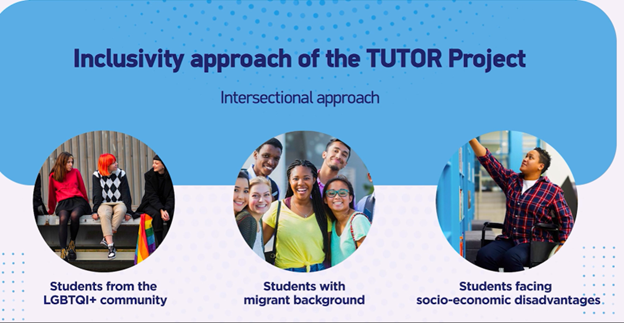
    TUTOR aims to create partnerships between teacher education and training providers to set up Teacher Academies developing a European and international outlook on inclusion in teacher education.  These Academies will embrace inclusivity in education and contribute to achieving the objectives of the European Education Area. In particular, the project will address the need for educators to develop their capacities to understand, analyse and develop strategic responses to the diversity in their classroom and to promote a more inclusive learning environment. TUTOR project intends to foster a more inclusive environment in education, that is open to students from migrant, LGBTQI+, and socioeconomically disadvantaged backgrounds, with a particular focus on safeguarding the elements of tolerance, acceptance, and inclusion.

    The TUTOR objectives 

    To contribute to the improvement of teacher education policies and practices in Europe by creating networks and communities that bring together providers of secondary teacher education and providers of continuing professional development, and other relevant actors (such as ministries) and stakeholders to develop a Train the Trainers approach, focused on inclusivity in learning, 

    • To define a forward-looking strategy upskilling strategy for secondary school teachers, 
    • To enhance the European dimension and internationalization of teacher education through innovative and practical collaboration and by sharing experiences for the further development of teacher education in Europe, 
    • To foster holistic inclusivity in the learning environment, covering all its aspects such as tolerance, non-discrimination, flexibility, etc, 
    • To assess current and future skill mismatches in the targeted (teaching) profession, 
    • To disseminate widely all project products & maintain them in future communications. 

    Who is the TUTOR project for?  

    It is for teachers, students and policy makers who have an interest in inclusive education 

    • Educators/Teachers/ Trainers from the four participating countries of Greece, Ireland, Austria and Turkey 

    Reasons for engagement:  

    1. To update inclusivity skills of secondary education teachers in inclusive education.  
    1. To raise awareness with regards to the inclusivity needs of students being discriminated because they are part of the LGBTQI+ community, have migrant background and they face socioeconomic difficulties.  

    The TUTOR Consortium will 

    1) conduct desk and field research on the inclusivity skills needs of teachers, exploring both the desired status of inclusive education and the actual status within the partner countries, and at European level. 

    2) design a training program to match country-specific needs  

    3) promote and provide access to TUTOR e-learning platform – access to training materials and a network of professionals within their sector.  

    4) support teachers to develop skills to enable a more inclusive teaching experience for students from LGBTQI+ community, migrant backgrounds, and socioeconomically disadvantage to ensure that they are being equally treated.   

    5) work with policy-makers including ministries, local & regional authorities, EU bodies, (and other officials with the ability to influence policies) to make changes at a European and national level regarding transitions to a more inclusive teaching environment. 

    What has the TUTOR project achieved so far? 

    We commenced in June 2022 with a meeting of all partners in Athens, Greece, where the consortium partners developed an overall strategy including an assessment methodology, a Project Management Handbook and Financial Plan, a Dissemination Plan and a project website. Desk research was undertaken across the four countries and at EU level. Partners produced country specific literature reviews on inclusive education, and an overarching Transnational Literature Review.  

    The Department of Adult and Community Education, Maynooth University is the lead partner for Work Package 2 (WP2) Definition of a forward looking upskilling strategy for teachers. Partners have conducted focus group meetings with teachers and stakeholders in Ireland, Austria, Turkey and Greece. 

    What is currently happening in TUTOR? 

    TUTOR’s Transnational  Partner Meeting (TPM) is being hosted by the Department of Adult and Community Education, Maynooth University on 1st and 2nd February 2023, where we welcome partners from Greece, Turkey, Austria and Belgium. All partners are advocates for and are specialists in inclusive education. We will discuss the implications of the key findings of desk and field research to date and plan our strategy for defining a future looking upskilling strategy for teachers across Europe. For further information,  

    The TUTOR website is http://tutor-project.eu/ 

    The TUTOR Facebook: TUTOR Facebook 

    What’s next? 

    Large scale research activity and needs analysis on upskilling of teachers on inclusive education for students from LGBTQI+, migrants, ethnic minorities, and socio economically disadvantaged contexts. 

    TUTOR partners are exploring National-level and EU-level research on the current skills levels of secondary education and VET (Vocational Education and Training) teachers on inclusivity. As part of that process we will be conducting surveys and interviews with 800 teachers, engaging with 500 stakeholders and policy makers. We are developing a professional network of teachers, and developing opportunities for training and mobilities for teachers across the consortium partnership. 

    Contact bernie.grummell@mu.ie and margaret.nugent@mu.ie for further information and if you would like to find out more and become involved in the project. 

    TUTOR partner consortium 

    P1. AKMI ANONIMI EKPAIDEFTIKI ETAIRIA (AKMI), Greece  

    P2. School of Pedagogical & Technological Education (ASPAITE), Greece  

    P3. Symplexis, Greece 

    P4. EVTA, Belgium  

    P5. EVBB, Belgium 

    P6. Maynooth University, Ireland 

    P7. BPI OJAB, Austria 

    P8. Die Berater, Austria 

    P9. National Education Directorate of Serik District, Turkey

    P10. SERGED Teaching Academy, Turkey 

    P11. IGLYO, Belgium 


    Dr. Margaret Nugent is an academic and researcher with the Department of Adult and Community Education. Her professional experience and research interests extends to international peace building, conflict intervention, reconciliation in post conflict contexts and inclusive education. She specialises in qualitative, engaged and participatory research methodologies, and is an experienced practitioner and innovator in developing peacebuilding pedagogies. Margaret has delivered a very extensive portfolio of consultancy work with the adult, rural and community development sector, within further and higher education.

    Bernie Grummell is Associate Professor in the Department  of Adult and Community Education. She is co director of the Centre for Research in Adult Learning and Education and is the lead researcher for the TUTOR project in Maynooth University.

  • CREATE2Evaluate: Enhancing evaluation practice of Adult Education policies and programmes at regional and local levels 

    CREATE2Evaluate: Enhancing evaluation practice of Adult Education policies and programmes at regional and local levels 

    Between 2017 and 2019 an ERASMUS+ ‘Competitive Regions and Employability of Adults through Education’ (CREATE) project aimed to enhance performance and efficiency in adult education by addressing the gap between EU/national strategies and local/regional implementation at adult education policy level. CREATE identified a lack of policy tools and resources to evaluate the impact of adult education (AE) interventions, policies, and initiatives across Europe. This gap was particularly acute within regions tasked with AE policy formulation and implementation to progress towards the EU pan-European target of 15% AE participation. A second project, the CREATE2Evaluate project, was supported by ERASMUS+ from 2020 to 2022 to progress these findings. 

    The Create2Evaluate project and Partners 

    The Create 2 evaluate project is a transnational and multi-agency collaboration seeking to enhance the efficacy and valorisation of adult education at policy and governance levels. The primary aim of the project was identifying reliable tools for adult education evaluation at various layers of governance. The project has eight organisational partners from seven countries (Belgium, Germany, Ireland, Italy, Poland, Romania, and Spain) committed to identifying and operationalising these tools.  

    Click here for more information on the Eight collaborative partners 

    The first meeting of the partners, hosted by the German partner lead AEWB, took place online via teams on the 12th and 13th of November 2020. The project ‘Kick-Off Meeting’ discussed the overall project implementation of the defining timelines, respective duties and activities that will take place in the following months. 

    A snapshot of the first Create2Evaluate partners meeting 

    IO2-Report: Mapping the Impact, Validation and Evaluation of AE Policies 

    The eight partners researched and mapped their current adult education policy landscape regarding evaluation, assessment, and monitoring. Primary and secondary research was undertaken. Twenty-seven stakeholders in the field of adult education were interviewed and a key stakeholder survey was disseminated to provide thirty-six additional responses.  The project partners mapped and identified tools, methods, and resources employed to evaluate adult education programmes and initiatives throughout their regions. A mapping press release went live on the 03-03-2021. 

    Stakeholder collaborative conversations in action at Maynooth University. 

    Mapping Outcomes 

    Mapping and research enabled the CREATE2Evaluate partners to identify the lack of a centralised systemic evaluation framework, common definitions and standards. Feedback indicated that current evaluation policy is primary focused on quantitative outputs and student specific learning outcomes, and inconsistencies were apparent among targeted groups and in non-formal evaluation provision. Additionally, it was evidenced that although copious and significant qualitative evaluation is conducted across adult education centres, this data remains relatively difficult to access due to a lack of centralised systematic overarching analysis and learner protection requirements. Thus, it is very challenging for policy makers to assess the effectiveness of their adult education policies. To view result of the consolidation of findings stemming from the mapping at country and EU level performed by partners click here (full IO2 report) 

     The CREATE2 Evaluate Toolbox:  

    In response to the IO2 findings the partners collaboratively collected and developed helpful tools for the evaluation of adult education at various layers of governance. The CREATE 2 Evaluate ToolBox was conceived to ensure that local and regional policy makers from across Europe will be able to use the policy tools to better plan, design, implement and monitor AE policies with a clear vision of sustainability of public funding in AE. The selection of tools takes into account different purposes of evaluation (e.g., process, persuasive, symbolic, instrumental) as well as their place in the policy cycle. The tools are free, easily accessible and multilingual. The toolbox invites users to adopt the tools to their work realities with ease.  

    The Toolbox is structured in six different areas, each with specific resources and references that sustain local policy makers in better strategizing the alignment, consistence and coherence of local lifelong learning plans to EU horizons. There are a total of 42 tools; 4 best practice recommendations; 5 networks/ Forums; 4 networks/platforms, and a collection of policy documents and strategies are available. The toolbox was officially released on the 26-09-2022. 

    Overview of the Toolbox sections and tools 


    Click each area to view the distinctive tools and resources 

    1.  Consistency of the objectives and outcomes  

    2.  Programme creation at the policy/public administration level 

    3.Inclusivity of AE policies and availability of AE programmes 

    4. AE trainings and programmes delivery 

    5. Value added stemming from the participation in AE 

    6. Continuity of programme evaluation and use of its results to improve AE policies 

    To view the full toolbox and additional resources click ToolBox

    CREATE2Evaluate implementation Package and Green Paper 

    The CREATE2Evaluate implementation Package and Green Paper are the final two components of the CREATE2Evaluate project. These two deliverables were consolidated, and the press release went live on the 19-10-22.  

    The CREATE2Evaluate implementation Package consists of a training suite for the policy making target groups. It is provided as a guide, with step-by-step procedures on the use and implementation of the tools to evaluate policy interventions in the domain of AE. The Training Suite includes user-friendly and flexible training resources for policy makers. Included are guidelines on the policy evaluation tools, scenario setting and profiling tools and a users’ manual and Introduction CREATE2Evaluate ToolBox 

    The CREATE2Evaluate Green Paper advances the debate and stimulates the discussion on policy formulation, implementation, and evaluation of adult education. It provides incite into the challenges and drivers that contributed to the project and the final output of the CREATE2Evaluate Toolbox.. Additionally, it considers the marginalisation of adult education and considers the context in which policy is developed and implemented in adult education, thus enhancing the awareness of the issues evident across the EU adult education landscape. Importantly it offers a critical analysis of the current landscape of adult education from the perspective of the stakeholders and considers the position of the learners. The CREATE2Evaluate resources and CREATE2Evaluate Green Paper should stimulate policy dialogue and exchange on how to advance adult education for socio-economic development and integration.  

    All CREATE2Evaluate results are available in multilingual versions, free and without restrictions through the dedicated open educational resource (OER) platform. To know more about the project, the organisations involved and all resources available, please feel free to consult the Open Education Resource Platform of Create2Evaluate: www.create2evaluate.eu 

    Michael Kenny is a lecturer in the Department of Adult and Community Education. He is co-director of the Higher Diploma in Further Education (HDFE), and the director of the post graduate Certificate in Programme Design and Validation (PCPDV). He is currently the Principal Investigator (PI) on 6 Erasmus+ Projects, including the CREATE2Evaluate project.  

    Margaret Nugent is an associate academic, researcher and lecturer with Department of Adult and Community Education. Margaret is research associate on the Diversity and several European projects. She is a specialist in engaged methodologies, conflict intervention and peace pedagogies. 

  • Mindfulness as self-care in professional practice

    Mindfulness as self-care in professional practice

    Each year during the summer months I have a practice of going on a silent retreat. When I tell people that I am heading away to sit and do nothing for 7 days as part of my annual leave – no writing, no reading, no talking – I get some wry looks indeed. But I also get some interested looks, and indeed some looks that I interpret as envious. It seems that the endless hurry that characterizes many people’s lives, the constant demand of work, social media, the on-duty and high alert nature of the social world, can wear out our resources without our full knowledge or consent.  

    Not that a retreat is an easy thing to do. For my part I experience the removal of stimulation and demand as a challenge for sure. There is a true sense of disorientation when you don’t have phone, e mails, internet, constant distraction, or indeed the affirmation that often comes from work. Who am I if I don’t have those things in my psychic space?  

    But, despite, or perhaps because of, the challenge, I keep going back.  It seems to me that the single most important resource that I draw on in my work as an adult educator, the thing that sustains me in my pedagogical life as well as my psychological life, is the practice I have had for over three decades of taking time each day to sit and to be, to allow for a short time the world to be the world and me to be me. In this space I detach from constant doing and come in to the realm of being. Doing this every day, supported by my annual retreat, together with a like-minded community of practitioners, seems to have the impact of refreshing, renewing and resourcing the core part of me that I draw on in my pedagogical life. 

    I work in the Department of Adult and Community Education in Maynooth University in the contexts of both adult education and adult guidance counselling. I see these as rewarding and demanding vocational choices. We work to animate change in individual lives and in the wider society, enacting and embodying a commitment to values of equality and justice.  In our work lives we find ourselves in the midst of group participants’ challenging experiences and stories, and we extend our hearts and minds to support the people we work with, often at a cost to ourselves that our institutions don’t recognize, reward or support. There is a sense in which self-care can seem like another demand on our time and energy, another task on top of the stresses of our work, another. 

    Mindfulness practice offers me something important that resources me in the face of the requirements of the neo-liberal world: it offers a set of formal and informal practices that can teach me how to ground myself in the present moment with curiosity and openness and to relate to myself and to my own experience with kindness and compassion (Kabat-Zinn 2005, 2013). This can nurture a freedom to be with whatever is, in a way that offers supports in the midst of the challenges and demands of daily living. Mindful practice can support us to be present to ourselves at one and the same time that we are present to others, and to the myriad demands on our time, attention and care throughout our days.   

    It also offers something in addition, a philosophy of living that is congruent with my values as an adult educator. Though mindfulness has been correctly critiqued for its susceptibility to neo liberal discourse, at its best it brings with it a radical critique of power, greed and narcissism. It emphasizes holistic connection: between body, mind and emotion, between self and other, between the human community and the environment we are embedded in, and on which we depend for well-being (Kabat-Zinn, 2005, 2018; Bristow et al 2022). There is nothing like a retreat from the daily compulsive consumption – of news, of goods, of resources – to alert you to the core difference between what is needed and nourishing, and what is compulsively consumed at the expense of well-being. 

    As another academic year begins, I have a practice of asking myself a core question that I take from Joanna Macy’s work on hope: what would I most like to do to contribute to healing our world? Or as the subtitle of her book asks: how do I face the mess without going crazy (Macy & Johnstone, 2012)?  A retreat is a good place to address this challenge and the answer emerges easily: I will continue to resource myself with a daily mindfulness practice, strengthen my learning about the contemplative origins of mindfulness and continue to teach the practices I have learned to others.  

    David is hosting a CPD opportunity over 8 weeks on Zoom for adult educators and adult guidance counsellors who would like to learn about Mindfulness and develop their own contemplative practice. If you would like to further details, please see flyer at the end of this blog post, or contact: Ann Smith at Ann.smith@mu.ie  

    Bristow, J., Bell, R., Wamsler, C. (2022). Reconnection: Meeting the Climate Crisis Inside Out. Research and policy report. The Mindfulness Initiative and LUCSUS. www.themindfulnessinitiative.org/reconnection 

    Kabat-Zinn, J. (2005). Coming to our senses: Healing ourselves and the World through mindfulness.  Piatkus. 

    Kabat-Zinn, J. (2013). Full catastrophe living, revised edition: How to cope with stress, pain and illness using mindfulness meditation (Revised ed.). Piatkus. 

    Kabat-Zinn, J. (2018) The Healing Power of Mindfulness: A New Way of Being. Hachette. 

    Macy, J. and Johnstone, C. (2012) Active Hope: How to face the mess without going crazy. New World Library.  

  • The Adult Education Teachers Organisation (AETO) – the 5 Ws

    The Adult Education Teachers Organisation (AETO) – the 5 Ws

    Adult Education is the study of how we learn and develop as adults to collaborate in the creation of a just, equitable and sustainable society'. In the provision of education for adults who may not have been well served by the formal education system, adult education tutors provide a valuable service. The Department of Adult and Community Education at Maynooth University works closely with many professionals in adult education including with adult education tutors. The Department promotes a view of education which recognises the importance of learning which promotes justice and equality in society. The AETO shares these values and can support our department in promoting these values in education spaces in which their members work and to promote adult education in broader society

    Who is in the AETO?

    The AETO is a National Organisation of teachers in diverse roles in adult education. Adult Education involves teachers who work in Community Education, Literacy, English for Speakers of Other Languages (ESOL) and other sectors. Membership of the AETO is open to any teacher working with adults in Ireland, be they working with an ETB or for an organisation funded by an ETB. There are about 3,000 adult education teachers nationally and the AETO has been able to engage 300 adult education teachers in its group so far. We expect that many more teachers will join as we raise our profile nationally. 

    A committee has been set up to further the work of the organisation. The Chair of the Association is James O’Keeffe who works in CDETB, the treasurer is Lorcan McNamee from MSLETB, Sinéad Hyland from CDETB is the secretary of the organisation and Avril Tierney from CDETB is the PRO.

    The organisation can be contacted by email at aeto2021@gmail.com

    What are the aims of the AETO?

    The AETO has various goals, all of which aim to improve the working lives of members and to help maintain a focus on learner centred education which will improve access, transfer and progression in the provision of adult education.

    We believe that respect for adult learners involves respect for their teachers. The AETO provides a valuable network for teachers in adult education by providing support for them and in turn for the learners with whom they work.

    Apart from those who have participated in adult education, there seems to be little public awareness of the work of Adult Education teachers. The AETO would like to inform the public of the work and practice of Adult Education Teachers and the life improvements that they help to bring about for students.  

    The AETO would like the importance of our sector to be visible to the public and to the government. Our contribution to education for adults who are vulnerable and marginalised is specialised and of great value to the communities in which we work. We want to achieve working conditions that are merited by this contribution including:

    • a public service contract
    • recognition of prior service and a pay scale
    • recognition of teaching and other qualifications
    • terms and conditions that reflect these qualifications, service experience and status as teaching staff
    • a career path with progression pathways for teachers

    We believe that this will encourage others to join us in the important work that we do and that will make our work sustainable.

    Why?

    Adult Education Teachers work in diverse roles and, so far, have had few opportunities to network. This national organisation provides a space for teachers to get to know and support one another and to share best practice in terms of their teaching.

    There has been a realisation of late of the power of adult education and lifelong learning to address many of the issues that Ireland faces and to equip its population with the skills to survive and prosper in an ever-changing environment. Adult education teachers work with adults to develop skills which enable better communication. resilience and critical skills. 

    The AETO recognises that, in the future, there will be a greater need for committed adult education tutors, to offer learning to adults who wish to re-engage or start out with their education. Many of the actions from the Learning for Life: The White Paper on Adult Education from July 2000 have not yet been put in place regarding adult education teachers. Since then, strategies have been published by various bodies including SOLAS (Future FET: Transforming Learning), Department of Further and Higher Education, Research Innovation and Science (Adult Literacy for Life- A 10 year strategy for literacy, numeracy and digital literacy) and Education and Training Boards Ireland (ETBI Strategy Statement 2022-2024) that depend on adult education teachers to deliver learning for adults to achieve the goals set out.

    As a response to the fragmentation of the sector there is a need to engage colleagues who work in different areas. What is common to all adult education teachers is working with participants with various motivations, some of whom are returning to education having had negative experiences of education in the past. As such, their needs for support are complex. Adult education tutors are ready to provide those supports, allowing learners to develop whole person skills, as well as skills that can lead to work or further study.

    Where?

    There is representation on the group from all 16 ETBs.  There are also local groups based in ETBs who contribute to the national group and who organise locally.

    Much of the communication is on the AETO WhatsApp group but we have had meetings face to face as well as online.

    How?

    The AETO aims to unite adult education teachers in a safe and communicative space where we agree on actions together and can act as the voice for Adult Education Teachers in Ireland.

    We are in contact with our members and are engaging in different ways to with Adult Education Teachers so we can ensure that we are representing the wishes of the group.

    Without adult education teachers there is no adult education.

    Sinéad Hyland is a Tutor and Researcher with Maynooth University Department of Adult and Community Education and City of Dublin Education and Training Board. Sinéad has worked on many projects in adult education and in her work on the Return to Learning Programme in MU has focussed on helping adults to make transitions to higher education.

  • DIVERSITY

    DIVERSITY

    Including Migrants through Organisational Development and Programme Planning in Adult Education

    Ireland is no stranger to waves of migration, spanning 5,000 years, from the first documented migrants arriving on the shores of the North Mayo Ceide Fields to the recent wave of Ukranian refugees. Following the second world war in 1946, Operation Shamrock, in the Glencree Centre for Peace and Reconciliation, (then an Army barracks) supported 500 traumatised children arriving from war torn Germany who were then hosted by families in country Wicklow and beyond. We welcomed migrants from Vietnam in the 1970’s and in the early 2000s refugees and asylum seekers from the continent of Africa arrived in numbers previously unforeseen, the impact of the Direct Provision system has yet to be fully appreciated or resolved.

    Internal displacement has also been a recurring them on the island of Ireland. Displacement of western farming communities occurred through the Land Commission from its establishment in 1881 throughout the 1900s, as well as displacement of communities fleeing conflict across the border in the 1970s.  Describing the impact of displacement in The ‘Emerald Curtain’, it is estimated that 11,000 people were internally displaced as a result of partition of the island. RTE Archives documented the arrival of displaced people from Belfast to Gormanstown Army barracks in the 1970’s.  Fifty years later, we are considering using the same army buildings in Gormanstown to host Ukranian refugees, that were  used to host families fleeing the troubles in Northern Ireland. Global flows of migration continue to be topical issues for us.

    Europe is currently experiencing the greatest number of economic and conflict migrants since the second world war. Modern society knows of internal displacement and external migration from African countries for some years but set it aside as a problem to be dealt with by the European Union. Few of us have had to actively deal with the issue until migrants began to arrive in significant numbers from war-torn Syria and economically and ecologically depressed North Africa.

    As the numbers grew, emergency responses were adopted. Dedicated budgets were set aside, and willing educators were allocated to migrant groups primarily to teach English and assist them in their integration process. In many cases, “adult education for migrants” was subdivided into “adult education for refugees” and “adult education for other migrants”. Thus, migrants are considered as a “special” target group of adult education, with specifically tailored solutions. This approach may be appropriate in emergency response to a sudden migrant inflow, but long term it leaves migrants outside the mainstream adult education provision and contributes to isolation and ghettoization.

    Now every statutory adult learning provider is required to meet the needs of the newly arrived migrants and refugees to a greater or lesser extent. We now realise what we have been doing  is not an adequate or sustainable response.

    DIVERSITY Partners Meeting

    The Erasmus + funded DIVERSITY project seeks to facilitate a policy and practice shift across Europe from focusing on migrants as distinct group requiring preparation for integration into the society around them, to including migrants in adult learning providers’ regular programs as equals.  The adult education ethos, principles and practices can actively and directly fosters diversity and inclusion in society.

    Diversity project logo composted of multipled blue, navy and pink rings
    EU flag logo with text: Co-funded by the Erasmus + Programme of the European Union

    The Diversity Project-Including Migrants through Organisational Development and Programme Planning in Adult Education, emerged from the desire of European Adult Education providers to welcome refugees, and provide needs based appropriate adult education. It aims to support adult education management, programme planning and executive staff to assess their current practices for implicit barriers and to develop appropriate modes of inclusion for migrants in adult education.

    The DIVERSITY Project is situated within the context of European emergency response mechanisms. It is focused primarily on supporting Adult Education managers, planners and providers to embrace and include migrants through organisational development and programme planning in Adult Education spaces. DIVERSITY project partners have developed several resources including country gap analysis reports, a training curriculum designed to address the specific requirements for this organisational shift and a policy recommendations and action plan report. To achieve good policy recommendations that reflect the needs of diverse migrant and refugee groups of adult learners, consultation with member organisations and representative groups is vital. Such an approach will ensure that policy is grounded in practice and is cognisant of experiential knowledge. The engagement of adult education actors in the Diversity Project to date suggests that having a genuine interest in people, their culture, traditions and language is important to facilitate inclusion. It is also important for adult education  organisations, staff and students to be aware of the semantics, the wording and labelling of people as ‘other’ creates barriers to integration and inclusion and can create miscommunication.
    While most adult education providers would agree that a diverse learning community is a desirable goal, most are also less clear on how to create this respectful, caring, supportive, appreciative, mutually beneficial reality. Changing organisations is notoriously difficult and while agreement on the overall vision is crucial, identifying manageable, specific steps to take in the workplace can eventually make a bigger difference.  We have developed resources which we hope will be of use to adult education providers.

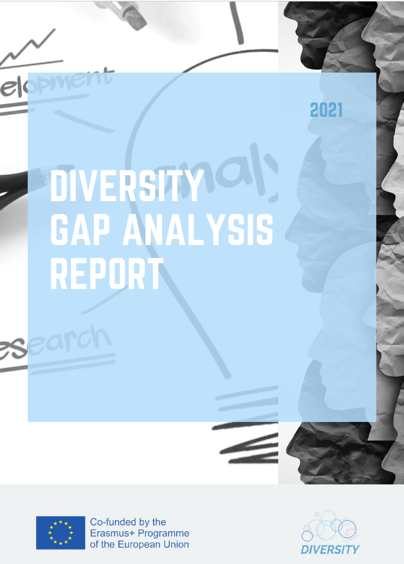
    The Diversity Gap Analysis Report consolidates the current state of play in migrant related AE provision in each partner country and across Europe. The report profiles the readiness of adult education systems in Europe to develop more sustainable approaches towards managing diversity. It provides a review of relevant policy and practice documents along with interviews, surveys and focus groups involving managers, planners and learners (both migrants and non-migrants) as immediate target groups.

    Cover of the diversity gap analysis report
    Click on the image to open the report

    The Diversity Curriculum is aimed at management, programme planning and executive staff with the modular curriculum allows providers to a) assess their current practices for implicit barriers to migrant participation, and to b) develop appropriate avenues of evolution to realise their full potential. The curriculum modules can be turned into tailor-made trainings.

    Cover of the diversity curriculum
    Click on the image to open the curriculum

    The modules follow the mix-and-match approach – participants can pick only one, a couple or complete all of them, depending on their organisations’ needs. This offers the greatest possible degree of applicability. This curriculum is not a self-study course; it serves as the basis upon which trainers will build their trainings. The curriculum is available for free on https://www.aewb-nds.de/themen/eu-programme/diversity/and comes in five languages.

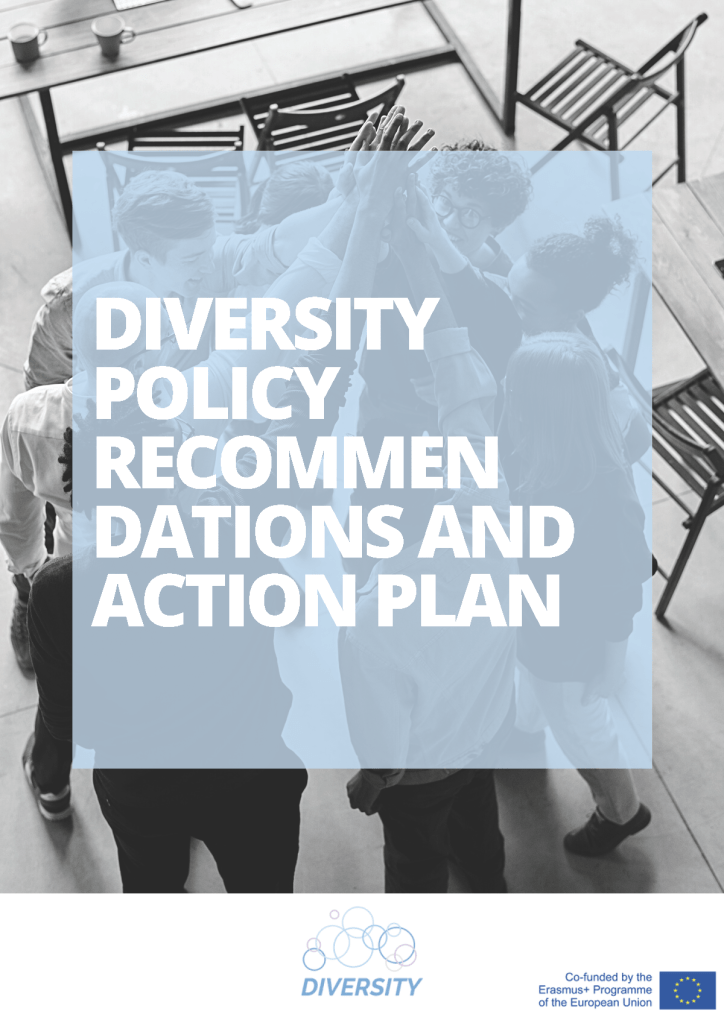
    The Diversity Policy Recommendations and Action Plan recognises that the inclusion of migrants into the wider planning strategies of adult education requires European policymakers to align their regional AE strategies. Adult education providers are important stakeholders in facilitating these changes. Therefore the Diversity project prepared a set of policy recommendations aiming at enhancing inclusion in Adult Education.

    Cover of the diversity policy recommendations and action plan
    Click on the image to open the action plan

    Michael Kenny is a lecturer in the Department  of Adult and Community Education. He is co director of the Higher Diploma in Further Education (HDFE), and the director of the post graduate Certificate in Programme Design and Validation (PCPDV). Michael is interested in formal and non-formal education in voluntary rural and urban organisations.  He is currently the Principal Investigator on 6 Erasmus+ Projects, including the Diversity project. 

    Margaret Nugent is an associate academic,  researcher and lecturer with Department  of Adult and Community Education. Margaret is research associate on the Diversity and several European projects. She is a specialist in engaged methodologies, conflict intervention and peace pedagogies.

  • Growing Space

    Growing Space

    Recovery, Education and Capability

    This was the first seminar to be held in Maynooth University since 2019, and I could certainly identify with and echo the words of Dr Derek Barter, that this event was an antidote to the fear we have been feeling over the last 2 years. The sense that some fragment of normalcy was returning was evident, the atmosphere outside the lecture hall beforehand was buzzing with relaxed chat. I must say it was nice to be at an event where the main topic was not Covid, no, today belonged to recovery. This ALL Institute and the Dept of Adult and Community Education (DACE), joint Addiction Studies/Psychology seminar did not disappoint as Dr Barter introduced Dr Mark Richardson from Growing Space.

    The story that unfolded as Mark began his presentation was one of true humanity, inclusion, caring and respect. Dr Richardson was joined by co-worker Nicola Vaile, and two participants from Growing Space, Michele and Marette. It was obvious from the beginning that the relationship between all four people was very special, you could feel the deep connection between them. Marks passion for what he does, and for what he has helped create in Growing Space was evident in his presentation. It flowed from him naturally because he deeply believes in it. Growing Space has been providing a space in Wales since 1992, in a place called Nant Bran (such a lovely name), where they continue to approach mental health issues through transformational education, community engagement, situationist practice, and emancipatory participation. All of this in the hope that those who suffer mental health issues might find that spark that ignites their journey of recovery. In Mark Richardson’s own words, “education is the bedrock of recovery”.

    Dr Richardson continued as he explained, in detail, the support they provide at Growing Space for the community. All the time connecting the theories and practices to the real-life experiences of Michele and Marette. This is not a medical, symptom management approach to mental health, although the medical approach is also important, as Dr Mary Ryan (Head of Dept of Adult and Community Education) alluded to. I found it refreshing to hear someone speak about people who can sometimes be forgotten about within society because of mental health issues and the stigma that surrounds it. One of the first things Mark done when he arrived at Growing Space was to paint the old building bright yellow, so as to let people know we are here and this is what we do, no more hiding. A simple but powerful statement, if we refuse to acknowledge or speak about serious social issues and the structures that support these beliefs, we give them the power to oppress. One of the first questions Mark asks anyone who comes to Growing Space is, what can you do, what do you want to do? Instead of, what’s wrong with you? Growing Space joins a person’s recovery journey and supports them by focusing on a person’s strengths. Mark goes on to tell us that Growing Space is there to “inspire learning”, and to “help people find their own recovery”.  

    Dr Richardson kept referring back to both Michele and Marette’s stories throughout his presentation, so as to give the audience a sense of their mental health issues, their pathways to recovery and their experiences within Growing Space. I for one found this approach very inclusive, a clever way of keeping both Michele and Marette involved in the presentation, as there were some serious anxiety issues, in particular with Marette, as we were to find out later. Somehow they found the strength to stand up in front of a room full of strangers and tell their very personal stories. Upon reflection I can see that it was only because of the relationship that Mark Richardson and his team have with the participants at Growing Space, that Marette and Michele had the confidence to share with us their experiences.

    Michele’s story was harrowing to hear at times, and by the end of it I had tears in my eyes, and I certainly wasn’t the only one. What Michele endured throughout her childhood was nothing short of horrific, at one point she did say, matter-of-factly, that she blamed her mother for her mental illness. When Michele first came to Growing Space she had literacy issues, but here Michele was, more than a stone’s throw away from home, standing in a very large lecture hall reading from her life story which she wrote herself – here was the power of adult education. This is what can happen when the barriers of stigma, language, and ignorance are removed, and replaced with humanity, cooperation, openness and exploration. The support from Nicola during the time Michele spent at the podium was visible, solid as a rock. The round of applause Michele received when she finished was emotional to say the least, it was in appreciation for her honesty and vulnerability; it’s true when Brene Brown says, there is power in vulnerability . It was not only for Michele’s honesty that such appreciation was shown, but the fact that she came through what she did, not unscathed by any means, but still standing none the less, how dare anyone stigmatise, exclude, or at the very least not strive to understand a powerful soul like Michele, is beyond me.

    Left to right Derek Barter (Maynooth), Michele, Marette, Nic, Mark

    When Marette made her way to the podium, the moral support of Nicola was ever present. Two very different stories in ways, but ultimately having similar outcomes, ill mental health. What did come through in Marette’s story was how important Growing Space and building a trusting relationship with Mark was in her journey of recovery. From speaking with Mark later in the day I can say that some of the obstacles that Marette has overcome is astonishing. I can only speculate that the occasion become too much for Marette during her talk and she couldn’t finish what she had written; without missing a beat in jumped Nicola to make sure that what Marette had written was heard. I can only liken it to a secret service agent jumping in front of a bullet for her president, marvellous. It was in this moment that I looked from Marette to Mark to Nicola, and what I saw will stay with me for a long time to come. What I saw was love, the type of love you see between a parent and a child or between siblings. They felt and acted with Marette in the moment, and I only hope that when they had time to reflect that they looked for the lesson in the experience.

    I really enjoyed the couple of hours I spent in the company of Mark, Nicola, Michele and Marette. It was a privilege to hear their stories and I hope I have done them justice in this piece. There is so much more to Dr Mark Richardson’s work and Growing Space. I was glad to have the chance to talk with Mark afterwards, and I asked him how he would approach stigma within people who were in recovery from addiction. His reply was, change the language you use. Now, I have to say, I was expecting more but, what I wasn’t expecting was that I would be still thinking about his answer a week later. I have been engaged in those five words ever since and thinking of different ways to put them into action. Mark didn’t give me the answer I was looking for, he joined me on my journey to finding the answer for myself. Thank you Mark.

    Glen.

    Glen Patrick Smith began his journey through Maynooth University in 2018, when he completed the certificate in Addictions Studies. From there he progressed on to the part-time evening degree in Community Studies, which he will complete in the summer of 2023. Returning to education, in particular the Adult and Community Education Department in Maynooth, has been the most important decision of his life thus far. It has given him a confidence to express himself, and it has afforded him opportunities he never though possible. As a result of his studies and the passion it has instilled in him for adult and community education, Glen has recently been employed by the local Family Resource Centre in Newbridge as a family support/community development worker. Glen intends to continue his studies in the near future.

  • Transformative Engagement Network: working together to create a sustainable future

    Transformative Engagement Network: working together to create a sustainable future

    Professor Anne Ryan writes about our involvement with colleagues in Malawi and Zambia since 2008 in the Transformative Engagement Network to address issues of climate justice from the standpoint of smallholder farmers.

    I need to wind the clock back more than a few decades to set the scene for this project…

    I first went to Zambia in 1974 when I was twenty-one.  I taught maths, history and English in a very rural secondary school in Chivuna. It was only when I returned to Ireland in 1977 that I fully realised the depth of the economic divide between rural Africa and the west. What shocked me most was not the poverty I’d witnessed but the affluence and waste I saw on my return. I’d grown up in rural Ireland. I was seventeen and in digs in Dublin before I experienced the luxury of having running water and all the amenities that go with that. Adjustment to living in Zambia was easy for me. I loved staying in the villages where my colleagues’ parents or grandparents lived. It was usual to leave the village laden with eggs, a chicken and whatever was in season. It reminded me of my childhood and how my father always farewelled visitors with whatever could be picked or dug up from the garden.  Zambia felt like home to me in the 1970s and has done ever since. Whenever I read or hear about subsistence farmers, I always recall particular individuals and families in Southern Province, Zambia. 

    In the intervening decades I never lost contact with Zambia and was very aware that climate change was exacerbating poverty and taking a very heavy toll on subsistence farmers right across Africa. Between 2012 and 2015 along with colleagues in Maynooth University I was fortunate enough to lead a project that linked us to small scale farmers in Zambia and Malawi.  The aim of the project called TEN – Transformative Engagement Network – was to model a process that would transform the nature of the engagement between the various stakeholders impacted by or concerned with climate change. Those of us involved in TEN believed that inequalities between and within countries was getting worse not better and therefore our thinking about development and our actions to promote development needed to change. We also believed that to make meaningful changes in our thinking and actions we needed to create opportunities that would allow information flows and dialogue between all the stakeholders.  These stakeholders included scientists, researchers, subsistence farmers and all the agencies that work with them. Four universities were involved – one in Ireland, two in Zambia and one in Malawi. Each university had an interdisciplinary project team, including climatologists, plant and animal scientists, and community educators. We wanted a two way exchanges between these stakeholders. Universities and other agencies would not just disseminate information but would also position themselves as learners. We wanted accountability to be two ways. Instead of only upward accountability whereby those who are funded account for their spending we also wanted those who fund to be accountable to meeting the most pressing needs / concerns of vulnerable communities.

    The Zambian and Malawian Universities drew on their links to local and national government, local rural communities and agencies working in these communities. We knew that within the academic world scientists easily and effectively engage with each other. Within TEN we wanted to build a network that would allow scientists to also dialogue with those who are most effected by climate change in their everyday lives. For example traditionally research in universities tends to be driven by the concerns of the discipline. Within TEN we hoped that the concerns of communities and those who work directly with them would play a role in formulating each university’s research agenda. In doing this we also hoped that research findings would become available to communities.   We also wanted to enhance the capacity of universities and policymakers to recognize and make use of community knowledge. We wanted to combine the western scientific knowledge that dominates our education systems with the lived knowledge of subsistence farmers whose very existence is testimony to their resilience and capacity to adapt.

     The networking aspect of the project necessitated layers of collaboration between entities that are frequently separated by issues of power and status. We learned a lot over the lifetime of TEN. In particular we learned that power and status are everywhere – between the disciplines in universities, between agencies working in rural communities, between individuals, families and groups in communities, within national and local governments and of course between all these different stakeholders.  We learned that although disciplinary specialisation has led to great advances in the natural and social sciences, it alone is often not sufficient to address complex problems such as poverty and climate change. We learned that traditional structures within universities prefer discipline-bound knowledge making it difficult to bring together the expertise to address these complex challenges. We learned that the key to an inclusive participatory process is to acknowledge the existence of power and status even when that power and status is not immediately evident and or is not easy to address.

    Perhaps most importantly of all we learned that when invited to participate small-holder farmers eagerly responded. They appreciated the reciprocity of knowledge flows between the stakeholders.  They were keen to know the findings of the research conducted in their communities and throughout the project they were as generous in sharing their knowledge, expertise, experiences and concerns as they had been in sharing their homes with me many decades ago.

    TEN had many outputs. The most surprising is that it didn’t really end. Sure the funded aspects ended but many of the activities carried on and there are plans for the partner universities to work together on another venture where small-holders will again play a lead role.

    Anne Ryan is Emeritus Professor at Maynooth University.  She was chair of the Department of Adult and Community Education from 2005 to 2018. Anne has worked in developing countries that experience extreme poverty (such as Bangladesh and Central Africa) and those that are war-torn (such as Afghanistan) and she has worked with disadvantaged communities in Australia and Ireland.  These experiences convince her of the potential of adult and community education to empower communities to respond to the critical challenges facing twenty-first century societies in ways that ensure their voice is heard by decision-makers.