Tag: Lifelong Learning

  • What’s Going on Today in Palestine is Not New

    Blog Authors: Anne Ryan and Tony Walsh

    I’m from the sound of tanks

    I’m from a hot place

    I grew up with the suffering and cruelty of occupation that still plagues my daily life

    I’m from an unjust world

    I really want to make peace with myself (first) then with others and with the world,

    But every time I try to do that I fail. I don’t know why, but maybe that’s my bad luck

    I grew up with the tears of my mom that make me very sad

    One day I walked up and saw a very strong man building the bad wall. I didn’t know what to do, cry or be happy

    Then my father told me that I had to accept that idea

    because we can’t do anything

    Rana Sameeh Gabbash[1]


    [1]  From the ‘Book of Poems’ Summer School Program, Al-Quds University Community Action Centre, (c2008)

    While this poem encapsulates the overt and covert violence of the Palestine we encountered more than a decade ago it also speaks to what we see nightly on our televisions these days.

    Between 2008-12 the Department of Adult and Community Education, Maynooth University was involved in an EU funded project in partnership with 4 Palestinian Universities – Al-Quds, Bethlehem, Birzeit, and the Islamic University of Gaza[2]. The project known as LLIPS, focused on identifying existing lifelong learning provisions on the part of our partner universities with a view to enhancing it to even better meet the needs of Palestinian communities in the West Bank and Gaza.

    During the project we were fortunate to meet and work with many academics in the partner universities. We also met with members of community groups and local NGOs – all engaged with different sectors of the population. We learned a great deal about life in the country; the most striking reality being that – every day – Palestinians lived in an environment where they faced issues of social, economic, political and educational marginalization. They lived in a society where their very way of being, their culture and history were silenced and subverted by the hegemony of the Israeli state. We were particularly struck by the restrictions imposed upon colleagues in our partner universities and by the complex strategies in which they had to engage in order to maintain their programmes. One such example was movement. At a local level for example it was difficult for Al-Quds University in Jerusalem to maintain contact with its Adult Education Centres.  The problem was the Wall. The main campus was outside the wall and the Centres were inside.  Crossing the Wall was no easy task. At a national level movement was also difficult. The LLIPS project found it impossible to bring all the partner universities together within Palestine because those from Gaza could not travel to the West Bank and visa versa. Instead, we all met in Jordan. Many Palestinians spoke of how restrictions on movement effect their everyday lives. They also regretted the negative impacts these have on other staff, on their students and indeed on their own families and friends. They had lost contact with many of the latter over the years.

    As the LLIPS project progressed we were increasingly aware of the subtle, as well as the overt issues of power which constructed the identity and lived reality of those we encountered.

    We found that the nature of the oppression and resistance across Palestine was multi-layered. Although we saw the Wall, the settlements choking the little towns and villages, the checkpoints, the guns, and the multiplicity of minor indignities casually doled out, as outsiders we could barely begin to imagine what it felt like to live there and what it took to sustain one’s self, one’s family and one’s sense of identity and nationhood in the face of unmitigated hostility.

    The emotional and psychic toll on the individuals working there, as well as the community members was very evident.  Even back then the need for support, solidarity, respite and resilience-building was clear. How much more the needs must be now and will be in the future.

    One picture remains strongly, symbolically evocative.

    We were being driven from Jerusalem to Jericho- the iconic path the ‘Good Samaritan’ of old had traversed. We were to lead a seminar for academic colleagues there. A black cassocked priest expertly drove, negotiating the multi-laned motorway. A seeming anomaly speaking of wealth and modernity, it wound its way seamlessly through ancient, barren hills, through an arid, desert landscape. Only the occasional Beduin, hazardously perched upon a donkey and following a small flock of sheep or goats up precarious hillsides broke the dun-coloured monotony. And then I noticed that here and there the dusty countryside was dotted with black tree trunks. Evidence of earlier habitation, perhaps of olive-farms?

    ‘Was this land cultivated not so long ago, Father’ I asked our driver.

    The reply was swift. “Yes there were lots of Palestinian olive farms here. Olive tress can cope with the most arid conditions. And the trees provided shade and vegetation. They’d been there – like the farmers – for generations. Since Jesus’ time. But the Israeli Government confiscated the farms and chopped the trees. They said they were a threat to security. Hammas fighters could hide among the foliage and threaten the army….or settlers.’

    The lifeless trunks bore silent witness to dispossession…and more. 


    [1]  From the ‘Book of Poems’ Summer School Program, Al-Quds University Community Action Centre, (c2008)

    [2] The project was entitled Lifelong Learning in Palestine (LLIPs). The Maynooth University Team were Josephine Finn, Bernie Grummell, Tony Walsh, Shauna Busto-Gilligan and Anne Ryan

    Anne Ryan is Emeritus Professor at Maynooth University.  She was chair of the Department of Adult and Community Education from 2005 to 2018. Anne has worked in developing countries that experience extreme poverty (such as Bangladesh and Central Africa) and those that are war-torn (such as Afghanistan) and she has worked with disadvantaged communities in Australia and Ireland.  These experiences convince her of the potential of adult and community education to empower communities to respond to the critical challenges facing twenty-first century societies in ways that ensure their voice is heard by decision-makers. 

    See previous blog by Anne Transformative Engagement Network: working together to create a sustainable future

    Tony Walsh was, until recent retirement from Maynooth University, lecturer and sometime Head of the Department of Adult and Community Education; he continues as Director of the Centre for the Study of Irish Protestantism and is a Fellow of the Young Centre for Anabaptist and Pietist Studies at Elizabethtown College, Pennsylvania,.  A licensed systemic constructivist psychotherapist he is engaged in writing, consultancy and research inquiry engagements in the US, the UK, Palestine and Ireland (including Northern Ireland). Current research emphases include i) the experience and culture of the Irish Protestant minority; ii) narrative study of the Old German Baptist Brethren, (an Amish-like Plain church in the US); iii) the role of reflexivity in radical adult education iv) narrative and autoethnograpic inquiry.

  • Lessons from Palestine

    Authors: Anne Ryan and Tony Walsh

    Suddenly the images of the bombed ruins of a Gaza shop front, perhaps a café, flashed across the news screens. Rags of ruined blinds fluttered in the breeze.

    Instantly I was back in a narrow, busy laneway in old Jerusalem and a sidewalk café fifteen years ago. We[1] were visiting Jerusalem as part of an educational research project. Blissfully relaxing in the sun’s heat and watching, watching as the multi-coloured crush of people in the narrow medieval street streamed by. Dark clothed and somber, Hasidic men bent purposefully towards prayer; camera toting tourists eyed them curiously as they wandered, talking, looking. Groups of Palestinian women laughing, chatting, baskets full of produce came from the market. Bright eyed kids racing in and out; swift arrows of colour between the adult crowds. Handcarts and motor bikes threaded a hazardous way down the street. A bizarre stream of Western pilgrims appeared toting a large cross, responding to a loud rosary.  The midday call to prayer resounded from a nearby minaret mingling with their words. Each group seemed insulated, bounded in their own reality. The smells of roasting coffee beans, strong mint tea and frying meat next door mingled – sensory overload, as pungent aromas and noise, noise, noise enveloped us.

    A group of Israeli soldiers stopped at the corner. They propped their machine guns against the wall and they surveyed the crowds – and us. One addressed his peers in loud New York tones.  They were young and jumpy …and very, very near.   Suddenly there was an explosive bang close-by. The soldiers grabbed their guns. The streaming crowds froze. Fear chilled our faces, congealed our limbs. And moments of time passed slowly by…. That time it was only a back-fire. Minutes later life returned to normal; the crowds streamed swiftly on their way.

    We have often recalled that day packed as it was with so much to marvel at and so much to fear.  We have often wondered what bearing these experiences coupled with current events in Palestine and global conflicts in general should have on how we approach education?

    We have been writing about and researching education for many decades.  Essentially, we believe that education’s main purpose is to help learners to understand their world, so that they are empowered to transform what is oppressive rather than accept it or adapt to it[2].  This includes understanding why conflict exists and what might be reasonable and appropriate responses to that conflict. We also believe that mainstream education often leaves learners ill equipped to either understand or address big global challenges such as war.

    We believe that if education focused on understanding how power operates in society – and between societies – it would enable a far more fluent appreciation of the complex nature of human experience and particularly of conflict.  It would raise awareness of how individuals, groups, nations become positioned in relation to each other. And would emphasize how conflict – and most particularly conflict interventions – require an understanding of these positions. 

    It seems to us that education that interrogates power is ever more needed in a world where disinformation and misinformation are increasingly evident and where what is ‘true’, what is ‘good’, what is ‘right’ are far from clear cut.

    Even as we watch the awful events unfold in Palestine our thoughts often return to that day at the café in Jerusalem where we observed something of the overt nature of power.  It was explicitly expressed in the actions and demeanour of the soldiers. They had the guns.  Their power, although apparently placidly accepted by those going about their daily lives, was nevertheless fragile. The response to the ‘back-fire’ that could have been a gun shot or a bomb blast spoke of an awareness of the potential of resistance and challenge to the existing order that the soldiers were protecting.

    Power is of course not always so easily observed. Mostly it is hidden, occluded within the everyday. We believe that a vital task of education is to reveal those occluded dynamics of power, marginalisation and oppression – those ‘on-going repetitive citations of the known order, citations that offer some a viable life and at the same time deny it to others’ (Davies 2008, 173)[3].  Without an emphasis on the interrogation of power education becomes mere compliance ‘a process of transferring the values and practices which are embedded in a specific culture and are particularly associated with the assumptions, values and maintenance of the power elites of that society.’[4]


    [1] The ‘we’ refers to Tony Walsh and Anne Ryan who in partnership with the administrative and academic staff in the University of Bethlehem explored the challenges and opportunities inherent in diversity.

    [2] This is essentially a Freirean philosophical position

    [3] Davies, B. (2008) ‘The Ethics of Responsibility.’ In Phelan, A. and Sumsion, J. (Eds), Critical Readings in Teacher Education. Rotterdam: Sense Publishers.

    [4] Ryan, A. and Walsh, T. (2018) Reflexivity and Critical Pedagogy. Leiden: Brill p1

    Anne Ryan is Emeritus Professor at Maynooth University.  She was chair of the Department of Adult and Community Education from 2005 to 2018. Anne has worked in developing countries that experience extreme poverty (such as Bangladesh and Central Africa) and those that are war-torn (such as Afghanistan) and she has worked with disadvantaged communities in Australia and Ireland.  These experiences convince her of the potential of adult and community education to empower communities to respond to the critical challenges facing twenty-first century societies in ways that ensure their voice is heard by decision-makers. 

    Tony Walsh was, until recent retirement from Maynooth University, lecturer and sometime Head of the Department of Adult and Community Education; he continues as Director of the Centre for the Study of Irish Protestantism and is a Fellow of the Young Centre for Anabaptist and Pietist Studies at Elizabethtown College, Pennsylvania,.  A licensed systemic constructivist psychotherapist he is engaged in writing, consultancy and research inquiry engagements in the US, the UK, Palestine and Ireland (including Northern Ireland). Current research emphases include i) the experience and culture of the Irish Protestant minority; ii) narrative study of the Old German Baptist Brethren, (an Amish-like Plain church in the US); iii) the role of reflexivity in radical adult education iv) narrative and autoethnograpic inquiry.

  • CREATE2Evaluate: Enhancing evaluation practice of Adult Education policies and programmes at regional and local levels 

    CREATE2Evaluate: Enhancing evaluation practice of Adult Education policies and programmes at regional and local levels 

    Between 2017 and 2019 an ERASMUS+ ‘Competitive Regions and Employability of Adults through Education’ (CREATE) project aimed to enhance performance and efficiency in adult education by addressing the gap between EU/national strategies and local/regional implementation at adult education policy level. CREATE identified a lack of policy tools and resources to evaluate the impact of adult education (AE) interventions, policies, and initiatives across Europe. This gap was particularly acute within regions tasked with AE policy formulation and implementation to progress towards the EU pan-European target of 15% AE participation. A second project, the CREATE2Evaluate project, was supported by ERASMUS+ from 2020 to 2022 to progress these findings. 

    The Create2Evaluate project and Partners 

    The Create 2 evaluate project is a transnational and multi-agency collaboration seeking to enhance the efficacy and valorisation of adult education at policy and governance levels. The primary aim of the project was identifying reliable tools for adult education evaluation at various layers of governance. The project has eight organisational partners from seven countries (Belgium, Germany, Ireland, Italy, Poland, Romania, and Spain) committed to identifying and operationalising these tools.  

    Click here for more information on the Eight collaborative partners 

    The first meeting of the partners, hosted by the German partner lead AEWB, took place online via teams on the 12th and 13th of November 2020. The project ‘Kick-Off Meeting’ discussed the overall project implementation of the defining timelines, respective duties and activities that will take place in the following months. 

    A snapshot of the first Create2Evaluate partners meeting 

    IO2-Report: Mapping the Impact, Validation and Evaluation of AE Policies 

    The eight partners researched and mapped their current adult education policy landscape regarding evaluation, assessment, and monitoring. Primary and secondary research was undertaken. Twenty-seven stakeholders in the field of adult education were interviewed and a key stakeholder survey was disseminated to provide thirty-six additional responses.  The project partners mapped and identified tools, methods, and resources employed to evaluate adult education programmes and initiatives throughout their regions. A mapping press release went live on the 03-03-2021. 

    Stakeholder collaborative conversations in action at Maynooth University. 

    Mapping Outcomes 

    Mapping and research enabled the CREATE2Evaluate partners to identify the lack of a centralised systemic evaluation framework, common definitions and standards. Feedback indicated that current evaluation policy is primary focused on quantitative outputs and student specific learning outcomes, and inconsistencies were apparent among targeted groups and in non-formal evaluation provision. Additionally, it was evidenced that although copious and significant qualitative evaluation is conducted across adult education centres, this data remains relatively difficult to access due to a lack of centralised systematic overarching analysis and learner protection requirements. Thus, it is very challenging for policy makers to assess the effectiveness of their adult education policies. To view result of the consolidation of findings stemming from the mapping at country and EU level performed by partners click here (full IO2 report) 

     The CREATE2 Evaluate Toolbox:  

    In response to the IO2 findings the partners collaboratively collected and developed helpful tools for the evaluation of adult education at various layers of governance. The CREATE 2 Evaluate ToolBox was conceived to ensure that local and regional policy makers from across Europe will be able to use the policy tools to better plan, design, implement and monitor AE policies with a clear vision of sustainability of public funding in AE. The selection of tools takes into account different purposes of evaluation (e.g., process, persuasive, symbolic, instrumental) as well as their place in the policy cycle. The tools are free, easily accessible and multilingual. The toolbox invites users to adopt the tools to their work realities with ease.  

    The Toolbox is structured in six different areas, each with specific resources and references that sustain local policy makers in better strategizing the alignment, consistence and coherence of local lifelong learning plans to EU horizons. There are a total of 42 tools; 4 best practice recommendations; 5 networks/ Forums; 4 networks/platforms, and a collection of policy documents and strategies are available. The toolbox was officially released on the 26-09-2022. 

    Overview of the Toolbox sections and tools 


    Click each area to view the distinctive tools and resources 

    1.  Consistency of the objectives and outcomes  

    2.  Programme creation at the policy/public administration level 

    3.Inclusivity of AE policies and availability of AE programmes 

    4. AE trainings and programmes delivery 

    5. Value added stemming from the participation in AE 

    6. Continuity of programme evaluation and use of its results to improve AE policies 

    To view the full toolbox and additional resources click ToolBox

    CREATE2Evaluate implementation Package and Green Paper 

    The CREATE2Evaluate implementation Package and Green Paper are the final two components of the CREATE2Evaluate project. These two deliverables were consolidated, and the press release went live on the 19-10-22.  

    The CREATE2Evaluate implementation Package consists of a training suite for the policy making target groups. It is provided as a guide, with step-by-step procedures on the use and implementation of the tools to evaluate policy interventions in the domain of AE. The Training Suite includes user-friendly and flexible training resources for policy makers. Included are guidelines on the policy evaluation tools, scenario setting and profiling tools and a users’ manual and Introduction CREATE2Evaluate ToolBox 

    The CREATE2Evaluate Green Paper advances the debate and stimulates the discussion on policy formulation, implementation, and evaluation of adult education. It provides incite into the challenges and drivers that contributed to the project and the final output of the CREATE2Evaluate Toolbox.. Additionally, it considers the marginalisation of adult education and considers the context in which policy is developed and implemented in adult education, thus enhancing the awareness of the issues evident across the EU adult education landscape. Importantly it offers a critical analysis of the current landscape of adult education from the perspective of the stakeholders and considers the position of the learners. The CREATE2Evaluate resources and CREATE2Evaluate Green Paper should stimulate policy dialogue and exchange on how to advance adult education for socio-economic development and integration.  

    All CREATE2Evaluate results are available in multilingual versions, free and without restrictions through the dedicated open educational resource (OER) platform. To know more about the project, the organisations involved and all resources available, please feel free to consult the Open Education Resource Platform of Create2Evaluate: www.create2evaluate.eu 

    Michael Kenny is a lecturer in the Department of Adult and Community Education. He is co-director of the Higher Diploma in Further Education (HDFE), and the director of the post graduate Certificate in Programme Design and Validation (PCPDV). He is currently the Principal Investigator (PI) on 6 Erasmus+ Projects, including the CREATE2Evaluate project.  

    Margaret Nugent is an associate academic, researcher and lecturer with Department of Adult and Community Education. Margaret is research associate on the Diversity and several European projects. She is a specialist in engaged methodologies, conflict intervention and peace pedagogies. 

  • The Adult Education Teachers Organisation (AETO) – the 5 Ws

    The Adult Education Teachers Organisation (AETO) – the 5 Ws

    Adult Education is the study of how we learn and develop as adults to collaborate in the creation of a just, equitable and sustainable society'. In the provision of education for adults who may not have been well served by the formal education system, adult education tutors provide a valuable service. The Department of Adult and Community Education at Maynooth University works closely with many professionals in adult education including with adult education tutors. The Department promotes a view of education which recognises the importance of learning which promotes justice and equality in society. The AETO shares these values and can support our department in promoting these values in education spaces in which their members work and to promote adult education in broader society

    Who is in the AETO?

    The AETO is a National Organisation of teachers in diverse roles in adult education. Adult Education involves teachers who work in Community Education, Literacy, English for Speakers of Other Languages (ESOL) and other sectors. Membership of the AETO is open to any teacher working with adults in Ireland, be they working with an ETB or for an organisation funded by an ETB. There are about 3,000 adult education teachers nationally and the AETO has been able to engage 300 adult education teachers in its group so far. We expect that many more teachers will join as we raise our profile nationally. 

    A committee has been set up to further the work of the organisation. The Chair of the Association is James O’Keeffe who works in CDETB, the treasurer is Lorcan McNamee from MSLETB, Sinéad Hyland from CDETB is the secretary of the organisation and Avril Tierney from CDETB is the PRO.

    The organisation can be contacted by email at aeto2021@gmail.com

    What are the aims of the AETO?

    The AETO has various goals, all of which aim to improve the working lives of members and to help maintain a focus on learner centred education which will improve access, transfer and progression in the provision of adult education.

    We believe that respect for adult learners involves respect for their teachers. The AETO provides a valuable network for teachers in adult education by providing support for them and in turn for the learners with whom they work.

    Apart from those who have participated in adult education, there seems to be little public awareness of the work of Adult Education teachers. The AETO would like to inform the public of the work and practice of Adult Education Teachers and the life improvements that they help to bring about for students.  

    The AETO would like the importance of our sector to be visible to the public and to the government. Our contribution to education for adults who are vulnerable and marginalised is specialised and of great value to the communities in which we work. We want to achieve working conditions that are merited by this contribution including:

    • a public service contract
    • recognition of prior service and a pay scale
    • recognition of teaching and other qualifications
    • terms and conditions that reflect these qualifications, service experience and status as teaching staff
    • a career path with progression pathways for teachers

    We believe that this will encourage others to join us in the important work that we do and that will make our work sustainable.

    Why?

    Adult Education Teachers work in diverse roles and, so far, have had few opportunities to network. This national organisation provides a space for teachers to get to know and support one another and to share best practice in terms of their teaching.

    There has been a realisation of late of the power of adult education and lifelong learning to address many of the issues that Ireland faces and to equip its population with the skills to survive and prosper in an ever-changing environment. Adult education teachers work with adults to develop skills which enable better communication. resilience and critical skills. 

    The AETO recognises that, in the future, there will be a greater need for committed adult education tutors, to offer learning to adults who wish to re-engage or start out with their education. Many of the actions from the Learning for Life: The White Paper on Adult Education from July 2000 have not yet been put in place regarding adult education teachers. Since then, strategies have been published by various bodies including SOLAS (Future FET: Transforming Learning), Department of Further and Higher Education, Research Innovation and Science (Adult Literacy for Life- A 10 year strategy for literacy, numeracy and digital literacy) and Education and Training Boards Ireland (ETBI Strategy Statement 2022-2024) that depend on adult education teachers to deliver learning for adults to achieve the goals set out.

    As a response to the fragmentation of the sector there is a need to engage colleagues who work in different areas. What is common to all adult education teachers is working with participants with various motivations, some of whom are returning to education having had negative experiences of education in the past. As such, their needs for support are complex. Adult education tutors are ready to provide those supports, allowing learners to develop whole person skills, as well as skills that can lead to work or further study.

    Where?

    There is representation on the group from all 16 ETBs.  There are also local groups based in ETBs who contribute to the national group and who organise locally.

    Much of the communication is on the AETO WhatsApp group but we have had meetings face to face as well as online.

    How?

    The AETO aims to unite adult education teachers in a safe and communicative space where we agree on actions together and can act as the voice for Adult Education Teachers in Ireland.

    We are in contact with our members and are engaging in different ways to with Adult Education Teachers so we can ensure that we are representing the wishes of the group.

    Without adult education teachers there is no adult education.

    Sinéad Hyland is a Tutor and Researcher with Maynooth University Department of Adult and Community Education and City of Dublin Education and Training Board. Sinéad has worked on many projects in adult education and in her work on the Return to Learning Programme in MU has focussed on helping adults to make transitions to higher education.

  • Transformative Engagement Network: working together to create a sustainable future

    Transformative Engagement Network: working together to create a sustainable future

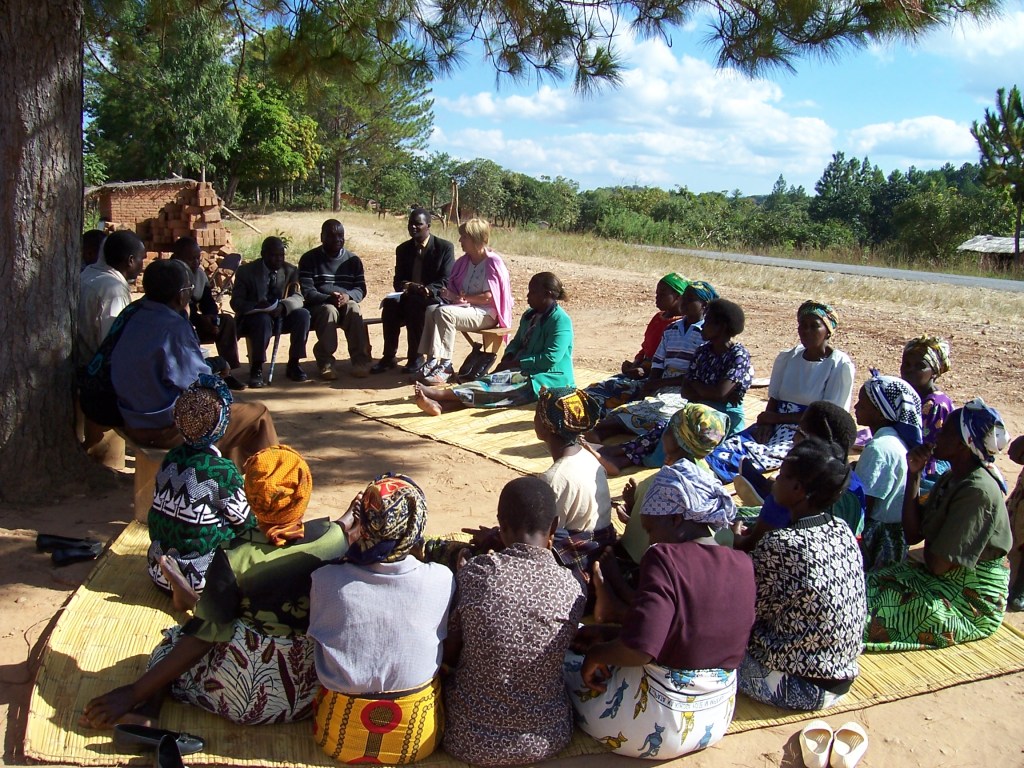
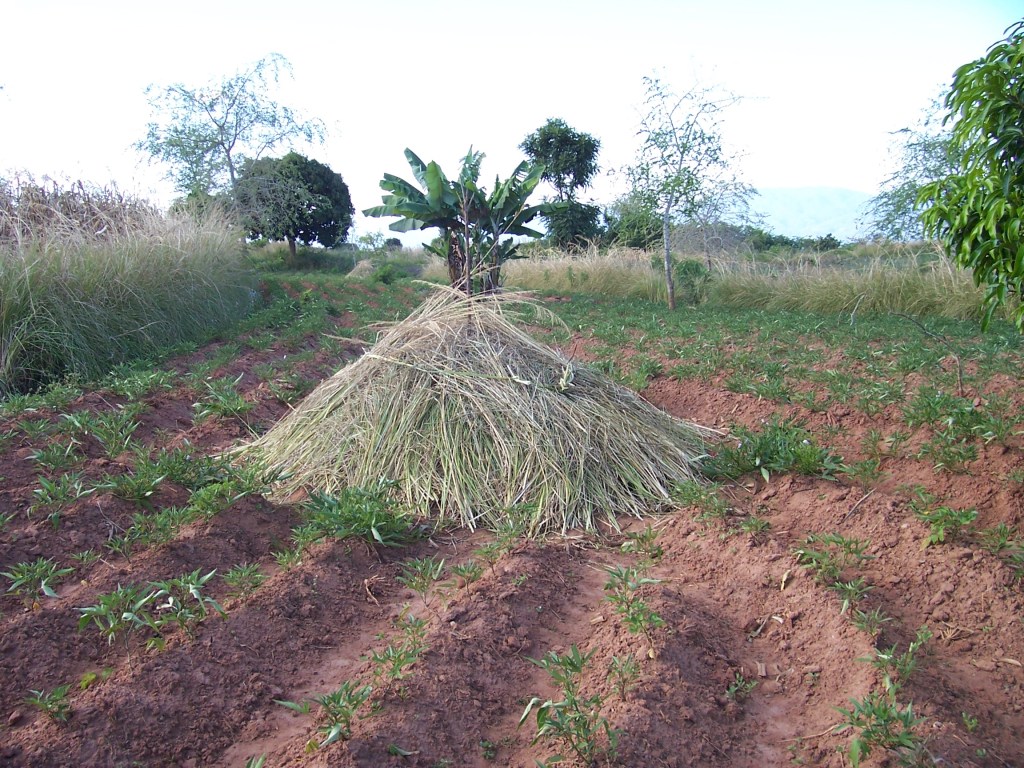
    Professor Anne Ryan writes about our involvement with colleagues in Malawi and Zambia since 2008 in the Transformative Engagement Network to address issues of climate justice from the standpoint of smallholder farmers.

    I need to wind the clock back more than a few decades to set the scene for this project…

    I first went to Zambia in 1974 when I was twenty-one.  I taught maths, history and English in a very rural secondary school in Chivuna. It was only when I returned to Ireland in 1977 that I fully realised the depth of the economic divide between rural Africa and the west. What shocked me most was not the poverty I’d witnessed but the affluence and waste I saw on my return. I’d grown up in rural Ireland. I was seventeen and in digs in Dublin before I experienced the luxury of having running water and all the amenities that go with that. Adjustment to living in Zambia was easy for me. I loved staying in the villages where my colleagues’ parents or grandparents lived. It was usual to leave the village laden with eggs, a chicken and whatever was in season. It reminded me of my childhood and how my father always farewelled visitors with whatever could be picked or dug up from the garden.  Zambia felt like home to me in the 1970s and has done ever since. Whenever I read or hear about subsistence farmers, I always recall particular individuals and families in Southern Province, Zambia. 

    In the intervening decades I never lost contact with Zambia and was very aware that climate change was exacerbating poverty and taking a very heavy toll on subsistence farmers right across Africa. Between 2012 and 2015 along with colleagues in Maynooth University I was fortunate enough to lead a project that linked us to small scale farmers in Zambia and Malawi.  The aim of the project called TEN – Transformative Engagement Network – was to model a process that would transform the nature of the engagement between the various stakeholders impacted by or concerned with climate change. Those of us involved in TEN believed that inequalities between and within countries was getting worse not better and therefore our thinking about development and our actions to promote development needed to change. We also believed that to make meaningful changes in our thinking and actions we needed to create opportunities that would allow information flows and dialogue between all the stakeholders.  These stakeholders included scientists, researchers, subsistence farmers and all the agencies that work with them. Four universities were involved – one in Ireland, two in Zambia and one in Malawi. Each university had an interdisciplinary project team, including climatologists, plant and animal scientists, and community educators. We wanted a two way exchanges between these stakeholders. Universities and other agencies would not just disseminate information but would also position themselves as learners. We wanted accountability to be two ways. Instead of only upward accountability whereby those who are funded account for their spending we also wanted those who fund to be accountable to meeting the most pressing needs / concerns of vulnerable communities.

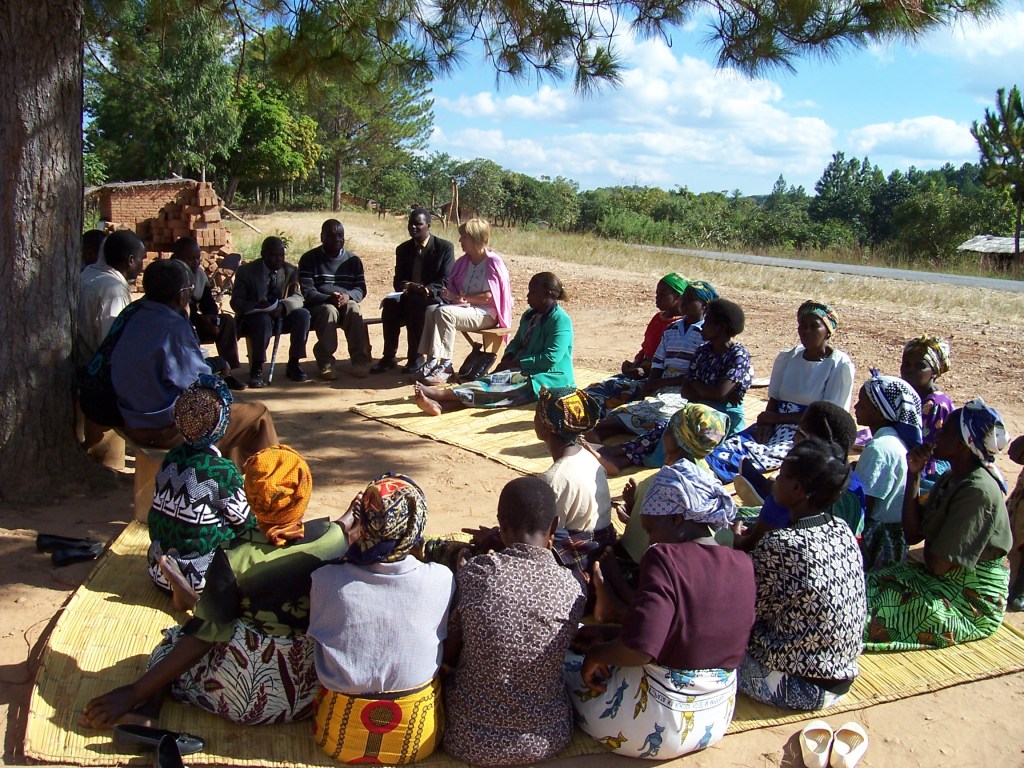
    The Zambian and Malawian Universities drew on their links to local and national government, local rural communities and agencies working in these communities. We knew that within the academic world scientists easily and effectively engage with each other. Within TEN we wanted to build a network that would allow scientists to also dialogue with those who are most effected by climate change in their everyday lives. For example traditionally research in universities tends to be driven by the concerns of the discipline. Within TEN we hoped that the concerns of communities and those who work directly with them would play a role in formulating each university’s research agenda. In doing this we also hoped that research findings would become available to communities.   We also wanted to enhance the capacity of universities and policymakers to recognize and make use of community knowledge. We wanted to combine the western scientific knowledge that dominates our education systems with the lived knowledge of subsistence farmers whose very existence is testimony to their resilience and capacity to adapt.

     The networking aspect of the project necessitated layers of collaboration between entities that are frequently separated by issues of power and status. We learned a lot over the lifetime of TEN. In particular we learned that power and status are everywhere – between the disciplines in universities, between agencies working in rural communities, between individuals, families and groups in communities, within national and local governments and of course between all these different stakeholders.  We learned that although disciplinary specialisation has led to great advances in the natural and social sciences, it alone is often not sufficient to address complex problems such as poverty and climate change. We learned that traditional structures within universities prefer discipline-bound knowledge making it difficult to bring together the expertise to address these complex challenges. We learned that the key to an inclusive participatory process is to acknowledge the existence of power and status even when that power and status is not immediately evident and or is not easy to address.

    Perhaps most importantly of all we learned that when invited to participate small-holder farmers eagerly responded. They appreciated the reciprocity of knowledge flows between the stakeholders.  They were keen to know the findings of the research conducted in their communities and throughout the project they were as generous in sharing their knowledge, expertise, experiences and concerns as they had been in sharing their homes with me many decades ago.

    TEN had many outputs. The most surprising is that it didn’t really end. Sure the funded aspects ended but many of the activities carried on and there are plans for the partner universities to work together on another venture where small-holders will again play a lead role.

    Anne Ryan is Emeritus Professor at Maynooth University.  She was chair of the Department of Adult and Community Education from 2005 to 2018. Anne has worked in developing countries that experience extreme poverty (such as Bangladesh and Central Africa) and those that are war-torn (such as Afghanistan) and she has worked with disadvantaged communities in Australia and Ireland.  These experiences convince her of the potential of adult and community education to empower communities to respond to the critical challenges facing twenty-first century societies in ways that ensure their voice is heard by decision-makers. 

  • Muscat, Maigh Mucreimhe, Mezirow and Maynooth

    Muscat, Maigh Mucreimhe, Mezirow and Maynooth

    Mondays mean Maynooth and mine starts at 5.15 a.m.

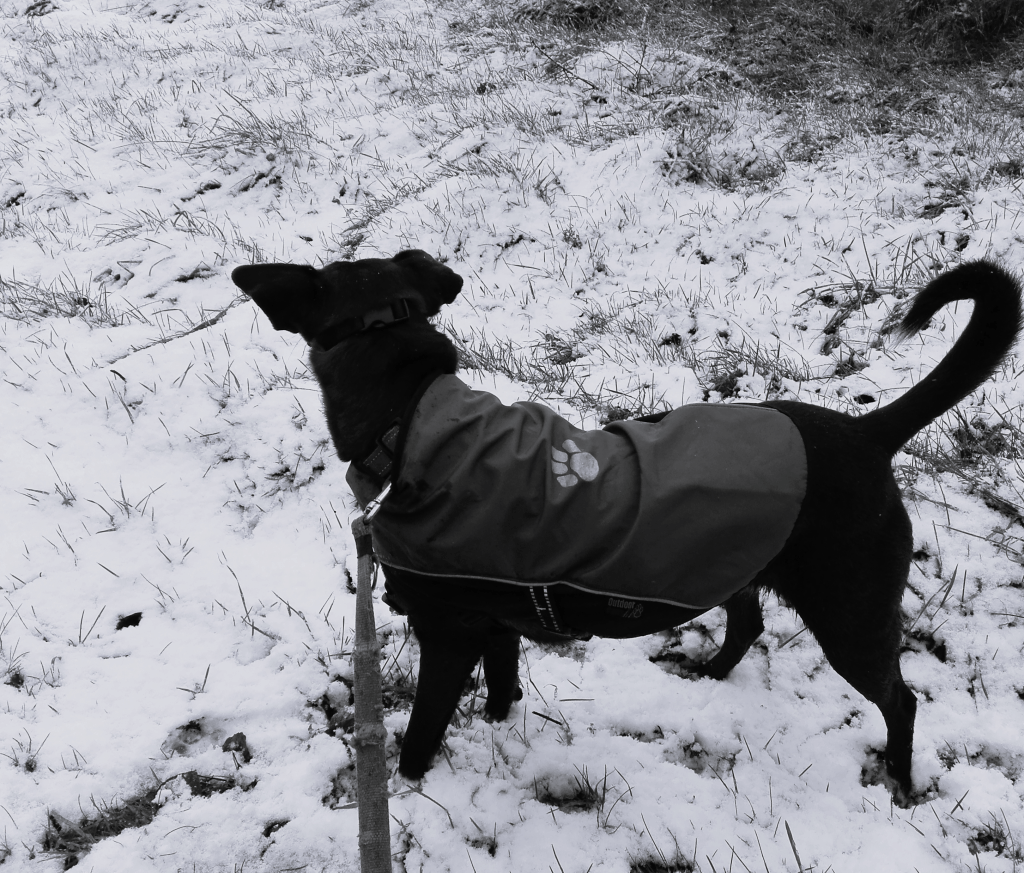
    I force myself out of bed and if my legs aren’t that inclined to work, I pull into my wheelchair and push myself down to the kitchen. I tell Sowdee to ‘get her thing’ namely the leash. She does her happy dance and we find ourselves outside. I love this. The cold, soft mist. It is Galway after all.

    Home.

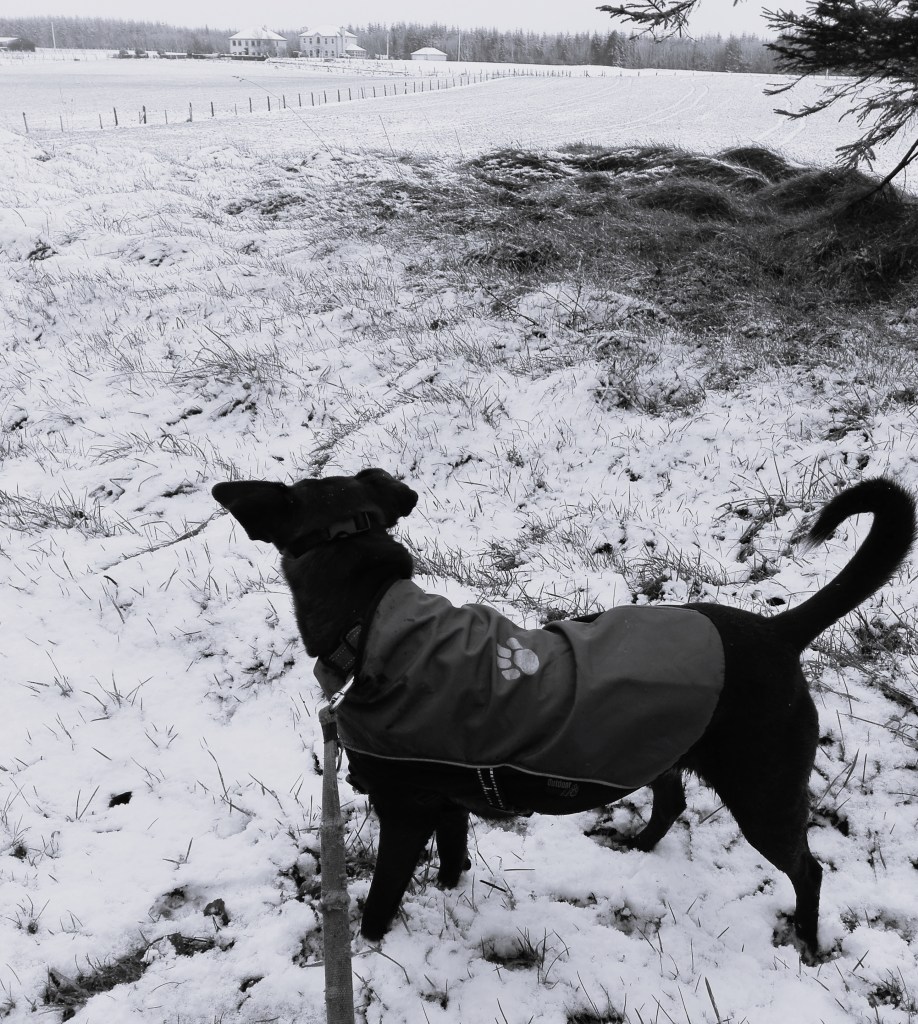
    I can’t walk that well, so we’ve successfully adapted a system from our days in Muscat involving a long lead out the car window. Sometimes, she misses the hot sand and trots along our boithrín until she is ready to run. It is her favourite thing, so we go faster and faster as the sky, anticipating dawn, turns a lighter shade of dark. Close by, the early birds sing their sweet-sounding threats, and a lonesome fox lets out a shrill imploration to a hidden suitor.

    Nonetheless, it remains a time for reflective contemplation.

    I park up and Sowdee sniffs the air catching strains of the amorous fox. I call her name and she looks to me with her big chocolate eyes as I say ‘epistemological’ three times and ‘ontology’ twice, practicing the language of Maynooth. She blinks back quizzically. From this height we look across fields to the half ringfort and the almost imperceptible fall and rise of Ériu in slumber, a slight swaying of the tall grass. Other worlds meet as the dark cobalt turns a grey silver, the best we can hope for mid-February under Galway skies. We take all this in.

    I think of where we are and where we were. I think of my own journey that includes Muscat, Maigh Mucreimhe, Mezirow and Maynooth. ‘What am I doing Sowdee.’ I ask, ‘nearly fifty, and pursuing a masters?’  Madness.  What brought me here? I am reminded on coming home to Ireland of the advice of wiser, better people, educators that I admire and aspire to emulate, of the erudite Bern from GRETB who suggested that I obtain literacy teaching qualifications from WIT. And once there coming under the tutelage of Sarah Bates Evoy, the single most encouraging and motivating lecturer of my long, learning ‘career.’ It was Sarah who pushed me to reach for more, towards Maslow’s zenith. Later, telling her that I had three offers including Maynooth and was unable to decide, she replied, ‘choose Maynooth. You will see why.’

    So, I did, and I do.

    I think of this new ‘language’ that has given form to old thoughts creating a window of opportunity, not necessarily in the material but in terms of self-acceptance. From this, I equate Maynooth with my wheelchair. Both are agents of liberation. Both allow me to go further. Both have the capacity to free perspective from distress. The brisk air affords clarification and I think of my journey from callipers, to crutches and a more recent embrace of the wheelchair. Those few years of almost independent walking have drifted away from me now. Water under the bridge.  I am reminded then of the dilemmata of disability, my faulty frames of reference and the need for transformation. Uh-oh, the inevitable prompt, my Mezirow assignment is due!

    Windows come to mind, the windows of our classroom and the architecture of Maynooth, beyond them, the heavenly inspired, spire, reaching skywards and the juxtaposition of the wings of a colossal, fallen angel within its shadow. The dichotomous struggle within us all. This speaks to a growing self-awareness, of being and I say to myself ‘all human beings desire knowledge.’

    Sowdee isn’t impressed with my Aristotelian quotes.

    Despite my shortcomings, I remind her, ‘I am fully human, and I desire knowledge.’

    And breakfast.

    I reflect on my ‘truths.’ Challenged and transformed as they are through discourse within the Department of Adult and Community Education and I say out loud, “no one is born fully-formed; it is through self-experience in the world that we become what we are.”

    ‘Freire said that,’ I brag but my companion ignores me busily scratching her ear. 

    Despite this slight, I remain enraptured with the scholarship, with Freire, Foucault, Butler, and Goffman and am thankful to the Department of Adult and Community Education for the exposure to them. I reflect on new ways of thinking and not just of thinking but of understanding that thinking. I think therefore I am.

    I think I am still hungry.

    As is the suddenly affectionate dog.

    She reminds me of our journey, her wild, precarious hold to life on the streets and beaches of Muscat, our coming together and eventual journey home. We are all wanderers to some extent. Looking to find our way. Looking to leave our mark. I think then of the diversity within the Department of Adult and Community Education and how it informs and enriches us. I think of the journeys of my fellow ‘Maynoovians,’ those diurnal and life journeys, Kilkenny, Kenya, Botswana, Newbridge and from Banja Luka to the banks of the Liffey.

    These important people, my classmates, my friends.

    The Department of Adult and Community Education, Maynooth and the MEd are part of us now. We are in a privileged place, refuelling epistemologically, gathering thoughts, appreciating understanding, and pondering the next step.

    I breathe in deeply, filling my lungs with morning air. 

    ‘Come on Sowdee,’ I say looking eastwards at the semblance of a rising sun, ‘we have to go…’ I pause to add, ‘because immobility represents a fatal threat.’

    I sense her rolling her eyes, ‘Freire again!?’

    As I look forward to the road and the journey to Maynooth.

    Niall Dempsey is an educator from Athenry currently studying the MEd in Adult and Community Education at Maynooth. His interests are in Adult Literacy, Autoethnography, and Disability Identity. He taught for a decade in the Sultanate of Oman where he met his two Omani hounds, Jojo and Sowdee. While travel remains a passion, they live together now ‘at home’ near a haunted castle, surrounded by forest and family. “Life is good!”

  • SMILE: Social Meaning Impact through Lifelong Learning

    SMILE: Social Meaning Impact through Lifelong Learning

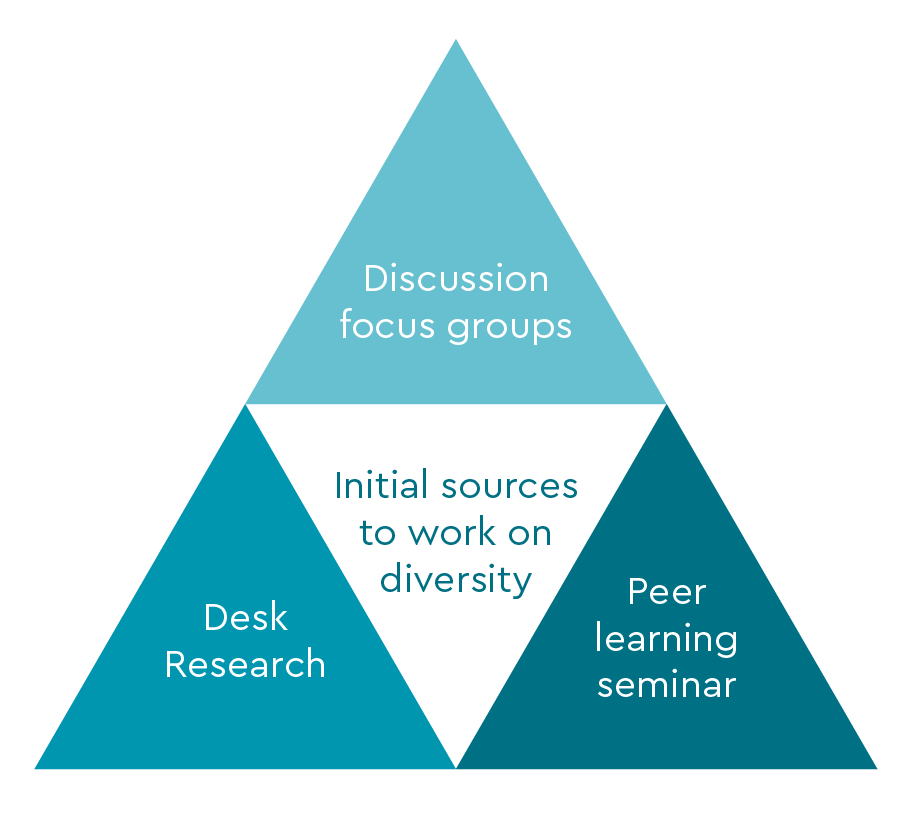
    Our team in the Department of Adult Education are involved in a European Commission funded project called SMILE which we’d like to give you an overview.  It is building on previous work that we’ve been involved in to support greater diversity and inclusion in education across Europe.

    The project is led by eucen, the European Universities Continuing Education Network with university-based partners include European Students Union (EU), Johannes Gutenberg University (Germany), Maynooth University (Ireland), University of Turku (Finland), University of Malta (Malta), Università degli Studi di Cagliari (Italy), Gheorghe Asachi Technical University of Iaşi (Bulgaria) and civil society partners including Fundació Solidaritat (Spain), NOTUS (Spain) and Solidar (Belgium).

    SMILE is a network of European universities and partners working together to promote inclusive learning across higher education.  Our collective aim in this project is to co-develop, test and implement innovative tools that improve the way education institutions deal with diversity and social inclusion. We work across three areas: migration, socio-economic background and gender.

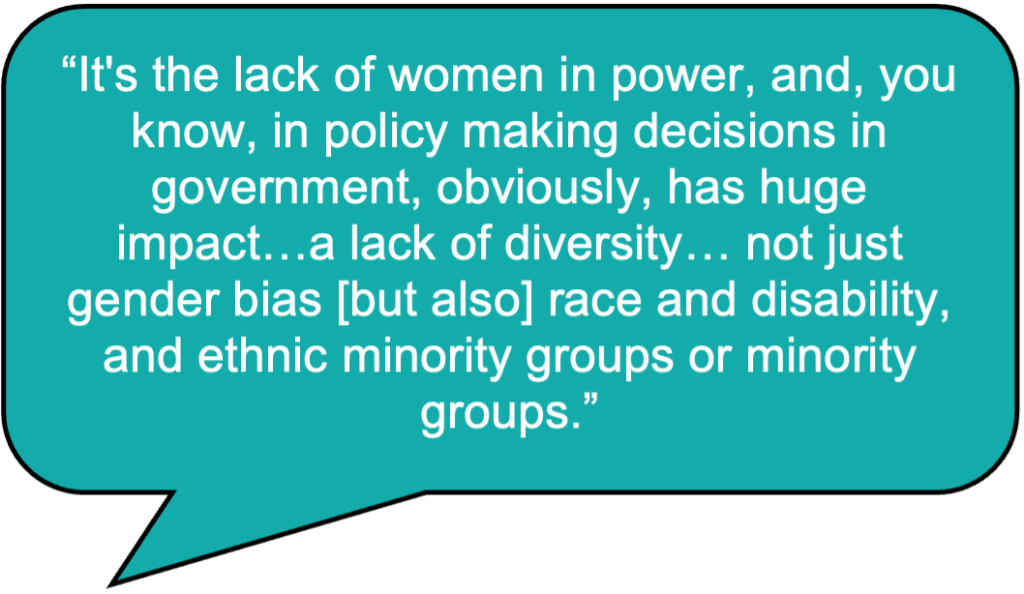
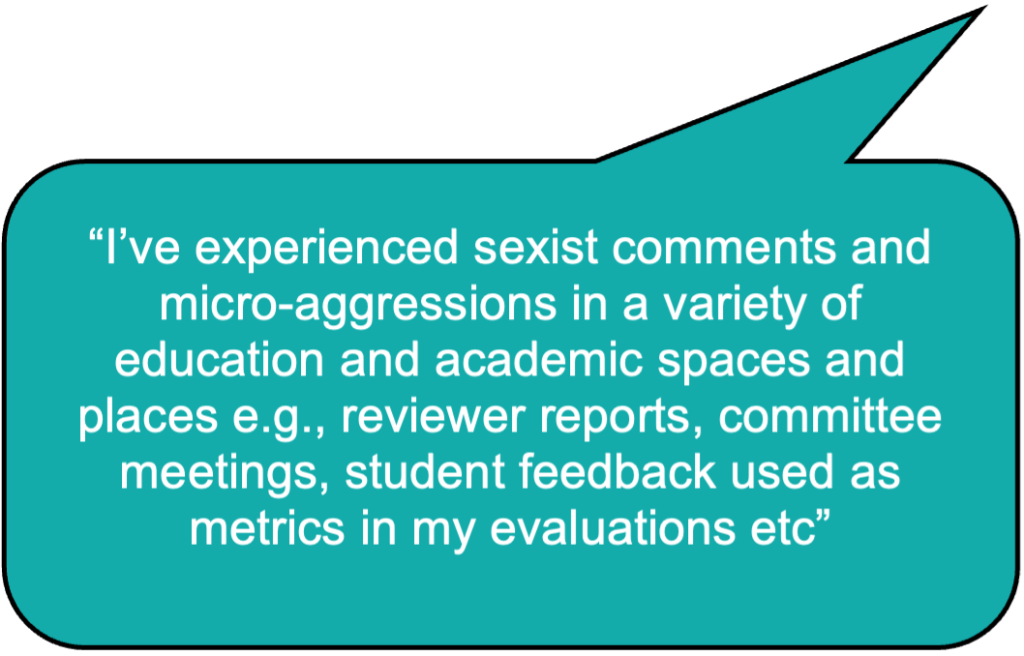
    Maynooth University’s role is to manage one strand of the overall project which focuses on the gender equality and inclusion of women in leadership positions in higher education.  We are aware there is a lot of work being done regarding women and leadership within higher education, and because of this, our focus is on women employed on non-permanent contracts who are often invisible or excluded from institutional gender equality processes.

    We are designing our tools with other adult education settings in mind; such as colleges of further education, community and adult education centres.  We are developing three tools:

    1. Giving voice to Women in Leadership report which researching experiences of women in education and reviews current literature and research

    2. Designing, delivering and evaluating continuous professional development training to staff, both teaching and non-teaching, that promotes women in leadership.

    3. Developing and testing a diversity audit tool to support organisations to assess diversity across all aspects of their organisations.

    We will be developing three continuous professional development (CPD) courses for university staff (academic and non-academic) so that they are better trained to support inclusion in their work. The CPD courses will be developed using a bottom up approach that will involve representatives of the education institutions, NGOs and community groups, with the aim to give voice to the diverse experiences of staff and students.

    The Diversity Audit will be tested and continuously improved through a peer-audit process that will involve a total of 20 universities. At the end of the process, the Diversity Audit Tool will be finalised and made available for any institution interested in using it. A policy operational action plan with recommendations will also be produced, to guide and support universities fulfilling and realising their commitment to diversity and social inclusion.

    We are guided in this work by a research advisory group, comprised of women in key positions in different education and women’s groups, who will share their insights and guidance with us. We will be engaging in public communications and activities on a local, national and transnational level during 2022 and 2023, including national colloquiums with key institutional and national decision-makers and a European round-table in Brussels and a final symposium in Barcelona.

    We hope that the activities of this project will develop education resources that will be made available across Europe to address concerns about the opportunities for women to take up senior leadership roles within higher and further education providers as well as policy making organisations.  We will be inviting interested people to participate in, or nominate people to participate in, the continuous professional development programme which we will pilot later this year. 

    The project hopes to strengthen relationships within Ireland and with the activities conducted by our partners across Europe.  As part of SMILE’s ambition is to shape European Commission policy, participants will also benefit from the opportunity to make direct recommendations to the EC on these issues and shape an education system that is more inclusive of the experiences of people from diverse gender, migrant and socio-economic backgrounds.

    We’d love to hear from you in relation to the themes of this project.

    Bernie, Camilla, Angela and Sinead

    Department of Adult and Community Education

    More information about the project is at The SMILE website 

  • The Story Exchange Project

    The Story Exchange Project

    To get to the chapel in Mountjoy prison you first go through a corridor. This leads into a semi-circular cage-like structure with two upper floors. Through the metal grilles you can see the corridors or wings leading off to the left and right. The corridors are painted yellow, the bars white, and the metal cell doors lining either side are grey. Depending on the time of day, the doors may be open, and prisoners could be congregated in the corridors and landings. The prison at these times is a noisy hub of activity. At other times, the cell doors may all be shut, and the only sound is that of officers marching back and forth, keys rattling.

    You cross the circle to a narrow stair well, climb the stairs to the first floor, and then turn back on yourself to go around the barred landing in a semicircle, back in the direction from which you came. It is disorientating. The far-side steps up to the chapel have double doors made of wood, a change from all the metal, and when you enter the room with its high ceilings, split levels and huge stained-glass windows, the effect is breath taking.

    There are a group of ‘lads’ in their late teens or early twenties seated to the right as we enter, and Niall and Marc, the two young facilitators from Gaisce aren’t instantly discernible. We however, as two female, middle-aged, and middle-class university staff members are. We join the circle and awkward introductions are made. There is some shuffling and nervous sniggering before Niall and Marc take hold of the situation and set us to work. I’m paired with the only young man not wearing sports-clothes. ‘I’ve just come from the kitchen’ he explains, as I pull up my chair. Our topic for conversation is ‘the first time I did something’, and I experience a moment of panic as I wonder what on earth I am going to share with this complete stranger.

    ‘I’m Darren’ my partner offers politely, ‘what’s your name again?’ Darren (pseudonym) thankfully agrees to go first and tells me about the first time he played for his school in Croke Park, and it doesn’t take long before I am with him. I am with him as he describes the feeling of coming onto the pitch through the tunnel, and of scoring for his team. I am with him as he speaks of his pride at being celebrated by the whole school and the school principal at the after-party, and I understand why to this day he keeps a small piece of turf from the field as a souvenir of a special day. And throughout his story, I am wondering how this boy with the long eyelashes, whose eyes are full of light at his childhood memory, has ended up in Dublin’s largest prison.

    When it comes to sharing our stories back to the main group, I go first. I introduce myself as Darren, 20 years old, and recount the first time I played in Croke Park for my primary school. I strive to retell the experience with all the details that matter to Darren because I am responsible for his story. It is like I have been entrusted with this very precious memory and I want to do it justice. When it is Darren’s turn to speak, he introduces himself as Sarah, 45 years old. He tells the story of the first time I went skiing and nearly killed myself, making my way down a mountain Mr Bean style, using trees and barriers to slow my descent, while children, mini-pro ski champions, screeched with laughter as they sailed overhead on ski lifts. I notice how Darren’s rendition of my story is a kinder version. While the story gets some laughs, he omits some of my details and retells it from a perspective that garners empathy towards my plight as opposed to ridicule.

    A group enter the chapel sheepishly, and the conversations in the circle come to a halt. A huddle of terrified looking girls and guys are marshalled over to our space by the Progression Unit Governor, and I remember that they will have just walked through the cage. They are introduced as the Maynooth University students who will be joining the Mountjoy Progression Unit prisoners every Friday for 13 weeks to take part in the Story Exchange Project. There is a self-conscious round of names and timid hand waves before the group is shepherded back out the doors for the rest of their prison tour. They will be starting next week.

    Meaney, S. (2020). Evaluating the Story Exchange Project – A participatory arts-based research project with inmates and university students. Maynooth University: Ireland. Available at: https://educationmatters.ie/launch-of-publication-examining/

    The Story Exchange Project will feature on the IUA documentary series ‘Changemakers’ airing on RTE1 in January 2022. 

    Sarah Meaney Sartori completed her PhD with the Department of Adult and Community Education at Maynooth University. Funded by the Irish Research Council, her research was a creative exploration of the experience of educational exclusion from the perspective of prisoners and youth. Currently, Sarah is the research manager for College Connect, a programme aimed at widening educational diversity, and focussed on the educational inclusion for refugees, people with convictions and Travellers. She has worked as an adult educator for over 15 years, developing and delivering modules and programmes to a wide variety of groups. Sarah is trained and experienced in using arts-based methodologies, which involves taking research outside the academy and into the public sphere for engagement and to inspire social change. Sarah is on the MU Sanctuary Committee, the steering group of the Mountjoy Prison and Maynooth University Partnership, the National Traveller Mental Health Network Allies Forum and has acted as a consultant for a variety of organisations including the Traveller Counselling Service and LGTBI Ireland.

  • Community Education: So Much More than a Course

    Community Education: So Much More than a Course

    On a bright summer’s day in 2017, around 8 of us gathered in an upstairs room over a busy community centre on the outskirts of Limerick city. All of us had been working in community education in some shape or form for several decades. Some of us were on the front-line, organising and sometimes delivering community education, others worked in advocacy organisations whose role it was to create networks for practitioners and promote the work. The rest were academics who in a previous life had worked in community education and were still connected to the sector. Had we done the maths, there was probably around 100 years’ experience in the room if not more. I won’t name the people there as I’m bound to forget someone, what matters more is the reason we were there. You see we were each passionate about a particular version of community education; one that is about people’s needs, about democracy, participation, equality, social change. We were worried this was being erased by government policies that viewed the work as not about needs but about outputs. And only outputs that could be measured.  This was a ‘bums on seats’ approach that was drowning in the language of work-readiness and up-skilling for employment.  Where did it all go wrong? Vocational education is important, but it’s not the only factor. 

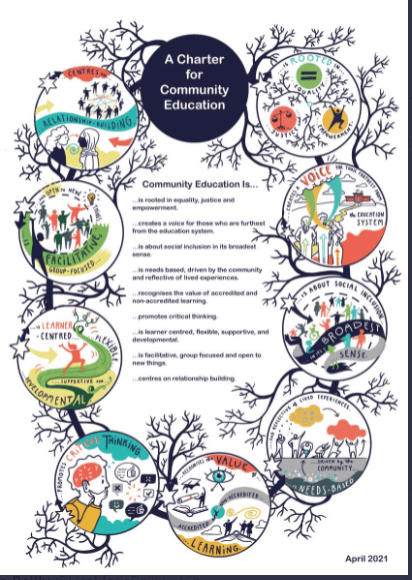
    We knew that we were not the only ones feeling this way in fact many people working in community education were just as fed up as we were. Certainly, many practitioners enjoy aspects of their work but they can also feel trapped in roles where they are not able to exercise the freedoms to work to well-established Freirean principles of community education (Fitzsimons 2017). People felt paralysed by previous brutal cuts that have been inflected on the community and voluntary sector as recently as the 2010s. Nobody wants to jeopardise funding to their project.  At that meeting in Limerick we gave ourselves a name ‘The 3-Pillars Group’.  One of the first things we did was to reach out to the two largest national community education provider networks in Ireland; The AONTAS Community Education Network (CEN) which is a network of over 100 independently managed community education providers; and Community Education Facilitator’s Association (CEFA) which connects public-sector employees who work as Community Education Facilitators (CEFs). It did not surprise us that these networks were having the same sorts of conversations as we were. So, the 3-Pillars group decided it was time to reassert the principles and values that underpin our collective understanding of community education. We did this by drawing from facilitated conversations within CEN and CEFA and came up with the following:   

    Community education……  

    Is rooted in equality, justice and empowerment. 

    Creates a voice for those who are furthest from the education system.   

    Is about social inclusion in its broadest sense.    

    Is needs based, driven by the community and reflective of lived experiences.   

    Recognises the value of accredited and non-accredited learning        

    Promotes critical thinking 

    Is learner centred, flexible, supportive, and developmental.   

    Is facilitative, group focused and open to new things.   

    Centres on relationship building.   

    The charter was launched at a hugely successful webinar on the 29th of April called Reasserting the Politics of Community Education.  

    A charter for Community Education

    Mae Shaw and I (the speakers) took the title to heart and did not hold back on asking critical questions about whose side we are on. Do we, as practitioners want to be accountable to students, communities and social movements, or to neoliberal governments whose policies re-enforce a model of capitalism that allows a small number of people to get extremely wealthy while things get worse for millions of people. We encouraged people to make strange the familiar, to question such stalwarts as ‘community’ and even ‘education’. As Mae Shaw reminded us, community and community development have its origins in colonial policies that were put in place to create compliant citizens. Education is also worthy of interrogation as something that successfully   corrals people into very particular jobs and life-chances depending on your socio-economic background.  But the event was hopeful too, not least because the Charter is a wonderful celebration of the values held dear by community educators, but because of the work that is still being done that asks critical questions about the sort of world that we want to live in.  

    Fitzsimons, C. (2017) Community Education and Neoliberalism, philosophies, policies and practices in Ireland. Switzerland: Palgrave Macmillan. https://www.palgrave.com/gp/book/9783319459363  

    Camilla Fitzsimons is a Lecturer in the Department of Adult and Community Education, Maynooth University. She hails from Dublin and has been working in adult and community education since the 1990s. She has worked with women’s groups, residents groups and campaign groups all as part of wider community development and leadership initiatives. Camilla’s practice is influenced by feminist critical pedagogy and her research influence extends across the breadth of adult and community education where the emphasis is on equality, social justice and dialogic, democratic learning. Camilla has published extensively in adult and community education, with an emphasis on the neoliberalisation of grassroots community education. She has also researched and written about broader feminist issues relating to equality, health and reproductive justice. All of Camilla’s work seeks to uncover asymmetries in power and privilege. At Maynooth she works across a range of programmes at under-graduate and post-graduate level. Camilla is currently the Course Coordinator of the Higher Diploma in Further Education.

  • Learning to Teach, Teaching to Learn

    Teacher, Writer, Entrepreneur: To employ your teaching skills, look for opportunities outside the formal accreditation system. 

    The author Stephen King states that you can call yourself a writer when you pay a bill with money earned from writing. In 2015 I paid a phone bill that way and added writer to my profile. In 2016 I graduated Higher Diploma in Further Education from Maynooth University and proudly added teacher to that list. After graduating I took an opportunity to start up a business, earning another title, entrepreneur. I couldn’t commit the time to a traditional teaching role but I stayed involved by invigilating and marking State Exams. However, that was peripheral work and I feared that with passing time I would become far removed from the vocation I loved.  

    To employ my teaching skills, I realised I would need to look for opportunities outside the formal accreditation system. The new business had a 16-PC co-working space and so I started a beginners’ computer skills course. The success of this led to advanced classes and workshops. With recognition other opportunities arose; local businesses required bespoke staff training; an international internship company required a programme for disadvantaged young adults from Germany. It was a pleasure to facilitate these groups, in particular the German learners, hearing their stories and seeing their social and language skills develop along with their confidence. The culmination of their visit was to deliver PowerPoint presentations to an audience. For most it was their first time to speak in public and to do that in a second language was commendable.   
    I was then commissioned to design an intensive course for a group of local government employees from Poland. Their aim was to learn about aspects of Irish society to enable them to return to Poland as cultural advisors. At our first meeting I found out only one member spoke English! Not to burden him as a translator I trialled translation apps for handouts, leading to some entertaining ice-breaker results.  The group brought to the table matters for discussion such as education, emigration, tourism, agriculture, the provincial divide, and even why we need two taps on our sinks (delivered by a wonderful mime of swiping hands from boiling to freezing water). While gaining the confidence to test their English they taught me enough Polish, German and Russian phrases to, at least, confidently order lunch.

    I also ran workshops as part of the annual Lifelong Learning Festival and from that I was invited onto the community steering group for University College Cork’s Learning Neighbourhoods and Learning Neighbourhood Mentors, an initiative of S.O.A.R. (Inter-Institutional Collaboration on Access.), supporting under-represented groups and individuals in gaining access to education. 

    At this time I was immersed in writing a novel that evolved from my Classics thesis and I was inspired to create a course on Ancient Athens for the UCC/ACE (University College Cork Adult Continuing Education) short course programme. I run this course twice a year, and I’m putting together a new course on ancient theatre. In preparation for going fully online UCC gave staff technology training. They also offered wellbeing advice and one valuable suggestion I took away was to realise we’re all in this together. I now ask for student volunteers to monitor the chat room or the hands up function, to watch time, and remind me to record the session.

    I also designed and deliver online creative writing workshops as part of a support programme for adults with Asperger Syndrome. Online engagement can be difficult for some in the group and as facilitator it is stimulating to adapt to needs, and the wide-range of interests is motivating for all of us.   Although my teaching pursuits are diverse, at no time do I feel I have neglected my values. I have always aspired to a humanist, student-centred ethos. I am a strong advocate of the educational theories of Howard Gardner’s Multiple Intelligences, also Carl Rogers, and Malcom Knowles, with respect to appreciating the individual and encouraging self-direction in learning. Acknowledging prior experience enables the learner to communicate. This develops critical thinking skills, which leads to greater confidence and motivation. My teaching experiences have taught me that the same principles apply to me. The students in the Post Leaving Cert classroom, the Polish professionals, the retired academics of ACE, the computer beginners, the creative writers, all bring unique perspective and experience and I am the one who has truly benefitted. In seeking new paths to teaching I have learned from these interactions, and I am fortunate to have a platform in which to reflect on my practice and reassert my values. I am a teacher, writer, entrepreneur, learner.

    Theresa Ryder was assistant to the late author J.P. Donleavy for many years before graduating M.A. (Classics), 2013, and H. Dip. F.E. from Maynooth University, 2016. She has a particular interest in autism in the adult classroom. She won the Molly Keane Creative Writing award in 2015 and has had short fiction, poetry and plays published. She is a regular contributor to the award winning #WomenXBorders project in the Irish Writers Centre and is one of 16 emerging writers contributing to The 32: An Anthology of Working Class Voices, (publication May 2021).