Tag: HDFE

  • What’s Going on Today in Palestine is Not New

    Blog Authors: Anne Ryan and Tony Walsh

    I’m from the sound of tanks

    I’m from a hot place

    I grew up with the suffering and cruelty of occupation that still plagues my daily life

    I’m from an unjust world

    I really want to make peace with myself (first) then with others and with the world,

    But every time I try to do that I fail. I don’t know why, but maybe that’s my bad luck

    I grew up with the tears of my mom that make me very sad

    One day I walked up and saw a very strong man building the bad wall. I didn’t know what to do, cry or be happy

    Then my father told me that I had to accept that idea

    because we can’t do anything

    Rana Sameeh Gabbash[1]


    [1]  From the ‘Book of Poems’ Summer School Program, Al-Quds University Community Action Centre, (c2008)

    While this poem encapsulates the overt and covert violence of the Palestine we encountered more than a decade ago it also speaks to what we see nightly on our televisions these days.

    Between 2008-12 the Department of Adult and Community Education, Maynooth University was involved in an EU funded project in partnership with 4 Palestinian Universities – Al-Quds, Bethlehem, Birzeit, and the Islamic University of Gaza[2]. The project known as LLIPS, focused on identifying existing lifelong learning provisions on the part of our partner universities with a view to enhancing it to even better meet the needs of Palestinian communities in the West Bank and Gaza.

    During the project we were fortunate to meet and work with many academics in the partner universities. We also met with members of community groups and local NGOs – all engaged with different sectors of the population. We learned a great deal about life in the country; the most striking reality being that – every day – Palestinians lived in an environment where they faced issues of social, economic, political and educational marginalization. They lived in a society where their very way of being, their culture and history were silenced and subverted by the hegemony of the Israeli state. We were particularly struck by the restrictions imposed upon colleagues in our partner universities and by the complex strategies in which they had to engage in order to maintain their programmes. One such example was movement. At a local level for example it was difficult for Al-Quds University in Jerusalem to maintain contact with its Adult Education Centres.  The problem was the Wall. The main campus was outside the wall and the Centres were inside.  Crossing the Wall was no easy task. At a national level movement was also difficult. The LLIPS project found it impossible to bring all the partner universities together within Palestine because those from Gaza could not travel to the West Bank and visa versa. Instead, we all met in Jordan. Many Palestinians spoke of how restrictions on movement effect their everyday lives. They also regretted the negative impacts these have on other staff, on their students and indeed on their own families and friends. They had lost contact with many of the latter over the years.

    As the LLIPS project progressed we were increasingly aware of the subtle, as well as the overt issues of power which constructed the identity and lived reality of those we encountered.

    We found that the nature of the oppression and resistance across Palestine was multi-layered. Although we saw the Wall, the settlements choking the little towns and villages, the checkpoints, the guns, and the multiplicity of minor indignities casually doled out, as outsiders we could barely begin to imagine what it felt like to live there and what it took to sustain one’s self, one’s family and one’s sense of identity and nationhood in the face of unmitigated hostility.

    The emotional and psychic toll on the individuals working there, as well as the community members was very evident.  Even back then the need for support, solidarity, respite and resilience-building was clear. How much more the needs must be now and will be in the future.

    One picture remains strongly, symbolically evocative.

    We were being driven from Jerusalem to Jericho- the iconic path the ‘Good Samaritan’ of old had traversed. We were to lead a seminar for academic colleagues there. A black cassocked priest expertly drove, negotiating the multi-laned motorway. A seeming anomaly speaking of wealth and modernity, it wound its way seamlessly through ancient, barren hills, through an arid, desert landscape. Only the occasional Beduin, hazardously perched upon a donkey and following a small flock of sheep or goats up precarious hillsides broke the dun-coloured monotony. And then I noticed that here and there the dusty countryside was dotted with black tree trunks. Evidence of earlier habitation, perhaps of olive-farms?

    ‘Was this land cultivated not so long ago, Father’ I asked our driver.

    The reply was swift. “Yes there were lots of Palestinian olive farms here. Olive tress can cope with the most arid conditions. And the trees provided shade and vegetation. They’d been there – like the farmers – for generations. Since Jesus’ time. But the Israeli Government confiscated the farms and chopped the trees. They said they were a threat to security. Hammas fighters could hide among the foliage and threaten the army….or settlers.’

    The lifeless trunks bore silent witness to dispossession…and more. 


    [1]  From the ‘Book of Poems’ Summer School Program, Al-Quds University Community Action Centre, (c2008)

    [2] The project was entitled Lifelong Learning in Palestine (LLIPs). The Maynooth University Team were Josephine Finn, Bernie Grummell, Tony Walsh, Shauna Busto-Gilligan and Anne Ryan

    Anne Ryan is Emeritus Professor at Maynooth University.  She was chair of the Department of Adult and Community Education from 2005 to 2018. Anne has worked in developing countries that experience extreme poverty (such as Bangladesh and Central Africa) and those that are war-torn (such as Afghanistan) and she has worked with disadvantaged communities in Australia and Ireland.  These experiences convince her of the potential of adult and community education to empower communities to respond to the critical challenges facing twenty-first century societies in ways that ensure their voice is heard by decision-makers. 

    See previous blog by Anne Transformative Engagement Network: working together to create a sustainable future

    Tony Walsh was, until recent retirement from Maynooth University, lecturer and sometime Head of the Department of Adult and Community Education; he continues as Director of the Centre for the Study of Irish Protestantism and is a Fellow of the Young Centre for Anabaptist and Pietist Studies at Elizabethtown College, Pennsylvania,.  A licensed systemic constructivist psychotherapist he is engaged in writing, consultancy and research inquiry engagements in the US, the UK, Palestine and Ireland (including Northern Ireland). Current research emphases include i) the experience and culture of the Irish Protestant minority; ii) narrative study of the Old German Baptist Brethren, (an Amish-like Plain church in the US); iii) the role of reflexivity in radical adult education iv) narrative and autoethnograpic inquiry.
  • Community Education: So Much More than a Course

    Community Education: So Much More than a Course

    On a bright summer’s day in 2017, around 8 of us gathered in an upstairs room over a busy community centre on the outskirts of Limerick city. All of us had been working in community education in some shape or form for several decades. Some of us were on the front-line, organising and sometimes delivering community education, others worked in advocacy organisations whose role it was to create networks for practitioners and promote the work. The rest were academics who in a previous life had worked in community education and were still connected to the sector. Had we done the maths, there was probably around 100 years’ experience in the room if not more. I won’t name the people there as I’m bound to forget someone, what matters more is the reason we were there. You see we were each passionate about a particular version of community education; one that is about people’s needs, about democracy, participation, equality, social change. We were worried this was being erased by government policies that viewed the work as not about needs but about outputs. And only outputs that could be measured.  This was a ‘bums on seats’ approach that was drowning in the language of work-readiness and up-skilling for employment.  Where did it all go wrong? Vocational education is important, but it’s not the only factor. 

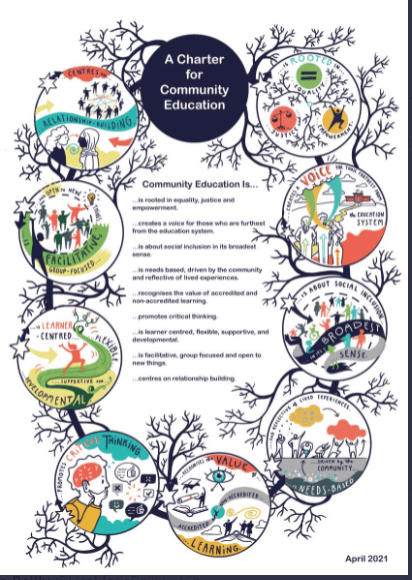
    We knew that we were not the only ones feeling this way in fact many people working in community education were just as fed up as we were. Certainly, many practitioners enjoy aspects of their work but they can also feel trapped in roles where they are not able to exercise the freedoms to work to well-established Freirean principles of community education (Fitzsimons 2017). People felt paralysed by previous brutal cuts that have been inflected on the community and voluntary sector as recently as the 2010s. Nobody wants to jeopardise funding to their project.  At that meeting in Limerick we gave ourselves a name ‘The 3-Pillars Group’.  One of the first things we did was to reach out to the two largest national community education provider networks in Ireland; The AONTAS Community Education Network (CEN) which is a network of over 100 independently managed community education providers; and Community Education Facilitator’s Association (CEFA) which connects public-sector employees who work as Community Education Facilitators (CEFs). It did not surprise us that these networks were having the same sorts of conversations as we were. So, the 3-Pillars group decided it was time to reassert the principles and values that underpin our collective understanding of community education. We did this by drawing from facilitated conversations within CEN and CEFA and came up with the following:   

    Community education……  

    Is rooted in equality, justice and empowerment. 

    Creates a voice for those who are furthest from the education system.   

    Is about social inclusion in its broadest sense.    

    Is needs based, driven by the community and reflective of lived experiences.   

    Recognises the value of accredited and non-accredited learning        

    Promotes critical thinking 

    Is learner centred, flexible, supportive, and developmental.   

    Is facilitative, group focused and open to new things.   

    Centres on relationship building.   

    The charter was launched at a hugely successful webinar on the 29th of April called Reasserting the Politics of Community Education.  

    A charter for Community Education

    Mae Shaw and I (the speakers) took the title to heart and did not hold back on asking critical questions about whose side we are on. Do we, as practitioners want to be accountable to students, communities and social movements, or to neoliberal governments whose policies re-enforce a model of capitalism that allows a small number of people to get extremely wealthy while things get worse for millions of people. We encouraged people to make strange the familiar, to question such stalwarts as ‘community’ and even ‘education’. As Mae Shaw reminded us, community and community development have its origins in colonial policies that were put in place to create compliant citizens. Education is also worthy of interrogation as something that successfully   corrals people into very particular jobs and life-chances depending on your socio-economic background.  But the event was hopeful too, not least because the Charter is a wonderful celebration of the values held dear by community educators, but because of the work that is still being done that asks critical questions about the sort of world that we want to live in.  

    Fitzsimons, C. (2017) Community Education and Neoliberalism, philosophies, policies and practices in Ireland. Switzerland: Palgrave Macmillan. https://www.palgrave.com/gp/book/9783319459363  

    Camilla Fitzsimons is a Lecturer in the Department of Adult and Community Education, Maynooth University. She hails from Dublin and has been working in adult and community education since the 1990s. She has worked with women’s groups, residents groups and campaign groups all as part of wider community development and leadership initiatives. Camilla’s practice is influenced by feminist critical pedagogy and her research influence extends across the breadth of adult and community education where the emphasis is on equality, social justice and dialogic, democratic learning. Camilla has published extensively in adult and community education, with an emphasis on the neoliberalisation of grassroots community education. She has also researched and written about broader feminist issues relating to equality, health and reproductive justice. All of Camilla’s work seeks to uncover asymmetries in power and privilege. At Maynooth she works across a range of programmes at under-graduate and post-graduate level. Camilla is currently the Course Coordinator of the Higher Diploma in Further Education.

  • Learning to Teach, Teaching to Learn

    Teacher, Writer, Entrepreneur: To employ your teaching skills, look for opportunities outside the formal accreditation system. 

    The author Stephen King states that you can call yourself a writer when you pay a bill with money earned from writing. In 2015 I paid a phone bill that way and added writer to my profile. In 2016 I graduated Higher Diploma in Further Education from Maynooth University and proudly added teacher to that list. After graduating I took an opportunity to start up a business, earning another title, entrepreneur. I couldn’t commit the time to a traditional teaching role but I stayed involved by invigilating and marking State Exams. However, that was peripheral work and I feared that with passing time I would become far removed from the vocation I loved.  

    To employ my teaching skills, I realised I would need to look for opportunities outside the formal accreditation system. The new business had a 16-PC co-working space and so I started a beginners’ computer skills course. The success of this led to advanced classes and workshops. With recognition other opportunities arose; local businesses required bespoke staff training; an international internship company required a programme for disadvantaged young adults from Germany. It was a pleasure to facilitate these groups, in particular the German learners, hearing their stories and seeing their social and language skills develop along with their confidence. The culmination of their visit was to deliver PowerPoint presentations to an audience. For most it was their first time to speak in public and to do that in a second language was commendable.   

    I was then commissioned to design an intensive course for a group of local government employees from Poland. Their aim was to learn about aspects of Irish society to enable them to return to Poland as cultural advisors. At our first meeting I found out only one member spoke English! Not to burden him as a translator I trialled translation apps for handouts, leading to some entertaining ice-breaker results.  The group brought to the table matters for discussion such as education, emigration, tourism, agriculture, the provincial divide, and even why we need two taps on our sinks (delivered by a wonderful mime of swiping hands from boiling to freezing water). While gaining the confidence to test their English they taught me enough Polish, German and Russian phrases to, at least, confidently order lunch.

    I also ran workshops as part of the annual Lifelong Learning Festival and from that I was invited onto the community steering group for University College Cork’s Learning Neighbourhoods and Learning Neighbourhood Mentors, an initiative of S.O.A.R. (Inter-Institutional Collaboration on Access.), supporting under-represented groups and individuals in gaining access to education. 

    At this time I was immersed in writing a novel that evolved from my Classics thesis and I was inspired to create a course on Ancient Athens for the UCC/ACE (University College Cork Adult Continuing Education) short course programme. I run this course twice a year, and I’m putting together a new course on ancient theatre. In preparation for going fully online UCC gave staff technology training. They also offered wellbeing advice and one valuable suggestion I took away was to realise we’re all in this together. I now ask for student volunteers to monitor the chat room or the hands up function, to watch time, and remind me to record the session.

    I also designed and deliver online creative writing workshops as part of a support programme for adults with Asperger Syndrome. Online engagement can be difficult for some in the group and as facilitator it is stimulating to adapt to needs, and the wide-range of interests is motivating for all of us.   Although my teaching pursuits are diverse, at no time do I feel I have neglected my values. I have always aspired to a humanist, student-centred ethos. I am a strong advocate of the educational theories of Howard Gardner’s Multiple Intelligences, also Carl Rogers, and Malcom Knowles, with respect to appreciating the individual and encouraging self-direction in learning. Acknowledging prior experience enables the learner to communicate. This develops critical thinking skills, which leads to greater confidence and motivation. My teaching experiences have taught me that the same principles apply to me. The students in the Post Leaving Cert classroom, the Polish professionals, the retired academics of ACE, the computer beginners, the creative writers, all bring unique perspective and experience and I am the one who has truly benefitted. In seeking new paths to teaching I have learned from these interactions, and I am fortunate to have a platform in which to reflect on my practice and reassert my values. I am a teacher, writer, entrepreneur, learner.

    Theresa Ryder was assistant to the late author J.P. Donleavy for many years before graduating M.A. (Classics), 2013, and H. Dip. F.E. from Maynooth University, 2016. She has a particular interest in autism in the adult classroom. She won the Molly Keane Creative Writing award in 2015 and has had short fiction, poetry and plays published. She is a regular contributor to the award winning #WomenXBorders project in the Irish Writers Centre and is one of 16 emerging writers contributing to The 32: An Anthology of Working Class Voices, (publication May 2021). 

  • Migrant to Teacher, Writer and Doctoral Student

    How Adult Education can Change Your Life

    I am Oleg Chupryna, an economic migrant from Ukraine. I am delighted to be able to contribute to the exciting blog from the Maynooth University Department of Adult and Community Education. I believe that my story may help others to start a journey which brings meaningful changes and satisfaction to one’s life. By sharing my experience, I hope to help adults who are undecided, or even desperate, to see that there is always a light at the end of a tunnel; and that light is Education – no matter how old you are. One just needs to be determined and keep going despite any obstacles they may come across with. That is my firm belief, and as a famous quote goes:

    The world is one great battlefield,

    With forces all arrayed;

    If in my heart I do not yield,

    I’ll overcome some day.

    [Charles Albert Tindley]

    I am a Higher Diploma in Further Education (HDFE) graduate of the Department of Adult and Further Education (DACE), and I am currently enrolled in the PhD programme (part-time) in the Department of Sociology at Maynooth University. I also teach in a Secondary School in Dublin and am a guest lecturer at Maynooth University. But my journey to where I am now, began a long time ago in Ukraine, where I was born into a working-class family. After a Secondary School, which I did not like at all, I worked in a factory for a couple of years as a general operative until I was called to military duty where I spent another two years as a soldier. I still did not know what I wanted in life, but on returning home from the military, I knew what I did not want. I wanted neither to return to a factory or continue military service.

    Although nobody in my extended family ever went to university before, my parents convinced me to get into the University access scheme for working-class people. I became a student of the Kharkiv State University, in the city of Kharkiv in Ukraine.

    Five years later, I became a proud graduate with a 1st class degree in History and Social Sciences.

    Consequently, I was offered a teaching job in one of the Universities where I was happy to work for several years, until the country’s and the family circumstances made me emigrate to South America first, and then to Ireland. People in Ukraine who lived through 1990s still call them the ‘merciless nineties’ as most of the people in the country were severely affected, many became unemployed, and many emigrated looking for a better life elsewhere. My own experience in this regard helped me better understand Irish people who, for generations, were looking for better life chances overseas.

    Since I left my home I’ve had to work elsewhere to make a living. A salesman, construction worker, motorbike mechanic, gym instructor, bodyguard, and private tutor are just a few of many jobs I have done. But I always had a dream to work in Education, because teaching is what I am really passionate about and I was told I was good at it. However, during those years in emigration, I lost confidence in my ability to be a teacher again until one day a casual talk with an Irish person opened my eyes. She convinced me to go back to education and apply to the Higher Diploma in Further Education (HDFE) in Maynooth University, which I did and am very happy about it now.

    However, during the HDFE, I came across a very stressful situation and a potential barrier to my future progress, which thanks to my determination and perhaps stubbornness, I eventually overcame. Almost at the end of the course, I discovered that I owed the University over five thousand euro. It happened because, as a foreigner, I was not aware of the ‘nuts and bolts’ of the Irish higher education funding processes. As a result, I did not apply for the SUSI (Student Universal Support Ireland) grant in time. When I found about how it worked, SUSI refused my application, saying it was too late. Despite all my efforts, such as appealing their decision and looking for help from my local TD (member of parliament), I was not able to overcome the bureaucratic ‘red tape’. Eventually, I borrowed money and repaid my debt to the University and happily received my parchment a year after graduation.   

    The HDFE course was crucial for my further career development and most importantly in restoring my confidence in my ability to be a teacher again, especially in English language environment which is not my mother tongue. While doing my Higher Diploma, I was also encouraged by my sociology lecturer to do a PhD as he believed in my great potential.  He also helped me to refine the topic for my research and recommended a potential PhD supervisor. Another staff member encouraged me to start my blog where I could share ideas and knowledge in my field of expertise; international relations, Eastern European politics and Ukraine’s politics in particular. Since then I have started the blog and I have written a number of published articles in RTE Brainstorm, the London School of Economics and Politics website, the Eurasia Review, and the Maynooth University Department of Sociology website. I am very grateful for their encouragement and the DACE contribution to my professional and personal progress.

    I hope my story helps others find their professional development and personal satisfaction path.

    Oleg Chupryna is a PhD candidate in the Department of Sociology, Maynooth University.