Tag: Community Education

  • Rethinking Feminism in Ireland

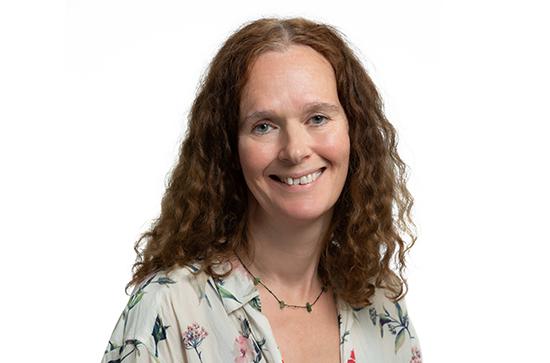
    Professor Camilla Fitzsimons

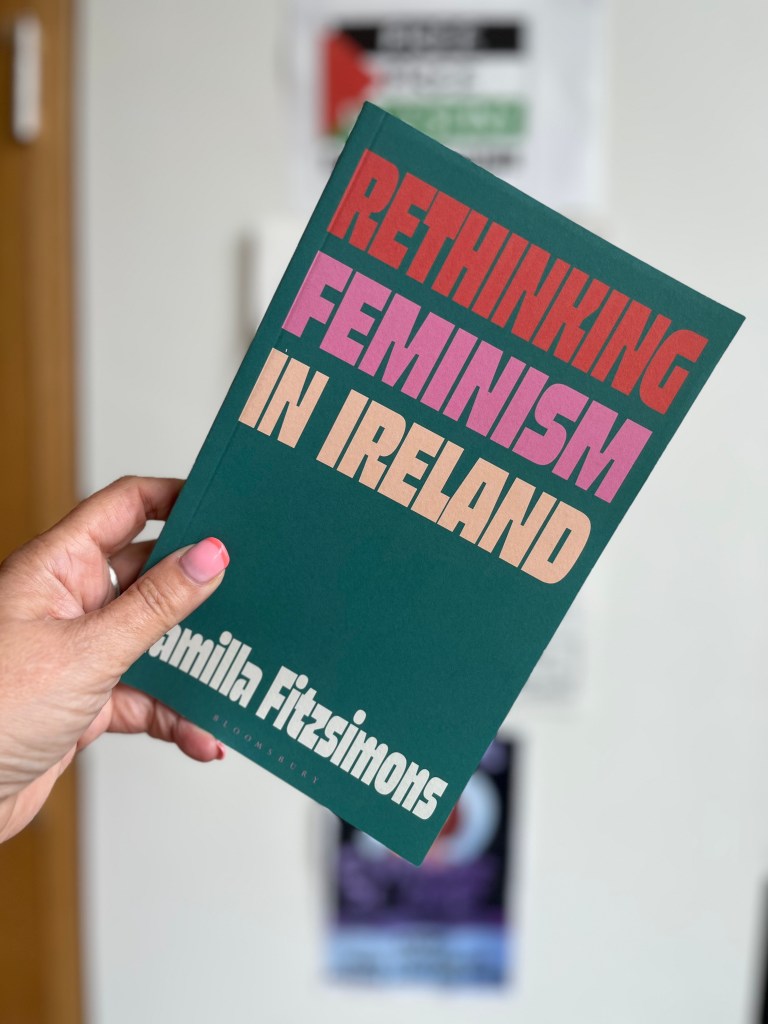
    Last Friday, the 27th June, my fourth book Rethinking Feminism in Ireland was published. This one has been a labour of love and, perhaps with all my books, a case of me seeking to write what I think the students that I meet and the people that I share activist interests with would benefit from reading. In other words, I wrote this book because I couldn’t’ find anything to recommend that would complement the conversations I found myself in when talking about feminism in Ireland.  

    What I particularly like about this book is how I brought the words of some important activists in Ireland to the fore. I interviewed people across the spectrum of politics including Brid Smith the former TD for People before Profit and Senator Lynn Ruanne. Lynn is a former community worker who does amazing work in, as she puts it, ‘equality proofing’ as many laws as she can when they cross her desk. She’s not the only community worker who features. Rita Fagan took the time to sit down with me and share stories of feminism from the vantage point of St Michael’s estate Family Resource Centre and Amel Yacef also shared insights from activism that spans a range of communities and equality-based causes. I also talked to trade unionists, including Therese Caherty, people who were active in Ireland’s pro-abortion movement like the formidable Sinéad Kennedy and Orla O’Connor from the National Women’s Council of Ireland. And thanks to Mary McDermott of Safe Ireland who also took time out to share her insights with me. You’ll have to read the book to find out who else features, but the good news is that it is freely available, right here thanks to my wonderful publishers Bloomsbury Press but especially Olive Dellow.

    So, what am I asking people to ‘rethink’? I contend that there are two souls of feminism – something I also write about here. The first and often most dominant is neoliberal feminism which is an extension of liberal feminism in that it focuses on empowerment and equality of participation in an otherwise largely unchanged world. The second, and the one that I argue for is radical, or anti-capitalist feminism. I object to neoliberal feminism’s hyper emphasis on individual success within today’s capitalist logic and argue instead for a version of feminism that recognizes our ability to control our lives is extremely limited. Our gender identity helps set these parameters, but so does our social class, perceived ability, sexual orientation, ethnicity, exposure to poverty, and our proximity to the catastrophic impacts of climate change, none of which are mutually exclusive.

    My thinking has been influenced my many amazing writers and activists who have come before me. As Sara Ahmed puts it, I am a Feminist Killjoy and proudly so even when it can make me unpopular. Given the current expansion of settler colonialism, I must also acknowledge the work of Rafia Zakharia and her book Against White Feminism within which she speaks so clearly about the current practice of using feminism as the justification for imperialism. I draw from others too across the spectrum of socialism (including Marnie Holborow’s excellent Homes in Crisis Capitalism), critical education and radical feminism and spread these ideas across seven chapters – The trouble with feminism, Feminism and electoral politics, Feminism, work and trade unions, Feminism and trams liberation, Confronting gender-based violence, Reframing reproductive rights, and Doing feminism.

    And if you like my writing, why not also check out my blogs where I write about a range of topics across trans liberation, electoral politics and feminism, but also Love Island and Taylor Swift

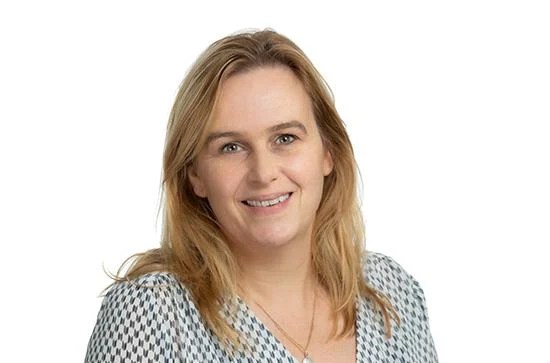
    Camilla Fitzsimons is a Professor of Adult and Community Education and the current Head of Department here in the Department of Adult and Community Education at Maynooth. This is Camilla’s fourth book – you can read a full list of her publications here

  • Rethinking Feminism in Ireland

    Professor Camilla Fitzsimons

    Last Friday, the 27th June, my fourth book Rethinking Feminism in Ireland was published. This one has been a labour of love and, perhaps with all my books, a case of me seeking to write what I think the students that I meet and the people that I share activist interests with would benefit from reading. In other words, I wrote this book because I couldn’t’ find anything to recommend that would complement the conversations I found myself in when talking about feminism in Ireland.  

    What I particularly like about this book is how I brought the words of some important activists in Ireland to the fore. I interviewed people across the spectrum of politics including Brid Smith the former TD for People before Profit and Senator Lynn Ruanne. Lynn is a former community worker who does amazing work in, as she puts it, ‘equality proofing’ as many laws as she can when they cross her desk. She’s not the only community worker who features. Rita Fagan took the time to sit down with me and share stories of feminism from the vantage point of St Michael’s estate Family Resource Centre and Amel Yacef also shared insights from activism that spans a range of communities and equality-based causes. I also talked to trade unionists, including Therese Caherty, people who were active in Ireland’s pro-abortion movement like the formidable Sinéad Kennedy and Orla O’Connor from the National Women’s Council of Ireland. And thanks to Mary McDermott of Safe Ireland who also took time out to share her insights with me. You’ll have to read the book to find out who else features, but the good news is that it is freely available, right here thanks to my wonderful publishers Bloomsbury Press but especially Olive Dellow.

    So, what am I asking people to ‘rethink’? I contend that there are two souls of feminism – something I also write about here. The first and often most dominant is neoliberal feminism which is an extension of liberal feminism in that it focuses on empowerment and equality of participation in an otherwise largely unchanged world. The second, and the one that I argue for is radical, or anti-capitalist feminism. I object to neoliberal feminism’s hyper emphasis on individual success within today’s capitalist logic and argue instead for a version of feminism that recognizes our ability to control our lives is extremely limited. Our gender identity helps set these parameters, but so does our social class, perceived ability, sexual orientation, ethnicity, exposure to poverty, and our proximity to the catastrophic impacts of climate change, none of which are mutually exclusive.

    My thinking has been influenced my many amazing writers and activists who have come before me. As Sara Ahmed puts it, I am a Feminist Killjoy and proudly so even when it can make me unpopular. Given the current expansion of settler colonialism, I must also acknowledge the work of Rafia Zakharia and her book Against White Feminism within which she speaks so clearly about the current practice of using feminism as the justification for imperialism. I draw from others too across the spectrum of socialism (including Marnie Holborow’s excellent Homes in Crisis Capitalism), critical education and radical feminism and spread these ideas across seven chapters – The trouble with feminism, Feminism and electoral politics, Feminism, work and trade unions, Feminism and trams liberation, Confronting gender-based violence, Reframing reproductive rights, and Doing feminism.

    And if you like my writing, why not also check out my blogs where I write about a range of topics across trans liberation, electoral politics and feminism, but also Love Island and Taylor Swift

    Camilla Fitzsimons is a Professor of Adult and Community Education and the current Head of Department here in the Department of Adult and Community Education at Maynooth. This is Camilla’s fourth book – you can read a full list of her publications here

  • TUTOR Webinar Series in Review: Empowering Every Student – Reimagining Inclusive Education

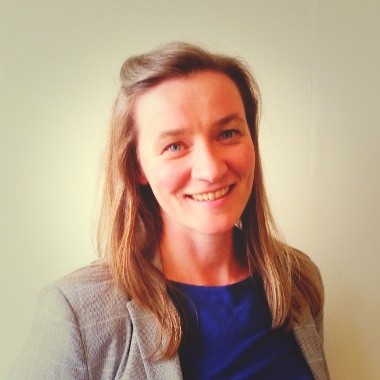
    AuthorSinead Matson

    As we head into the summer month and get a small reprieve from the year’s workload, it gives us an opportunity to catch up on events or information we may have missed out on during a busy academic year.

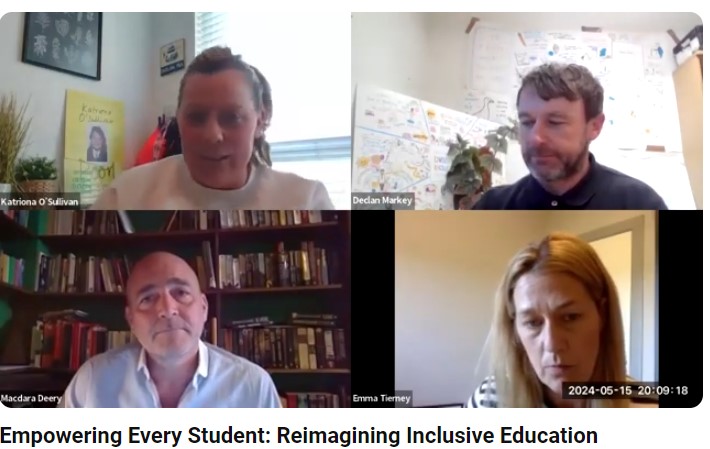
    The TUTOR project’s second webinar from the Facebook Live series, “Empowering every student: reimagining inclusive education” is one to put on your watch list.

    Fronted by TUTOR Project Ireland’s second ambassador, Macdara Deery, a post-primary teacher from Gallen Community School in Co. Offaly, Empowering Every Student focused on inclusive education with a particular lens on social class and the experiences of socio-economic disadvantage on a community, school, and its students.

    The panel held a wide range of experience and depth, from FET, initial teacher education, alternative pathways, and personal experience and testimony.

    Emma Tierney, undertaking her post-graduate diploma in Further Education and training in Maynooth University offered really perceptive and nuanced glimpses into the disconnect that may occur from training to practice because of systemic barriers such as having the ability to challenge the dominate ways of doing, that exist, and have always existed, when you enter a new setting as a FET tutor in training, a newly trained FET tutor, or indeed as a student. She also drew attention to the lived experiences of students with intersecting identities and how they are experiencing their education with a lack of autonomy over their own learning journey. Emma used an example of a student she had during her teaching practice who held asylum seeker status, and how without any warning  “was  uprooted and displaced midway through the academic year and his course taken and put down in a different part of the country … completely uprooted.” This example really shone a light on the lack of power students may face and how the systems around them upheld and reenforced that lack of autonomy – it brings to light how as educators, we really need to examine all aspects of our students’ lives, not just what happens in the classroom.

    Katriona O’Sullivan, Digital Skills Senior Lecturer in Maynooth University, and author of bestselling autobiography Poor, really challenged educators: teachers and tutors to change the narrative for the students in their classroom. A particularly important and powerful moment in the webinar, was Katriona’s reminder:

    “we don’t need to change poor people, lads, we’re grand. We’re amazing. We need to change the people who are already in education. Like, loads of people are saying this in the chat, which is amazing, principals are saying it, and inclusive education isn’t about educating the people necessarily, it’s [about] changing the system … the teachers need to be educated, policy makers need to be educated, the people in education need to be educated about what inequality is, and what it looks like, and what disadvantage is, in the space of our of our universities or our schools.”

    I personally found this to be such a powerful reminder because we can tend to get bogged down in practice and lay everything at the door of educators when in reality we need to spend more time challenging and changing the system, speaking to initial teacher trainers, policy makers and so on about the realities of inequalities and show them what inclusive education really looks like.

    Our final panel member, Declan Markey, is a lecturer in the Adult and Community Education department in Maynooth University, and co-coordinator of the Turn to Teaching programme. Declan, like Emma and Katriona, challenged the system and its barriers, but also went back to what Emma was discussing about the training-practice gap and pointed out the importance of doing the work as well as learning the skills and tools. He emphasises the importance of engaging in anti-bias type auditing on ourselves and our practices, and really reflecting, acknowledging, and unpacking all of the learned assumptions, stereotypes, and biases we consciously and unconsciously hold from our cultural and lived experiences:

    “ you know the concept of inclusive education and you know we know Universal Design for Learning (UDL) – you equip people with a skill set and they can do some training oh yeah I can do inclusive education if they haven’t had a shift in their mindset that actually believes and you know in you know every student and learner that’s in front of them and stuff or you know and we all have assumptions and prejudices and stuff but if you can’t critically reflect on that and acknowledge you know your own kind of cultural background and your cultural assumptions and get past them and actually you know well then it doesn’t you know inclusive education isn’t really going kind make any difference in terms of the space that you’re in.”

    Truly, this is an important webinar that very honestly, and provocatively, shines a light on the real conversations we need to be having in education – particularly when it comes to inequalities and creating truly inclusive education environments. If you missed the wonderful, radical webinar, grab yourself a cuppa and click here to watch.

    Sinead Matson is a postdoctoral researcher working on the Erasmus+ funded TUTOR project for inclusive education in FET and Second Level schools. See https://tutor-project.eu/ for more details. 

  • What’s Going on Today in Palestine is Not New

    Blog Authors: Anne Ryan and Tony Walsh

    I’m from the sound of tanks

    I’m from a hot place

    I grew up with the suffering and cruelty of occupation that still plagues my daily life

    I’m from an unjust world

    I really want to make peace with myself (first) then with others and with the world,

    But every time I try to do that I fail. I don’t know why, but maybe that’s my bad luck

    I grew up with the tears of my mom that make me very sad

    One day I walked up and saw a very strong man building the bad wall. I didn’t know what to do, cry or be happy

    Then my father told me that I had to accept that idea

    because we can’t do anything

    Rana Sameeh Gabbash[1]


    [1]  From the ‘Book of Poems’ Summer School Program, Al-Quds University Community Action Centre, (c2008)

    While this poem encapsulates the overt and covert violence of the Palestine we encountered more than a decade ago it also speaks to what we see nightly on our televisions these days.

    Between 2008-12 the Department of Adult and Community Education, Maynooth University was involved in an EU funded project in partnership with 4 Palestinian Universities – Al-Quds, Bethlehem, Birzeit, and the Islamic University of Gaza[2]. The project known as LLIPS, focused on identifying existing lifelong learning provisions on the part of our partner universities with a view to enhancing it to even better meet the needs of Palestinian communities in the West Bank and Gaza.

    During the project we were fortunate to meet and work with many academics in the partner universities. We also met with members of community groups and local NGOs – all engaged with different sectors of the population. We learned a great deal about life in the country; the most striking reality being that – every day – Palestinians lived in an environment where they faced issues of social, economic, political and educational marginalization. They lived in a society where their very way of being, their culture and history were silenced and subverted by the hegemony of the Israeli state. We were particularly struck by the restrictions imposed upon colleagues in our partner universities and by the complex strategies in which they had to engage in order to maintain their programmes. One such example was movement. At a local level for example it was difficult for Al-Quds University in Jerusalem to maintain contact with its Adult Education Centres.  The problem was the Wall. The main campus was outside the wall and the Centres were inside.  Crossing the Wall was no easy task. At a national level movement was also difficult. The LLIPS project found it impossible to bring all the partner universities together within Palestine because those from Gaza could not travel to the West Bank and visa versa. Instead, we all met in Jordan. Many Palestinians spoke of how restrictions on movement effect their everyday lives. They also regretted the negative impacts these have on other staff, on their students and indeed on their own families and friends. They had lost contact with many of the latter over the years.

    As the LLIPS project progressed we were increasingly aware of the subtle, as well as the overt issues of power which constructed the identity and lived reality of those we encountered.

    We found that the nature of the oppression and resistance across Palestine was multi-layered. Although we saw the Wall, the settlements choking the little towns and villages, the checkpoints, the guns, and the multiplicity of minor indignities casually doled out, as outsiders we could barely begin to imagine what it felt like to live there and what it took to sustain one’s self, one’s family and one’s sense of identity and nationhood in the face of unmitigated hostility.

    The emotional and psychic toll on the individuals working there, as well as the community members was very evident.  Even back then the need for support, solidarity, respite and resilience-building was clear. How much more the needs must be now and will be in the future.

    One picture remains strongly, symbolically evocative.

    We were being driven from Jerusalem to Jericho- the iconic path the ‘Good Samaritan’ of old had traversed. We were to lead a seminar for academic colleagues there. A black cassocked priest expertly drove, negotiating the multi-laned motorway. A seeming anomaly speaking of wealth and modernity, it wound its way seamlessly through ancient, barren hills, through an arid, desert landscape. Only the occasional Beduin, hazardously perched upon a donkey and following a small flock of sheep or goats up precarious hillsides broke the dun-coloured monotony. And then I noticed that here and there the dusty countryside was dotted with black tree trunks. Evidence of earlier habitation, perhaps of olive-farms?

    ‘Was this land cultivated not so long ago, Father’ I asked our driver.

    The reply was swift. “Yes there were lots of Palestinian olive farms here. Olive tress can cope with the most arid conditions. And the trees provided shade and vegetation. They’d been there – like the farmers – for generations. Since Jesus’ time. But the Israeli Government confiscated the farms and chopped the trees. They said they were a threat to security. Hammas fighters could hide among the foliage and threaten the army….or settlers.’

    The lifeless trunks bore silent witness to dispossession…and more. 


    [1]  From the ‘Book of Poems’ Summer School Program, Al-Quds University Community Action Centre, (c2008)

    [2] The project was entitled Lifelong Learning in Palestine (LLIPs). The Maynooth University Team were Josephine Finn, Bernie Grummell, Tony Walsh, Shauna Busto-Gilligan and Anne Ryan

    Anne Ryan is Emeritus Professor at Maynooth University.  She was chair of the Department of Adult and Community Education from 2005 to 2018. Anne has worked in developing countries that experience extreme poverty (such as Bangladesh and Central Africa) and those that are war-torn (such as Afghanistan) and she has worked with disadvantaged communities in Australia and Ireland.  These experiences convince her of the potential of adult and community education to empower communities to respond to the critical challenges facing twenty-first century societies in ways that ensure their voice is heard by decision-makers. 

    See previous blog by Anne Transformative Engagement Network: working together to create a sustainable future

    Tony Walsh was, until recent retirement from Maynooth University, lecturer and sometime Head of the Department of Adult and Community Education; he continues as Director of the Centre for the Study of Irish Protestantism and is a Fellow of the Young Centre for Anabaptist and Pietist Studies at Elizabethtown College, Pennsylvania,.  A licensed systemic constructivist psychotherapist he is engaged in writing, consultancy and research inquiry engagements in the US, the UK, Palestine and Ireland (including Northern Ireland). Current research emphases include i) the experience and culture of the Irish Protestant minority; ii) narrative study of the Old German Baptist Brethren, (an Amish-like Plain church in the US); iii) the role of reflexivity in radical adult education iv) narrative and autoethnograpic inquiry.

  • TUTOR PROJECT

    Teachers Upskilling aiming at a holistic inclusivity in learning. 

    TUTOR is a 3 year European Union funded Teacher Academy project. The Department of Adult and Community Education, Maynooth University is a lead partner in TUTOR

    Ensuring inclusion in education has been a strong motivator for the Department of Adult and Community since its inception and over several decades. The Department is focused upon holistic, dialogical and pedagogical accompaniment of marginalised communities. It does this by co creating spaces for traditionally excluded voices to be heard,  and on ensuring a standard of excellence is achieved in qualitative, engaged and participatory research. The department’s philosophy of education, initial teacher education and continuous professional development is leading and influencing pedagogy and practice within adult, community and further education and training settings. That philosophy is strategically aligned with, and supportive of, the aims and objectives of the TUTOR project, and with the TUTOR consortium partnership.  The TUTOR project, alongside all of the international research projects the department partners with, encourages wider impact of inclusive education across the teaching profession at a European level.

    Key messages of the TUTOR Project 

    Summary of the TUTOR Project  

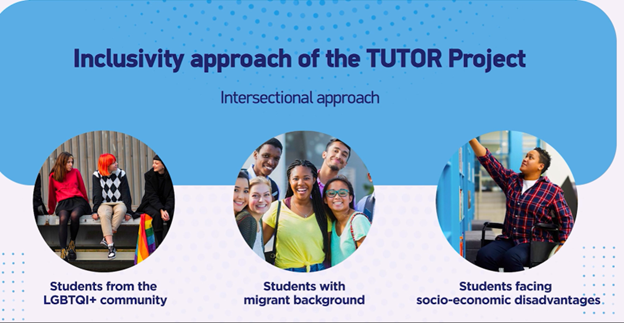
    TUTOR aims to create partnerships between teacher education and training providers to set up Teacher Academies developing a European and international outlook on inclusion in teacher education.  These Academies will embrace inclusivity in education and contribute to achieving the objectives of the European Education Area. In particular, the project will address the need for educators to develop their capacities to understand, analyse and develop strategic responses to the diversity in their classroom and to promote a more inclusive learning environment. TUTOR project intends to foster a more inclusive environment in education, that is open to students from migrant, LGBTQI+, and socioeconomically disadvantaged backgrounds, with a particular focus on safeguarding the elements of tolerance, acceptance, and inclusion.

    The TUTOR objectives 

    To contribute to the improvement of teacher education policies and practices in Europe by creating networks and communities that bring together providers of secondary teacher education and providers of continuing professional development, and other relevant actors (such as ministries) and stakeholders to develop a Train the Trainers approach, focused on inclusivity in learning, 

    • To define a forward-looking strategy upskilling strategy for secondary school teachers, 
    • To enhance the European dimension and internationalization of teacher education through innovative and practical collaboration and by sharing experiences for the further development of teacher education in Europe, 
    • To foster holistic inclusivity in the learning environment, covering all its aspects such as tolerance, non-discrimination, flexibility, etc, 
    • To assess current and future skill mismatches in the targeted (teaching) profession, 
    • To disseminate widely all project products & maintain them in future communications. 

    Who is the TUTOR project for?  

    It is for teachers, students and policy makers who have an interest in inclusive education 

    • Educators/Teachers/ Trainers from the four participating countries of Greece, Ireland, Austria and Turkey 

    Reasons for engagement:  

    1. To update inclusivity skills of secondary education teachers in inclusive education.  
    1. To raise awareness with regards to the inclusivity needs of students being discriminated because they are part of the LGBTQI+ community, have migrant background and they face socioeconomic difficulties.  

    The TUTOR Consortium will 

    1) conduct desk and field research on the inclusivity skills needs of teachers, exploring both the desired status of inclusive education and the actual status within the partner countries, and at European level. 

    2) design a training program to match country-specific needs  

    3) promote and provide access to TUTOR e-learning platform – access to training materials and a network of professionals within their sector.  

    4) support teachers to develop skills to enable a more inclusive teaching experience for students from LGBTQI+ community, migrant backgrounds, and socioeconomically disadvantage to ensure that they are being equally treated.   

    5) work with policy-makers including ministries, local & regional authorities, EU bodies, (and other officials with the ability to influence policies) to make changes at a European and national level regarding transitions to a more inclusive teaching environment. 

    What has the TUTOR project achieved so far? 

    We commenced in June 2022 with a meeting of all partners in Athens, Greece, where the consortium partners developed an overall strategy including an assessment methodology, a Project Management Handbook and Financial Plan, a Dissemination Plan and a project website. Desk research was undertaken across the four countries and at EU level. Partners produced country specific literature reviews on inclusive education, and an overarching Transnational Literature Review.  

    The Department of Adult and Community Education, Maynooth University is the lead partner for Work Package 2 (WP2) Definition of a forward looking upskilling strategy for teachers. Partners have conducted focus group meetings with teachers and stakeholders in Ireland, Austria, Turkey and Greece. 

    What is currently happening in TUTOR? 

    TUTOR’s Transnational  Partner Meeting (TPM) is being hosted by the Department of Adult and Community Education, Maynooth University on 1st and 2nd February 2023, where we welcome partners from Greece, Turkey, Austria and Belgium. All partners are advocates for and are specialists in inclusive education. We will discuss the implications of the key findings of desk and field research to date and plan our strategy for defining a future looking upskilling strategy for teachers across Europe. For further information,  

    The TUTOR website is http://tutor-project.eu/ 

    The TUTOR Facebook: TUTOR Facebook 

    What’s next? 

    Large scale research activity and needs analysis on upskilling of teachers on inclusive education for students from LGBTQI+, migrants, ethnic minorities, and socio economically disadvantaged contexts. 

    TUTOR partners are exploring National-level and EU-level research on the current skills levels of secondary education and VET (Vocational Education and Training) teachers on inclusivity. As part of that process we will be conducting surveys and interviews with 800 teachers, engaging with 500 stakeholders and policy makers. We are developing a professional network of teachers, and developing opportunities for training and mobilities for teachers across the consortium partnership. 

    Contact bernie.grummell@mu.ie and margaret.nugent@mu.ie for further information and if you would like to find out more and become involved in the project. 

    TUTOR partner consortium 

    P1. AKMI ANONIMI EKPAIDEFTIKI ETAIRIA (AKMI), Greece  

    P2. School of Pedagogical & Technological Education (ASPAITE), Greece  

    P3. Symplexis, Greece 

    P4. EVTA, Belgium  

    P5. EVBB, Belgium 

    P6. Maynooth University, Ireland 

    P7. BPI OJAB, Austria 

    P8. Die Berater, Austria 

    P9. National Education Directorate of Serik District, Turkey

    P10. SERGED Teaching Academy, Turkey 

    P11. IGLYO, Belgium 


    Dr. Margaret Nugent is an academic and researcher with the Department of Adult and Community Education. Her professional experience and research interests extends to international peace building, conflict intervention, reconciliation in post conflict contexts and inclusive education. She specialises in qualitative, engaged and participatory research methodologies, and is an experienced practitioner and innovator in developing peacebuilding pedagogies. Margaret has delivered a very extensive portfolio of consultancy work with the adult, rural and community development sector, within further and higher education.

    Bernie Grummell is Associate Professor in the Department  of Adult and Community Education. She is co director of the Centre for Research in Adult Learning and Education and is the lead researcher for the TUTOR project in Maynooth University.

  • CREATE2Evaluate: Enhancing evaluation practice of Adult Education policies and programmes at regional and local levels 

    CREATE2Evaluate: Enhancing evaluation practice of Adult Education policies and programmes at regional and local levels 

    Between 2017 and 2019 an ERASMUS+ ‘Competitive Regions and Employability of Adults through Education’ (CREATE) project aimed to enhance performance and efficiency in adult education by addressing the gap between EU/national strategies and local/regional implementation at adult education policy level. CREATE identified a lack of policy tools and resources to evaluate the impact of adult education (AE) interventions, policies, and initiatives across Europe. This gap was particularly acute within regions tasked with AE policy formulation and implementation to progress towards the EU pan-European target of 15% AE participation. A second project, the CREATE2Evaluate project, was supported by ERASMUS+ from 2020 to 2022 to progress these findings. 

    The Create2Evaluate project and Partners 

    The Create 2 evaluate project is a transnational and multi-agency collaboration seeking to enhance the efficacy and valorisation of adult education at policy and governance levels. The primary aim of the project was identifying reliable tools for adult education evaluation at various layers of governance. The project has eight organisational partners from seven countries (Belgium, Germany, Ireland, Italy, Poland, Romania, and Spain) committed to identifying and operationalising these tools.  

    Click here for more information on the Eight collaborative partners 

    The first meeting of the partners, hosted by the German partner lead AEWB, took place online via teams on the 12th and 13th of November 2020. The project ‘Kick-Off Meeting’ discussed the overall project implementation of the defining timelines, respective duties and activities that will take place in the following months. 

    A snapshot of the first Create2Evaluate partners meeting 

    IO2-Report: Mapping the Impact, Validation and Evaluation of AE Policies 

    The eight partners researched and mapped their current adult education policy landscape regarding evaluation, assessment, and monitoring. Primary and secondary research was undertaken. Twenty-seven stakeholders in the field of adult education were interviewed and a key stakeholder survey was disseminated to provide thirty-six additional responses.  The project partners mapped and identified tools, methods, and resources employed to evaluate adult education programmes and initiatives throughout their regions. A mapping press release went live on the 03-03-2021. 

    Stakeholder collaborative conversations in action at Maynooth University. 

    Mapping Outcomes 

    Mapping and research enabled the CREATE2Evaluate partners to identify the lack of a centralised systemic evaluation framework, common definitions and standards. Feedback indicated that current evaluation policy is primary focused on quantitative outputs and student specific learning outcomes, and inconsistencies were apparent among targeted groups and in non-formal evaluation provision. Additionally, it was evidenced that although copious and significant qualitative evaluation is conducted across adult education centres, this data remains relatively difficult to access due to a lack of centralised systematic overarching analysis and learner protection requirements. Thus, it is very challenging for policy makers to assess the effectiveness of their adult education policies. To view result of the consolidation of findings stemming from the mapping at country and EU level performed by partners click here (full IO2 report) 

     The CREATE2 Evaluate Toolbox:  

    In response to the IO2 findings the partners collaboratively collected and developed helpful tools for the evaluation of adult education at various layers of governance. The CREATE 2 Evaluate ToolBox was conceived to ensure that local and regional policy makers from across Europe will be able to use the policy tools to better plan, design, implement and monitor AE policies with a clear vision of sustainability of public funding in AE. The selection of tools takes into account different purposes of evaluation (e.g., process, persuasive, symbolic, instrumental) as well as their place in the policy cycle. The tools are free, easily accessible and multilingual. The toolbox invites users to adopt the tools to their work realities with ease.  

    The Toolbox is structured in six different areas, each with specific resources and references that sustain local policy makers in better strategizing the alignment, consistence and coherence of local lifelong learning plans to EU horizons. There are a total of 42 tools; 4 best practice recommendations; 5 networks/ Forums; 4 networks/platforms, and a collection of policy documents and strategies are available. The toolbox was officially released on the 26-09-2022. 

    Overview of the Toolbox sections and tools 


    Click each area to view the distinctive tools and resources 

    1.  Consistency of the objectives and outcomes  

    2.  Programme creation at the policy/public administration level 

    3.Inclusivity of AE policies and availability of AE programmes 

    4. AE trainings and programmes delivery 

    5. Value added stemming from the participation in AE 

    6. Continuity of programme evaluation and use of its results to improve AE policies 

    To view the full toolbox and additional resources click ToolBox

    CREATE2Evaluate implementation Package and Green Paper 

    The CREATE2Evaluate implementation Package and Green Paper are the final two components of the CREATE2Evaluate project. These two deliverables were consolidated, and the press release went live on the 19-10-22.  

    The CREATE2Evaluate implementation Package consists of a training suite for the policy making target groups. It is provided as a guide, with step-by-step procedures on the use and implementation of the tools to evaluate policy interventions in the domain of AE. The Training Suite includes user-friendly and flexible training resources for policy makers. Included are guidelines on the policy evaluation tools, scenario setting and profiling tools and a users’ manual and Introduction CREATE2Evaluate ToolBox 

    The CREATE2Evaluate Green Paper advances the debate and stimulates the discussion on policy formulation, implementation, and evaluation of adult education. It provides incite into the challenges and drivers that contributed to the project and the final output of the CREATE2Evaluate Toolbox.. Additionally, it considers the marginalisation of adult education and considers the context in which policy is developed and implemented in adult education, thus enhancing the awareness of the issues evident across the EU adult education landscape. Importantly it offers a critical analysis of the current landscape of adult education from the perspective of the stakeholders and considers the position of the learners. The CREATE2Evaluate resources and CREATE2Evaluate Green Paper should stimulate policy dialogue and exchange on how to advance adult education for socio-economic development and integration.  

    All CREATE2Evaluate results are available in multilingual versions, free and without restrictions through the dedicated open educational resource (OER) platform. To know more about the project, the organisations involved and all resources available, please feel free to consult the Open Education Resource Platform of Create2Evaluate: www.create2evaluate.eu 

    Michael Kenny is a lecturer in the Department of Adult and Community Education. He is co-director of the Higher Diploma in Further Education (HDFE), and the director of the post graduate Certificate in Programme Design and Validation (PCPDV). He is currently the Principal Investigator (PI) on 6 Erasmus+ Projects, including the CREATE2Evaluate project.  

    Margaret Nugent is an associate academic, researcher and lecturer with Department of Adult and Community Education. Margaret is research associate on the Diversity and several European projects. She is a specialist in engaged methodologies, conflict intervention and peace pedagogies. 

  • The Adult Education Teachers Organisation (AETO) – the 5 Ws

    The Adult Education Teachers Organisation (AETO) – the 5 Ws

    Adult Education is the study of how we learn and develop as adults to collaborate in the creation of a just, equitable and sustainable society'. In the provision of education for adults who may not have been well served by the formal education system, adult education tutors provide a valuable service. The Department of Adult and Community Education at Maynooth University works closely with many professionals in adult education including with adult education tutors. The Department promotes a view of education which recognises the importance of learning which promotes justice and equality in society. The AETO shares these values and can support our department in promoting these values in education spaces in which their members work and to promote adult education in broader society

    Who is in the AETO?

    The AETO is a National Organisation of teachers in diverse roles in adult education. Adult Education involves teachers who work in Community Education, Literacy, English for Speakers of Other Languages (ESOL) and other sectors. Membership of the AETO is open to any teacher working with adults in Ireland, be they working with an ETB or for an organisation funded by an ETB. There are about 3,000 adult education teachers nationally and the AETO has been able to engage 300 adult education teachers in its group so far. We expect that many more teachers will join as we raise our profile nationally. 

    A committee has been set up to further the work of the organisation. The Chair of the Association is James O’Keeffe who works in CDETB, the treasurer is Lorcan McNamee from MSLETB, Sinéad Hyland from CDETB is the secretary of the organisation and Avril Tierney from CDETB is the PRO.

    The organisation can be contacted by email at aeto2021@gmail.com

    What are the aims of the AETO?

    The AETO has various goals, all of which aim to improve the working lives of members and to help maintain a focus on learner centred education which will improve access, transfer and progression in the provision of adult education.

    We believe that respect for adult learners involves respect for their teachers. The AETO provides a valuable network for teachers in adult education by providing support for them and in turn for the learners with whom they work.

    Apart from those who have participated in adult education, there seems to be little public awareness of the work of Adult Education teachers. The AETO would like to inform the public of the work and practice of Adult Education Teachers and the life improvements that they help to bring about for students.  

    The AETO would like the importance of our sector to be visible to the public and to the government. Our contribution to education for adults who are vulnerable and marginalised is specialised and of great value to the communities in which we work. We want to achieve working conditions that are merited by this contribution including:

    • a public service contract
    • recognition of prior service and a pay scale
    • recognition of teaching and other qualifications
    • terms and conditions that reflect these qualifications, service experience and status as teaching staff
    • a career path with progression pathways for teachers

    We believe that this will encourage others to join us in the important work that we do and that will make our work sustainable.

    Why?

    Adult Education Teachers work in diverse roles and, so far, have had few opportunities to network. This national organisation provides a space for teachers to get to know and support one another and to share best practice in terms of their teaching.

    There has been a realisation of late of the power of adult education and lifelong learning to address many of the issues that Ireland faces and to equip its population with the skills to survive and prosper in an ever-changing environment. Adult education teachers work with adults to develop skills which enable better communication. resilience and critical skills. 

    The AETO recognises that, in the future, there will be a greater need for committed adult education tutors, to offer learning to adults who wish to re-engage or start out with their education. Many of the actions from the Learning for Life: The White Paper on Adult Education from July 2000 have not yet been put in place regarding adult education teachers. Since then, strategies have been published by various bodies including SOLAS (Future FET: Transforming Learning), Department of Further and Higher Education, Research Innovation and Science (Adult Literacy for Life- A 10 year strategy for literacy, numeracy and digital literacy) and Education and Training Boards Ireland (ETBI Strategy Statement 2022-2024) that depend on adult education teachers to deliver learning for adults to achieve the goals set out.

    As a response to the fragmentation of the sector there is a need to engage colleagues who work in different areas. What is common to all adult education teachers is working with participants with various motivations, some of whom are returning to education having had negative experiences of education in the past. As such, their needs for support are complex. Adult education tutors are ready to provide those supports, allowing learners to develop whole person skills, as well as skills that can lead to work or further study.

    Where?

    There is representation on the group from all 16 ETBs.  There are also local groups based in ETBs who contribute to the national group and who organise locally.

    Much of the communication is on the AETO WhatsApp group but we have had meetings face to face as well as online.

    How?

    The AETO aims to unite adult education teachers in a safe and communicative space where we agree on actions together and can act as the voice for Adult Education Teachers in Ireland.

    We are in contact with our members and are engaging in different ways to with Adult Education Teachers so we can ensure that we are representing the wishes of the group.

    Without adult education teachers there is no adult education.

    Sinéad Hyland is a Tutor and Researcher with Maynooth University Department of Adult and Community Education and City of Dublin Education and Training Board. Sinéad has worked on many projects in adult education and in her work on the Return to Learning Programme in MU has focussed on helping adults to make transitions to higher education.

  • Growing Space

    Growing Space

    Recovery, Education and Capability

    This was the first seminar to be held in Maynooth University since 2019, and I could certainly identify with and echo the words of Dr Derek Barter, that this event was an antidote to the fear we have been feeling over the last 2 years. The sense that some fragment of normalcy was returning was evident, the atmosphere outside the lecture hall beforehand was buzzing with relaxed chat. I must say it was nice to be at an event where the main topic was not Covid, no, today belonged to recovery. This ALL Institute and the Dept of Adult and Community Education (DACE), joint Addiction Studies/Psychology seminar did not disappoint as Dr Barter introduced Dr Mark Richardson from Growing Space.

    The story that unfolded as Mark began his presentation was one of true humanity, inclusion, caring and respect. Dr Richardson was joined by co-worker Nicola Vaile, and two participants from Growing Space, Michele and Marette. It was obvious from the beginning that the relationship between all four people was very special, you could feel the deep connection between them. Marks passion for what he does, and for what he has helped create in Growing Space was evident in his presentation. It flowed from him naturally because he deeply believes in it. Growing Space has been providing a space in Wales since 1992, in a place called Nant Bran (such a lovely name), where they continue to approach mental health issues through transformational education, community engagement, situationist practice, and emancipatory participation. All of this in the hope that those who suffer mental health issues might find that spark that ignites their journey of recovery. In Mark Richardson’s own words, “education is the bedrock of recovery”.

    Dr Richardson continued as he explained, in detail, the support they provide at Growing Space for the community. All the time connecting the theories and practices to the real-life experiences of Michele and Marette. This is not a medical, symptom management approach to mental health, although the medical approach is also important, as Dr Mary Ryan (Head of Dept of Adult and Community Education) alluded to. I found it refreshing to hear someone speak about people who can sometimes be forgotten about within society because of mental health issues and the stigma that surrounds it. One of the first things Mark done when he arrived at Growing Space was to paint the old building bright yellow, so as to let people know we are here and this is what we do, no more hiding. A simple but powerful statement, if we refuse to acknowledge or speak about serious social issues and the structures that support these beliefs, we give them the power to oppress. One of the first questions Mark asks anyone who comes to Growing Space is, what can you do, what do you want to do? Instead of, what’s wrong with you? Growing Space joins a person’s recovery journey and supports them by focusing on a person’s strengths. Mark goes on to tell us that Growing Space is there to “inspire learning”, and to “help people find their own recovery”.  

    Dr Richardson kept referring back to both Michele and Marette’s stories throughout his presentation, so as to give the audience a sense of their mental health issues, their pathways to recovery and their experiences within Growing Space. I for one found this approach very inclusive, a clever way of keeping both Michele and Marette involved in the presentation, as there were some serious anxiety issues, in particular with Marette, as we were to find out later. Somehow they found the strength to stand up in front of a room full of strangers and tell their very personal stories. Upon reflection I can see that it was only because of the relationship that Mark Richardson and his team have with the participants at Growing Space, that Marette and Michele had the confidence to share with us their experiences.

    Michele’s story was harrowing to hear at times, and by the end of it I had tears in my eyes, and I certainly wasn’t the only one. What Michele endured throughout her childhood was nothing short of horrific, at one point she did say, matter-of-factly, that she blamed her mother for her mental illness. When Michele first came to Growing Space she had literacy issues, but here Michele was, more than a stone’s throw away from home, standing in a very large lecture hall reading from her life story which she wrote herself – here was the power of adult education. This is what can happen when the barriers of stigma, language, and ignorance are removed, and replaced with humanity, cooperation, openness and exploration. The support from Nicola during the time Michele spent at the podium was visible, solid as a rock. The round of applause Michele received when she finished was emotional to say the least, it was in appreciation for her honesty and vulnerability; it’s true when Brene Brown says, there is power in vulnerability . It was not only for Michele’s honesty that such appreciation was shown, but the fact that she came through what she did, not unscathed by any means, but still standing none the less, how dare anyone stigmatise, exclude, or at the very least not strive to understand a powerful soul like Michele, is beyond me.

    Left to right Derek Barter (Maynooth), Michele, Marette, Nic, Mark

    When Marette made her way to the podium, the moral support of Nicola was ever present. Two very different stories in ways, but ultimately having similar outcomes, ill mental health. What did come through in Marette’s story was how important Growing Space and building a trusting relationship with Mark was in her journey of recovery. From speaking with Mark later in the day I can say that some of the obstacles that Marette has overcome is astonishing. I can only speculate that the occasion become too much for Marette during her talk and she couldn’t finish what she had written; without missing a beat in jumped Nicola to make sure that what Marette had written was heard. I can only liken it to a secret service agent jumping in front of a bullet for her president, marvellous. It was in this moment that I looked from Marette to Mark to Nicola, and what I saw will stay with me for a long time to come. What I saw was love, the type of love you see between a parent and a child or between siblings. They felt and acted with Marette in the moment, and I only hope that when they had time to reflect that they looked for the lesson in the experience.

    I really enjoyed the couple of hours I spent in the company of Mark, Nicola, Michele and Marette. It was a privilege to hear their stories and I hope I have done them justice in this piece. There is so much more to Dr Mark Richardson’s work and Growing Space. I was glad to have the chance to talk with Mark afterwards, and I asked him how he would approach stigma within people who were in recovery from addiction. His reply was, change the language you use. Now, I have to say, I was expecting more but, what I wasn’t expecting was that I would be still thinking about his answer a week later. I have been engaged in those five words ever since and thinking of different ways to put them into action. Mark didn’t give me the answer I was looking for, he joined me on my journey to finding the answer for myself. Thank you Mark.

    Glen.

    Glen Patrick Smith began his journey through Maynooth University in 2018, when he completed the certificate in Addictions Studies. From there he progressed on to the part-time evening degree in Community Studies, which he will complete in the summer of 2023. Returning to education, in particular the Adult and Community Education Department in Maynooth, has been the most important decision of his life thus far. It has given him a confidence to express himself, and it has afforded him opportunities he never though possible. As a result of his studies and the passion it has instilled in him for adult and community education, Glen has recently been employed by the local Family Resource Centre in Newbridge as a family support/community development worker. Glen intends to continue his studies in the near future.

  • Adult Learning, Inequality and Covid-19

    Adult Learning, Inequality and Covid-19

    Since 2006 I have been working as a part-time tutor teaching literacy and ICT in an Adult Education Centre in Tallaght. Four years ago, I decided to enhance my personal learning journey by beginning the BA in Community Studies in Maynooth University. My journey so far has been transformational as I have grown in my understanding of the assumptions that underlie my practice and the philosophies of education, which have fostered in me a new appreciation for adult education principles.  In 2020 for my thesis, I decided to use my experiences within adult education to investigate ways in which the pandemic has affected the learning opportunities of adults.

    Even before the pandemic, there has been a shift over the years in promoting economic growth by raising market-driven needs above the needs of individuals. This has had a significant impact on many sectors of society such as adult education. The implications of this have been that when we try to fit the students’ needs into the system rather than the other way around, it is the needs of the students that get lost within this process. I do appreciate that there is a need to reduce unemployment and to equip learners to compete in the job market, but what is equally necessary is an understanding of the conditions that make some groups more at risk to unemployment than others and it is in times like the current pandemic that these groups will be hit the hardest.  

    My research was carried out using a qualitative case study analysis, interviewing students, tutors and coordinators to hear their experiences of adult learning during the pandemic. Throughout these discussions key themes emerged such as; the isolating experience of online learning, lack of motivation, access to IT devices and an increase in the digital divide. Most students agreed that they found the online learning experience an isolating one. The prime focus throughout this year has been on providing the necessary devices to work online and while this has been important, what has been overlooked are the holistic values that are core to adult education principles. As stated by AONTAS (2020b) at the heart of learning is not technology, it is pedagogy. The term pedagogy means the art of teaching and covers so much more of the learning experience. Emotions and feelings are difficult to quantify, but they play a vital role within the learning experience that cannot afford to be discounted. The dynamic of the group is significant in providing support to enable learning from each other’s experiences. Within this research, the students who participated all recognised the knowledge within the group and placed value on one another in order to learn. Many adult learners felt that these aspects of group learning and engagements were missing now and were difficult to replicate through online platforms. In short, remote learning has provided a narrow-standardised medium for learning using ‘human capital’ to serve the needs of the workforce. Based on my research, the findings showed that this approach was only favoured by some while further marginalising many others. 
    Prior to the pandemic, a shift towards digitisation was already underway (DAE, 2015). Covid-19 has accelerated this paradigm, and it looks like this is set to continue. How much the pandemic has reshaped the way we live, learn and work; only time will tell. When it comes to adult learning some of the changes experienced may be lasting fixtures and part of the ‘new normal’ in a post-pandemic world. The impact of this will deepen the existing divide of inequality (AONTAS, 2020a). If we consider that this will be our future, then a critical awareness and deep understanding of inequality is more necessary now than ever.  

    Maria-Ana Kelly will complete her BA (Hons) in Community Studies from Maynooth University in January 2022. This degree consisted of modules from departments in Applied Social Studies, Anthropology, Sociology and Adult and Community Education. Maria-Ana’s main objective has been to develop a deeper understanding on issues of social justice and recognizes that it is possible to bridge the gap of inequality, through the approaches and methodologies used in the classroom. For her research thesis, she chose to examine in what way the pandemic has exacerbated inequality and has excluded certain students from the learning experience. Following on from the degree, Maria-Ana would like to begin the Master’s in Adult and Community Education next year.

    Bibliography 

    AONTAS (2020a). Growing evidence base on widening inequalities during Covid-19 for learners across Ireland. Retrieved from: https://www.aontas.com/knowledge/blog/growing-evidence-base-of-widening-inequalities-during-covid-19-for-learners-across-ireland [Accessed on 17th August 2021]. 

    AONTAS (2020b). Mitigating educational disadvantage (including Community Education issues) working group: Digital learning and disadvantage across tertiary education – a discussion paper. Retrieved from:  https://www.aontas.com/assets/resources/AONTASResearch/Digital%20Learning%20and%20Disadvantage%20across%20Tertiary%20Education.pdf [Accessed on 17th August 2021]. 

    DAE European Commission (2015). Digital agenda for Europe: Digital economy and society index 2015: Country profile: Ireland. Brussels. Retrieved from: https://ec.europa.eu/digital-agenda/en/scoreboard/ireland [Accessed on 17th August 2021].

  • Community Education: So Much More than a Course

    Community Education: So Much More than a Course

    On a bright summer’s day in 2017, around 8 of us gathered in an upstairs room over a busy community centre on the outskirts of Limerick city. All of us had been working in community education in some shape or form for several decades. Some of us were on the front-line, organising and sometimes delivering community education, others worked in advocacy organisations whose role it was to create networks for practitioners and promote the work. The rest were academics who in a previous life had worked in community education and were still connected to the sector. Had we done the maths, there was probably around 100 years’ experience in the room if not more. I won’t name the people there as I’m bound to forget someone, what matters more is the reason we were there. You see we were each passionate about a particular version of community education; one that is about people’s needs, about democracy, participation, equality, social change. We were worried this was being erased by government policies that viewed the work as not about needs but about outputs. And only outputs that could be measured.  This was a ‘bums on seats’ approach that was drowning in the language of work-readiness and up-skilling for employment.  Where did it all go wrong? Vocational education is important, but it’s not the only factor. 

    We knew that we were not the only ones feeling this way in fact many people working in community education were just as fed up as we were. Certainly, many practitioners enjoy aspects of their work but they can also feel trapped in roles where they are not able to exercise the freedoms to work to well-established Freirean principles of community education (Fitzsimons 2017). People felt paralysed by previous brutal cuts that have been inflected on the community and voluntary sector as recently as the 2010s. Nobody wants to jeopardise funding to their project.  At that meeting in Limerick we gave ourselves a name ‘The 3-Pillars Group’.  One of the first things we did was to reach out to the two largest national community education provider networks in Ireland; The AONTAS Community Education Network (CEN) which is a network of over 100 independently managed community education providers; and Community Education Facilitator’s Association (CEFA) which connects public-sector employees who work as Community Education Facilitators (CEFs). It did not surprise us that these networks were having the same sorts of conversations as we were. So, the 3-Pillars group decided it was time to reassert the principles and values that underpin our collective understanding of community education. We did this by drawing from facilitated conversations within CEN and CEFA and came up with the following:   

    Community education……  

    Is rooted in equality, justice and empowerment. 

    Creates a voice for those who are furthest from the education system.   

    Is about social inclusion in its broadest sense.    

    Is needs based, driven by the community and reflective of lived experiences.   

    Recognises the value of accredited and non-accredited learning        

    Promotes critical thinking 

    Is learner centred, flexible, supportive, and developmental.   

    Is facilitative, group focused and open to new things.   

    Centres on relationship building.   

    The charter was launched at a hugely successful webinar on the 29th of April called Reasserting the Politics of Community Education.  

    A charter for Community Education

    Mae Shaw and I (the speakers) took the title to heart and did not hold back on asking critical questions about whose side we are on. Do we, as practitioners want to be accountable to students, communities and social movements, or to neoliberal governments whose policies re-enforce a model of capitalism that allows a small number of people to get extremely wealthy while things get worse for millions of people. We encouraged people to make strange the familiar, to question such stalwarts as ‘community’ and even ‘education’. As Mae Shaw reminded us, community and community development have its origins in colonial policies that were put in place to create compliant citizens. Education is also worthy of interrogation as something that successfully   corrals people into very particular jobs and life-chances depending on your socio-economic background.  But the event was hopeful too, not least because the Charter is a wonderful celebration of the values held dear by community educators, but because of the work that is still being done that asks critical questions about the sort of world that we want to live in.  

    Fitzsimons, C. (2017) Community Education and Neoliberalism, philosophies, policies and practices in Ireland. Switzerland: Palgrave Macmillan. https://www.palgrave.com/gp/book/9783319459363  

    Camilla Fitzsimons is a Lecturer in the Department of Adult and Community Education, Maynooth University. She hails from Dublin and has been working in adult and community education since the 1990s. She has worked with women’s groups, residents groups and campaign groups all as part of wider community development and leadership initiatives. Camilla’s practice is influenced by feminist critical pedagogy and her research influence extends across the breadth of adult and community education where the emphasis is on equality, social justice and dialogic, democratic learning. Camilla has published extensively in adult and community education, with an emphasis on the neoliberalisation of grassroots community education. She has also researched and written about broader feminist issues relating to equality, health and reproductive justice. All of Camilla’s work seeks to uncover asymmetries in power and privilege. At Maynooth she works across a range of programmes at under-graduate and post-graduate level. Camilla is currently the Course Coordinator of the Higher Diploma in Further Education.