Co-authors: Niall Patrick Cullen* and Sasha Siobhan Buhr**
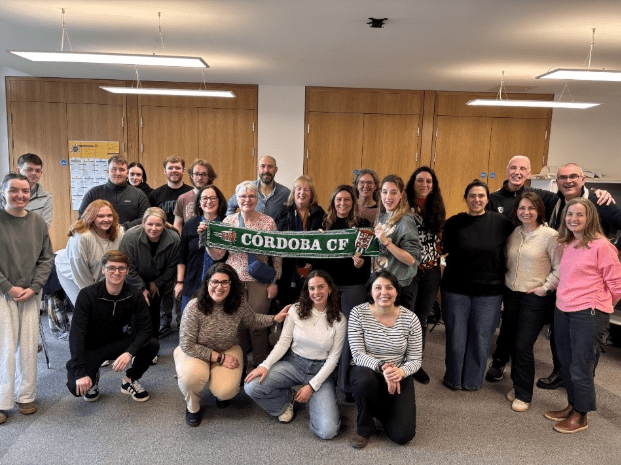
On March 11th 2026, Maynooth’s Return to Learning (R2L) course participants were visited by a group of language school students from “Escuela Oficial de Idiomas de Córdoba” in the city of Cordoba, in the Andalusian region of southern Spain. As part of their visit, our Spanish guests introduced us to some notable features of their culture and history, including some landmarks, attractions and cuisine that their beautiful city is home to.
Our guests, all of whom spoke English with impressive fluency, treated us to short, vivid PowerPoint presentations on what their home region has to offer. This included colourful and interesting introductions to Cordoba’s historic buildings, sites and some of the following festivals and traditions including the following :
• The Mezquita – a former mosque constructed in 785 AD which now serves as a Catholic Cathedral and UNESCO heritage site for the city of Cordoba.
• The Alcazar de los Reyes Cristianos – a historic fortress and palace that has over time served as a royal residence, military base and a seat of the notorious Spanish inquisition.
• The historical archaeological site of the city Medina Azahara (located approximately 5 miles from Cordoba) which was built in the 10th century by the first caliph of Cordoba, Abd al-Rahman III,
• The May Crosses (Cruces de Mayo) Festival, which involves decorating Cordoba’s streets and squares with large crosses covered in flowers, plants and other traditional Andalusian items.
• The Festival of Patios (Fiesta de los Patios), which is when homeowners open their courtyards to the public, inviting them to gather and admire their decorated patios adorned in colourful flowers and decorations.
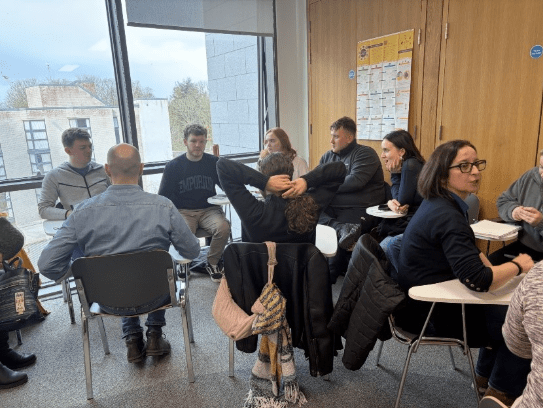
RTL and EOI students are discussing similarities and differences in their cultures
Following the presentations, we split up into smaller groups consisting of a mix of Maynooth and Cordoban students in each group, where we discussed some of the cultural similarities and differences – most notably the differences in weather! It was very interesting to see and experience the real pride our visitors had in their city and history and equally it was nice we were able to show them a video of Sinead O’Connor and the Chieftains performing “the Foggy Dew” in introducing them to traditional Irish ballad songs.
Our guests were also generous enough to bring us some delicious traditional Cordoban pastries and some sample sherry which made chatting that much more enjoyable. Most of us R2L students had only been to some of Spain’s tourist hotspots on holiday, often overlooking its rich cultural and historical history and that of the smaller regions such as Cordoba, so it was refreshing and exciting to delve into this topic further.
It was a very absorbing and enjoyable cultural exchange for which we would like to extend a very warm thanks to each of our friendly visitors and Maynooth University’s Department of Adult and Community Education which kindly co-ordinated and facilitated the visit.
We suspect Cordoba’s tourist numbers may increase with a number of R2L visitors heading over in the not too distant future.
*Student in the Return to Learning Certificate Programme in the Dept of Adult and Community Education, Maynooth University, 2025-26
Can you tell us a bit about yourself and what you are currently studying?
Paul:
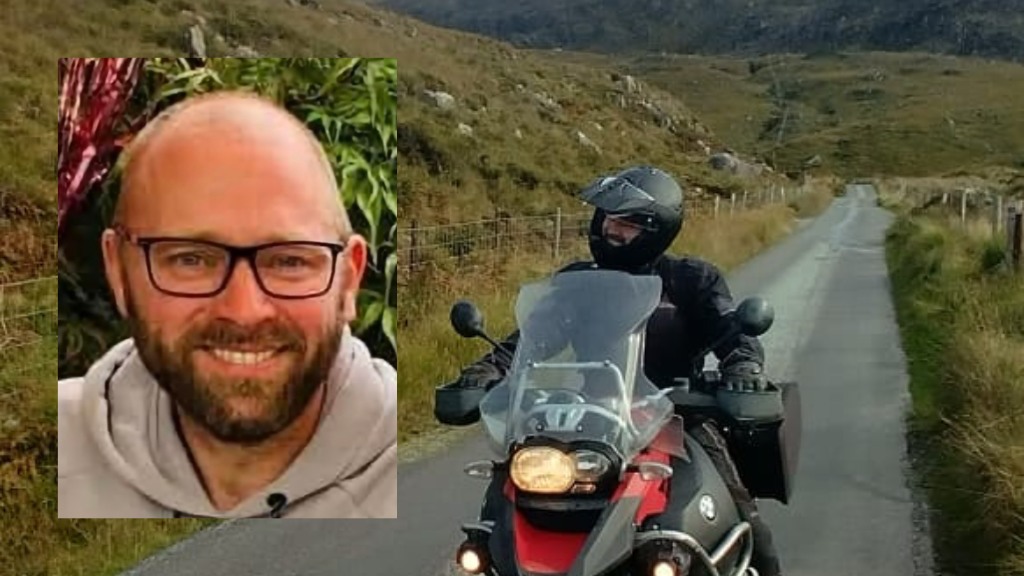
“I’m Paul Roberts, a mature student at Maynooth University, studying a BA in Community Studies.”
I imagine it was a very big decision to come to university as a mature student, adults can have so many things going on in their lives and it can be hard to find time to anything. What was it that led you to choose Maynooth’s evening BA programme?
Paul:
“The reason I chose this course is quite simple. I originally brought a young lad to the university’s open day to help him look at what his college options might be. At the time, I was fed up with my own job but I was really only going there looking for advice for him. While I was there, I met one of the lecturers at the Adult Education stand and I remember asking them if there were any courses for someone like me. My situation is that I had left school with absolutely no qualifications. I am also heavily dyslexic, so education was always something I struggled with and, if I’m honest, something I avoided.”
So, what was your life like before returning to education?
Paul:
“Well, I spent most of my life working in labouring jobs, truck driving, security, and as a nightclub doorman. But when I got to 54, I realized that I’d had enough. I was tired of the same routine and I wanted a change. I realised I needed to face something I’d always run from – education.”
Okay so there is thinking about returning to education and then there is doing a degree! That sounds like a very brave choice to dive straight in like you did. How did you feel about the idea of doing a degree at first?
Paul:
“When the lecturer that I met at the open day suggested doing a degree, I genuinely laughed at first. I didn’t even know how to spell ‘degree.’ But something stuck with me, and I thought about it, and thought about it, then decided to give it a go.”
That was a brave choice, but I honestly thing that lots more people than realize it are capable of doing a degree. Often it is as simple as what happens to you, that another person puts it to them ‘why don’t you do a degree?’ I have lost count of the number of times I have suggested this to people only for them to tell me that I am the first person who ever said that to them – that still surprises me to this day.
What was it like starting at university as a mature student?
Paul:
“Starting the course was a massive challenge. Walking into the university on the first night, I felt like I didn’t belong there. But that quickly changed when I met the other mature students. We were all in the same boat—nervous, unsure, but willing to try. That made a huge difference.”
It can’t have been all plain sailing though, how have you managed balancing college with the rest of your life?
Paul:
“Balancing college with work and family life hasn’t been easy, but once you get into it, you find your rhythm. I’ve made great friends, met incredible people, and learned so much—not just academically, but about myself as well.”
What support have you received during the course?
Paul:
“The lecturers have been brilliant. They’re supportive, approachable, and genuinely want you to succeed. If you ask for help, they’re there. They guide you in the right direction and give you the tools to do your best.”
And the question that I always like to ask people – how has the course changed the way you see the world?
Paul:
“This course has really opened my eyes to how communities work and what can be done to improve them. It’s changed how I see things.”
My mother heard about this course and told me about it. My brother, sister, and parents attended different colleges and universities. I wanted to attend university, so I applied for this course. I had an interview and told them that I wanted to study media studies. One day, I received a letter in my mailbox, and I opened it. I was accepted into Maynooth University. I felt over the moon and couldn’t believe I had been accepted—this was my dream come true.
What is the ILI?
It means Inclusive Learning Initiative. Five people with intellectual disabilities joined the first group of the ILI. We all studied different courses in Maynooth. This course was fully inclusive.
What I studied and why
I wanted to study media studies. I studied the history of media, creating a documentary, script writing, editing, and presenting for radio and television.
What parts of college did I enjoy?
I enjoyed being there. Inclusion is a feeling I’ve experienced through making friends and creating memories. It was difficult at the beginning, but then I focused on my module. Lecturers got used to me and the way I work. I am a visual learner. I also met people who really cared and wanted me to succeed. I enjoyed Kairos and working with the lights. I enjoyed doing voice-overs. I interviewed Shay Healy.
How did I show my learning?
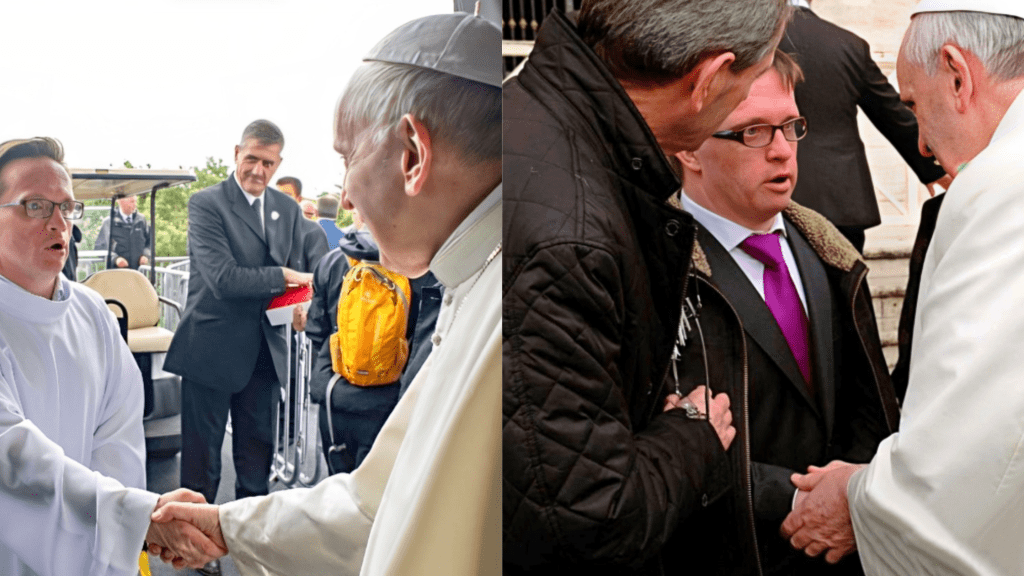
I created a show reel by compiling all my assignments. I made a documentary about my journey through college, titled Don’t Tell me, Show me. I am a visual learner who prefers structure and uses a portfolio of work. I also express myself through writing, poetry, and music. I received support from the ILI facilitator. As the lecturers got to know me, they became more open to different teaching and assessment methods. My assignments were practical; I interviewed Shay Healy, compared two wildlife programmes and shared my opinion, and conducted interviews in Rome during my work placement. All of this was assessed, including a report from Vatican Radio about my placement. I felt very honoured and humbled to meet Pope Francis, and I was very happy to see him.
What does inclusive education mean to me?
It means fostering natural and existing supports by learning from all the lecturers and students. Inclusive means I am involved in all modules. I want people to see me for who I am while living with Down syndrome.
The power that objects create?
I love music; it is very powerful. Two songs truly resonated with me. One is ‘This is me’ from The Greatest Showman. I like the line – but I won’t let them break me down, I know that there’s a place for us, for we are glorious.
The last song I will mention is ‘The Climb’ by Miley Cyrus. It reminds me of getting through college assignments and life in general.
There’s always gonna be another mountain
I’m always gonna want to make it move
Always gonna be an uphill battle
Sometimes I’m gonna have to lose
Ain’t about how fast I get there
Ain’t about what’s waiting on the other side
It’s the climb.
My advice to students!
The advice I can give to students is to enjoy their time with friends. Make use of the support available. Be creative in what you do and be honest with yourself.
My advice to universities
My advice for universities is to support students and guide them by recognising their potential.
What is important and why?
The most important thing is to follow your heart in everything you do. Focus on your studies and recognise your potential.
What kind of supports is important for students?
Patient and kind lecturers are essential. Support from family, friends, and other students is vital in helping the student achieve his potential.
Life is what you make it by Michael Gannon
Life is what you make it
Grab a hold and shake it
Hold on tight and take it
Don’t be afraid and fake it
You may think I’m a dreamer
More likely I’m a schemer
You may think I’m a sinner
But in truth I’m a winner
I do my best
Never mind the rest
My life is blessed
I’ll stand the test
So life is what you make it
Don’t lose your nerve
And break it
Michael’s Biography
Michael Gannon has a wide range of interests, including drama, dance, writing, fitness, and travel. Michael has never let his disability hold him back from his ambitions. He was a student at the National University of Ireland, Maynooth, for three years, studying media studies. His philosophy in life is that anything is possible and that you should never give up on your dreams.
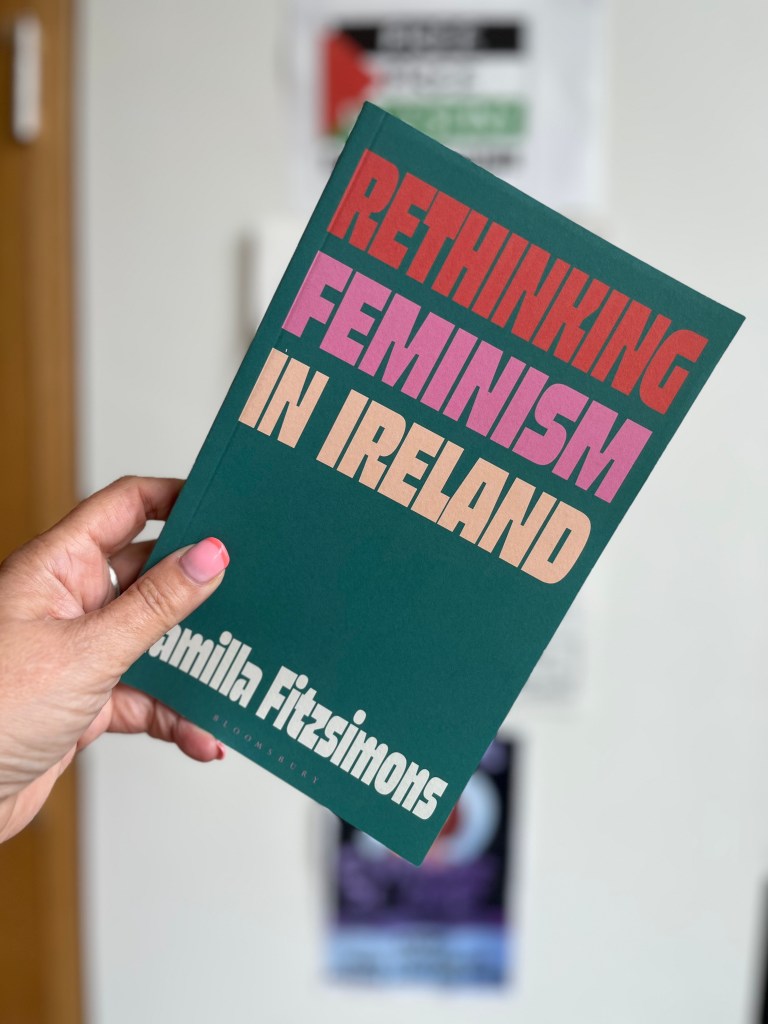
Last Friday, the 27th June, my fourth book Rethinking Feminism in Ireland was published. This one has been a labour of love and, perhaps with all my books, a case of me seeking to write what I think the students that I meet and the people that I share activist interests with would benefit from reading. In other words, I wrote this book because I couldn’t’ find anything to recommend that would complement the conversations I found myself in when talking about feminism in Ireland.
What I particularly like about this book is how I brought the words of some important activists in Ireland to the fore. I interviewed people across the spectrum of politics including Brid Smith the former TD for People before Profit and Senator Lynn Ruanne. Lynn is a former community worker who does amazing work in, as she puts it, ‘equality proofing’ as many laws as she can when they cross her desk. She’s not the only community worker who features. Rita Fagan took the time to sit down with me and share stories of feminism from the vantage point of St Michael’s estate Family Resource Centre and Amel Yacef also shared insights from activism that spans a range of communities and equality-based causes. I also talked to trade unionists, including Therese Caherty, people who were active in Ireland’s pro-abortion movement like the formidable Sinéad Kennedy and Orla O’Connor from the National Women’s Council of Ireland. And thanks to Mary McDermott of Safe Ireland who also took time out to share her insights with me. You’ll have to read the book to find out who else features, but the good news is that it is freely available, right here thanks to my wonderful publishers Bloomsbury Press but especially Olive Dellow.
So, what am I asking people to ‘rethink’? I contend that there are two souls of feminism – something I also write about here. The first and often most dominant is neoliberal feminism which is an extension of liberal feminism in that it focuses on empowerment and equality of participation in an otherwise largely unchanged world. The second, and the one that I argue for is radical, or anti-capitalist feminism. I object to neoliberal feminism’s hyper emphasis on individual success within today’s capitalist logic and argue instead for a version of feminism that recognizes our ability to control our lives is extremely limited. Our gender identity helps set these parameters, but so does our social class, perceived ability, sexual orientation, ethnicity, exposure to poverty, and our proximity to the catastrophic impacts of climate change, none of which are mutually exclusive.
My thinking has been influenced my many amazing writers and activists who have come before me. As Sara Ahmed puts it, I am a Feminist Killjoy and proudly so even when it can make me unpopular. Given the current expansion of settler colonialism, I must also acknowledge the work of Rafia Zakharia and her book Against White Feminism within which she speaks so clearly about the current practice of using feminism as the justification for imperialism. I draw from others too across the spectrum of socialism (including Marnie Holborow’s excellent Homes in Crisis Capitalism), critical education and radical feminism and spread these ideas across seven chapters – The trouble with feminism, Feminism and electoral politics, Feminism, work and trade unions, Feminism and trams liberation, Confronting gender-based violence, Reframing reproductive rights, and Doing feminism.
And if you like my writing, why not also check out my blogs where I write about a range of topics across trans liberation, electoral politics and feminism, but also Love Island and Taylor Swift!
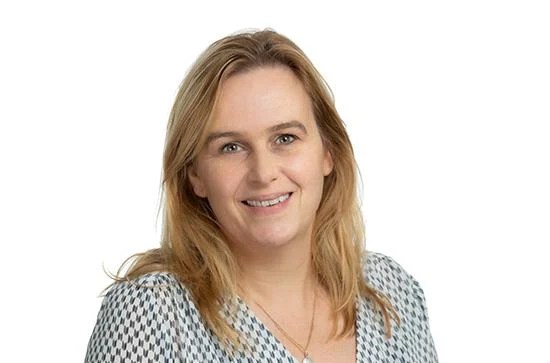
Camilla Fitzsimons is a Professor of Adult and Community Education and the current Head of Department here in the Department of Adult and Community Education at Maynooth. This is Camilla’s fourth book – you can read a full list of her publications here
Last Friday, the 27th June, my fourth book Rethinking Feminism in Ireland was published. This one has been a labour of love and, perhaps with all my books, a case of me seeking to write what I think the students that I meet and the people that I share activist interests with would benefit from reading. In other words, I wrote this book because I couldn’t’ find anything to recommend that would complement the conversations I found myself in when talking about feminism in Ireland.
What I particularly like about this book is how I brought the words of some important activists in Ireland to the fore. I interviewed people across the spectrum of politics including Brid Smith the former TD for People before Profit and Senator Lynn Ruanne. Lynn is a former community worker who does amazing work in, as she puts it, ‘equality proofing’ as many laws as she can when they cross her desk. She’s not the only community worker who features. Rita Fagan took the time to sit down with me and share stories of feminism from the vantage point of St Michael’s estate Family Resource Centre and Amel Yacef also shared insights from activism that spans a range of communities and equality-based causes. I also talked to trade unionists, including Therese Caherty, people who were active in Ireland’s pro-abortion movement like the formidable Sinéad Kennedy and Orla O’Connor from the National Women’s Council of Ireland. And thanks to Mary McDermott of Safe Ireland who also took time out to share her insights with me. You’ll have to read the book to find out who else features, but the good news is that it is freely available, right here thanks to my wonderful publishers Bloomsbury Press but especially Olive Dellow.
So, what am I asking people to ‘rethink’? I contend that there are two souls of feminism – something I also write about here. The first and often most dominant is neoliberal feminism which is an extension of liberal feminism in that it focuses on empowerment and equality of participation in an otherwise largely unchanged world. The second, and the one that I argue for is radical, or anti-capitalist feminism. I object to neoliberal feminism’s hyper emphasis on individual success within today’s capitalist logic and argue instead for a version of feminism that recognizes our ability to control our lives is extremely limited. Our gender identity helps set these parameters, but so does our social class, perceived ability, sexual orientation, ethnicity, exposure to poverty, and our proximity to the catastrophic impacts of climate change, none of which are mutually exclusive.
My thinking has been influenced my many amazing writers and activists who have come before me. As Sara Ahmed puts it, I am a Feminist Killjoy and proudly so even when it can make me unpopular. Given the current expansion of settler colonialism, I must also acknowledge the work of Rafia Zakharia and her book Against White Feminism within which she speaks so clearly about the current practice of using feminism as the justification for imperialism. I draw from others too across the spectrum of socialism (including Marnie Holborow’s excellent Homes in Crisis Capitalism), critical education and radical feminism and spread these ideas across seven chapters – The trouble with feminism, Feminism and electoral politics, Feminism, work and trade unions, Feminism and trams liberation, Confronting gender-based violence, Reframing reproductive rights, and Doing feminism.
And if you like my writing, why not also check out my blogs where I write about a range of topics across trans liberation, electoral politics and feminism, but also Love Island and Taylor Swift!
Camilla Fitzsimons is a Professor of Adult and Community Education and the current Head of Department here in the Department of Adult and Community Education at Maynooth. This is Camilla’s fourth book – you can read a full list of her publications here
As we head into the summer month and get a small reprieve from the year’s workload, it gives us an opportunity to catch up on events or information we may have missed out on during a busy academic year.
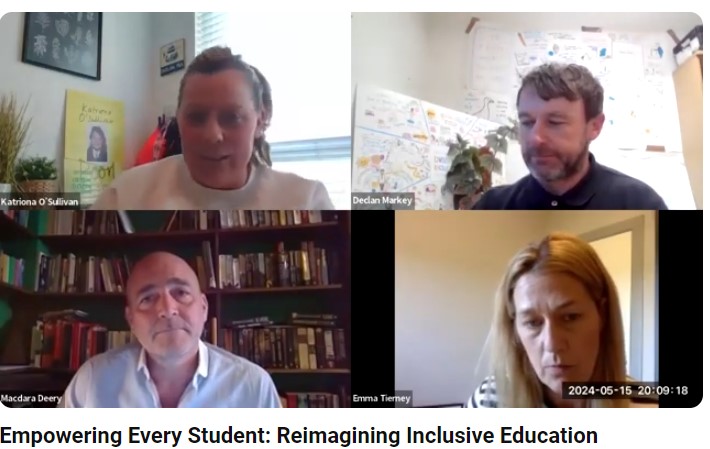
The TUTOR project’s second webinar from the Facebook Live series, “Empowering every student: reimagining inclusive education” is one to put on your watch list.
Fronted by TUTOR Project Ireland’s second ambassador, Macdara Deery, a post-primary teacher from Gallen Community School in Co. Offaly, Empowering Every Student focused on inclusive education with a particular lens on social class and the experiences of socio-economic disadvantage on a community, school, and its students.
The panel held a wide range of experience and depth, from FET, initial teacher education, alternative pathways, and personal experience and testimony.
Emma Tierney, undertaking her post-graduate diploma in Further Education and training in Maynooth University offered really perceptive and nuanced glimpses into the disconnect that may occur from training to practice because of systemic barriers such as having the ability to challenge the dominate ways of doing, that exist, and have always existed, when you enter a new setting as a FET tutor in training, a newly trained FET tutor, or indeed as a student. She also drew attention to the lived experiences of students with intersecting identities and how they are experiencing their education with a lack of autonomy over their own learning journey. Emma used an example of a student she had during her teaching practice who held asylum seeker status, and how without any warning “was uprooted and displaced midway through the academic year and his course taken and put down in a different part of the country … completely uprooted.” This example really shone a light on the lack of power students may face and how the systems around them upheld and reenforced that lack of autonomy – it brings to light how as educators, we really need to examine all aspects of our students’ lives, not just what happens in the classroom.
Katriona O’Sullivan, Digital Skills Senior Lecturer in Maynooth University, and author of bestselling autobiography Poor, really challenged educators: teachers and tutors to change the narrative for the students in their classroom. A particularly important and powerful moment in the webinar, was Katriona’s reminder:
“we don’t need to change poor people, lads, we’re grand. We’re amazing. We need to change the people who are already in education. Like, loads of people are saying this in the chat, which is amazing, principals are saying it, and inclusive education isn’t about educating the people necessarily, it’s [about] changing the system … the teachers need to be educated, policy makers need to be educated, the people in education need to be educated about what inequality is, and what it looks like, and what disadvantage is, in the space of our of our universities or our schools.”
I personally found this to be such a powerful reminder because we can tend to get bogged down in practice and lay everything at the door of educators when in reality we need to spend more time challenging and changing the system, speaking to initial teacher trainers, policy makers and so on about the realities of inequalities and show them what inclusive education really looks like.
Our final panel member, Declan Markey, is a lecturer in the Adult and Community Education department in Maynooth University, and co-coordinator of the Turn to Teaching programme. Declan, like Emma and Katriona, challenged the system and its barriers, but also went back to what Emma was discussing about the training-practice gap and pointed out the importance of doing the work as well as learning the skills and tools. He emphasises the importance of engaging in anti-bias type auditing on ourselves and our practices, and really reflecting, acknowledging, and unpacking all of the learned assumptions, stereotypes, and biases we consciously and unconsciously hold from our cultural and lived experiences:
“ you know the concept of inclusive education and you know we know Universal Design for Learning (UDL) – you equip people with a skill set and they can do some training oh yeah I can do inclusive education if they haven’t had a shift in their mindset that actually believes and you know in you know every student and learner that’s in front of them and stuff or you know and we all have assumptions and prejudices and stuff but if you can’t critically reflect on that and acknowledge you know your own kind of cultural background and your cultural assumptions and get past them and actually you know well then it doesn’t you know inclusive education isn’t really going kind make any difference in terms of the space that you’re in.”
Truly, this is an important webinar that very honestly, and provocatively, shines a light on the real conversations we need to be having in education – particularly when it comes to inequalities and creating truly inclusive education environments. If you missed the wonderful, radical webinar, grab yourself a cuppa and click here to watch.
Sinead Matson is a postdoctoral researcher working on the Erasmus+ funded TUTOR project for inclusive education in FET and Second Level schools. See https://tutor-project.eu/ for more details.
[1] From the ‘Book of Poems’ Summer School Program, Al-Quds University Community Action Centre, (c2008)
While this poem encapsulates the overt and covert violence of the Palestine we encountered more than a decade ago it also speaks to what we see nightly on our televisions these days.
Between 2008-12 the Department of Adult and Community Education, Maynooth University was involved in an EU funded project in partnership with 4 Palestinian Universities – Al-Quds, Bethlehem, Birzeit, and the Islamic University of Gaza[2]. The project known as LLIPS, focused on identifying existing lifelong learning provisions on the part of our partner universities with a view to enhancing it to even better meet the needs of Palestinian communities in the West Bank and Gaza.
During the project we were fortunate to meet and work with many academics in the partner universities. We also met with members of community groups and local NGOs – all engaged with different sectors of the population. We learned a great deal about life in the country; the most striking reality being that – every day – Palestinians lived in an environment where they faced issues of social, economic, political and educational marginalization. They lived in a society where their very way of being, their culture and history were silenced and subverted by the hegemony of the Israeli state. We were particularly struck by the restrictions imposed upon colleagues in our partner universities and by the complex strategies in which they had to engage in order to maintain their programmes. One such example was movement. At a local level for example it was difficult for Al-Quds University in Jerusalem to maintain contact with its Adult Education Centres. The problem was the Wall. The main campus was outside the wall and the Centres were inside. Crossing the Wall was no easy task. At a national level movement was also difficult. The LLIPS project found it impossible to bring all the partner universities together within Palestine because those from Gaza could not travel to the West Bank and visa versa. Instead, we all met in Jordan. Many Palestinians spoke of how restrictions on movement effect their everyday lives. They also regretted the negative impacts these have on other staff, on their students and indeed on their own families and friends. They had lost contact with many of the latter over the years.
As the LLIPS project progressed we were increasingly aware of the subtle, as well as the overt issues of power which constructed the identity and lived reality of those we encountered.
We found that the nature of the oppression and resistance across Palestine was multi-layered. Although we saw the Wall, the settlements choking the little towns and villages, the checkpoints, the guns, and the multiplicity of minor indignities casually doled out, as outsiders we could barely begin to imagine what it felt like to live there and what it took to sustain one’s self, one’s family and one’s sense of identity and nationhood in the face of unmitigated hostility.
The emotional and psychic toll on the individuals working there, as well as the community members was very evident. Even back then the need for support, solidarity, respite and resilience-building was clear. How much more the needs must be now and will be in the future.
One picture remains strongly, symbolically evocative.
We were being driven from Jerusalem to Jericho- the iconic path the ‘Good Samaritan’ of old had traversed. We were to lead a seminar for academic colleagues there. A black cassocked priest expertly drove, negotiating the multi-laned motorway. A seeming anomaly speaking of wealth and modernity, it wound its way seamlessly through ancient, barren hills, through an arid, desert landscape. Only the occasional Beduin, hazardously perched upon a donkey and following a small flock of sheep or goats up precarious hillsides broke the dun-coloured monotony. And then I noticed that here and there the dusty countryside was dotted with black tree trunks. Evidence of earlier habitation, perhaps of olive-farms?
‘Was this land cultivated not so long ago, Father’ I asked our driver.
The reply was swift. “Yes there were lots of Palestinian olive farms here. Olive tress can cope with the most arid conditions. And the trees provided shade and vegetation. They’d been there – like the farmers – for generations. Since Jesus’ time. But the Israeli Government confiscated the farms and chopped the trees. They said they were a threat to security. Hammas fighters could hide among the foliage and threaten the army….or settlers.’
The lifeless trunks bore silent witness to dispossession…and more.
[1] From the ‘Book of Poems’ Summer School Program, Al-Quds University Community Action Centre, (c2008)
[2] The project was entitled Lifelong Learning in Palestine (LLIPs). The Maynooth University Team were Josephine Finn, Bernie Grummell, Tony Walsh, Shauna Busto-Gilligan and Anne Ryan
Anne RyanTony Walsh
Anne Ryan is Emeritus Professor at Maynooth University. She was chair of the Department of Adult and Community Education from 2005 to 2018. Anne has worked in developing countries that experience extreme poverty (such as Bangladesh and Central Africa) and those that are war-torn (such as Afghanistan) and she has worked with disadvantaged communities in Australia and Ireland. These experiences convince her of the potential of adult and community education to empower communities to respond to the critical challenges facing twenty-first century societies in ways that ensure their voice is heard by decision-makers.
Tony Walsh was, until recent retirement from Maynooth University, lecturer and sometime Head of the Department of Adult and Community Education; he continues as Director of the Centre for the Study of Irish Protestantism and is a Fellow of the Young Centre for Anabaptist and Pietist Studies at Elizabethtown College, Pennsylvania,. A licensed systemic constructivist psychotherapist he is engaged in writing, consultancy and research inquiry engagements in the US, the UK, Palestine and Ireland (including Northern Ireland). Current research emphases include i) the experience and culture of the Irish Protestant minority; ii) narrative study of the Old German Baptist Brethren, (an Amish-like Plain church in the US); iii) the role of reflexivity in radical adult education iv) narrative and autoethnograpic inquiry.
Suddenly the images of the bombed ruins of a Gaza shop front, perhaps a café, flashed across the news screens. Rags of ruined blinds fluttered in the breeze.
Instantly I was back in a narrow, busy laneway in old Jerusalem and a sidewalk café fifteen years ago. We[1] were visiting Jerusalem as part of an educational research project. Blissfully relaxing in the sun’s heat and watching, watching as the multi-coloured crush of people in the narrow medieval street streamed by. Dark clothed and somber, Hasidic men bent purposefully towards prayer; camera toting tourists eyed them curiously as they wandered, talking, looking. Groups of Palestinian women laughing, chatting, baskets full of produce came from the market. Bright eyed kids racing in and out; swift arrows of colour between the adult crowds. Handcarts and motor bikes threaded a hazardous way down the street. A bizarre stream of Western pilgrims appeared toting a large cross, responding to a loud rosary. The midday call to prayer resounded from a nearby minaret mingling with their words. Each group seemed insulated, bounded in their own reality. The smells of roasting coffee beans, strong mint tea and frying meat next door mingled – sensory overload, as pungent aromas and noise, noise, noise enveloped us.
A group of Israeli soldiers stopped at the corner. They propped their machine guns against the wall and they surveyed the crowds – and us. One addressed his peers in loud New York tones. They were young and jumpy …and very, very near. Suddenly there was an explosive bang close-by. The soldiers grabbed their guns. The streaming crowds froze. Fear chilled our faces, congealed our limbs. And moments of time passed slowly by…. That time it was only a back-fire. Minutes later life returned to normal; the crowds streamed swiftly on their way.
We have often recalled that day packed as it was with so much to marvel at and so much to fear. We have often wondered what bearing these experiences coupled with current events in Palestine and global conflicts in general should have on how we approach education?
We have been writing about and researching education for many decades. Essentially, we believe that education’s main purpose is to help learners to understand their world, so that they are empowered to transform what is oppressive rather than accept it or adapt to it[2]. This includes understanding why conflict exists and what might be reasonable and appropriate responses to that conflict. We also believe that mainstream education often leaves learners ill equipped to either understand or address big global challenges such as war.
We believe that if education focused on understanding how power operates in society – and between societies – it would enable a far more fluent appreciation of the complex nature of human experience and particularly of conflict. It would raise awareness of how individuals, groups, nations become positioned in relation to each other. And would emphasize how conflict – and most particularly conflict interventions – require an understanding of these positions.
It seems to us that education that interrogates power is ever more needed in a world where disinformation and misinformation are increasingly evident and where what is ‘true’, what is ‘good’, what is ‘right’ are far from clear cut.
Even as we watch the awful events unfold in Palestine our thoughts often return to that day at the café in Jerusalem where we observed something of the overt nature of power. It was explicitly expressed in the actions and demeanour of the soldiers. They had the guns. Their power, although apparently placidly accepted by those going about their daily lives, was nevertheless fragile. The response to the ‘back-fire’ that could have been a gun shot or a bomb blast spoke of an awareness of the potential of resistance and challenge to the existing order that the soldiers were protecting.
Power is of course not always so easily observed. Mostly it is hidden, occluded within the everyday. We believe that a vital task of education is to reveal those occluded dynamics of power, marginalisation and oppression – those ‘on-going repetitive citations of the known order, citations that offer some a viable life and at the same time deny it to others’ (Davies 2008, 173)[3]. Without an emphasis on the interrogation of power education becomes mere compliance ‘a process of transferring the values and practices which are embedded in a specific culture and are particularly associated with the assumptions, values and maintenance of the power elites of that society.’[4]
[1] The ‘we’ refers to Tony Walsh and Anne Ryan who in partnership with the administrative and academic staff in the University of Bethlehem explored the challenges and opportunities inherent in diversity.
[2] This is essentially a Freirean philosophical position
[3] Davies, B. (2008) ‘The Ethics of Responsibility.’ In Phelan, A. and Sumsion, J. (Eds), Critical Readings in Teacher Education. Rotterdam: Sense Publishers.
Anne Ryan is Emeritus Professor at Maynooth University. She was chair of the Department of Adult and Community Education from 2005 to 2018. Anne has worked in developing countries that experience extreme poverty (such as Bangladesh and Central Africa) and those that are war-torn (such as Afghanistan) and she has worked with disadvantaged communities in Australia and Ireland. These experiences convince her of the potential of adult and community education to empower communities to respond to the critical challenges facing twenty-first century societies in ways that ensure their voice is heard by decision-makers.
Tony Walsh was, until recent retirement from Maynooth University, lecturer and sometime Head of the Department of Adult and Community Education; he continues as Director of the Centre for the Study of Irish Protestantism and is a Fellow of the Young Centre for Anabaptist and Pietist Studies at Elizabethtown College, Pennsylvania,. A licensed systemic constructivist psychotherapist he is engaged in writing, consultancy and research inquiry engagements in the US, the UK, Palestine and Ireland (including Northern Ireland). Current research emphases include i) the experience and culture of the Irish Protestant minority; ii) narrative study of the Old German Baptist Brethren, (an Amish-like Plain church in the US); iii) the role of reflexivity in radical adult education iv) narrative and autoethnograpic inquiry.
The power of conversation should never be underestimated. It can change attitudes, thinking, policies, research, and practice. We wanted to create conversational spaces for change through the TUTOR Ambassador webinar series, the first of which was hosted by Maynooth University. The webinar, An LGBTQI+ Inclusive Classroom: In conversation with Jamie Kenny TUTOR Ambassador, was held in early December. TUTOR is an Erasmus + project about inclusive education in second level and Further Education and Training of which Maynooth University is a partner. Jamie Kenny is the executive director for Dublin Pride and the first Irish TUTOR ambassador. He hosted a fireside chat with Angela Rickard, Course Leader for the year one Professional Master of Education (PME) in Maynooth University Education Department; Carrie Archer, Professional Learning and Development Coordinator for City of Dublin ETB and adjunct assistant professor in the National College of Ireland; Andrew Maloney, deputy principal in Firhouse Educate Together Secondary School; and Eoin Houlihan, second level teacher and guidance counsellor also at Firhouse Educate Together Secondary School, and lecturer on the PME programme in Maynooth University.
Carrie led the discussion on how a classroom can be LGBTQI+ inclusive without directly changing or adding content that is not already an existing part of the curriculum or learning outcomes – an argument she has frequently experienced in her work. She pointed out that even in business, childcare, beauty therapy, and hair dressing courses in FET, spaces for LGBTQI+ conversations already exist – you just have to look for them. Eoin agreed and added that in second level those spaces do already exist within the curriculum; for example mentioning the scientists and inventors from the LGBTQI+ community in science lessons when introducing students to a concept, theory, or experiment contextualises and makes visible LGBTQI+ for students. The same approach applies for English, Music, Geography, History, Art…really any other subject on the curriculum. When it is threaded through the curriculum and the day-to-day experience for students in the classroom it has the potential to become a more authentic way of inclusion and representation.
The conversation turned to the lived experiences of LGBTQI+ staff leading the advancement of greater representation and inclusion in schools and education settings which places those staff in demanding and potentially vulnerable and fatiguing positions. They described a fear experienced by many potential allies in education; a fear of getting it wrong, of causing offence, or of hurting someone. This fear can sometimes stifle or even silence the conversation. However, the burden of leading the conversations must not always be held by LGBTQI+ staff themselves. Andrew really highlighted the need for teachers to know that it backed up by law and equally importantly made explicit by leadership:
“I think it’s important to back teachers up, particularly teachers who are in teacher education, to understand that actually you have a legal basis to discuss this in your classroom… And particularly from school leaders, they need to hear that openly because if they don’t hear it openly, it’s not good enough just to be implicit about it because it happens to be enshrined in law.”
This struck a chord with me. In all the years I have worked with children I have never had a ‘child protection day’, or a ‘child protection week’ – it is enshrined in law therefore it is weaved into everything we do. If it is a legal requirement, is it part of the daily landscape of education?
Angela spoke of the appetite for inclusive conversations and spaces amongst the students in the initial teacher education programme in Maynooth University, and her experiences of visiting many second level schools across the country that are flying progress flags and taking part in BeLonG To’s safe and supportive schools training. This, she surmises, is hopeful and is having a very positive effect, making spaces for those conversations to continue amongst leadership, allies, and the LGBTQI+ community within schools and local communities. It is also providing opportunities for allies and leadership to lead the conversation rather than relying on LGBTQI+ identifying staff.
This conversation facilitated by Jamie in his position of TUTOR ambassador for Ireland has already caused real change. It has helped to inform the discussion we, as the TUTOR project researchers, have and the decisions we make when we will put together training and resources in the TUTOR programme. Attendees, who included teachers, tutors, leadership, and students engaged in initial teacher education have already spoken to us about the learnings they have taken and will put into practice. If you missed the conversation, but would like the opportunity to listen, please click this link and take an hour out of your time to listen to the real, practical knowledge and lived experiences that were shared with us.
Author Bio:
Sinéad Matson is a post-doctoral researcher with the Department of Adult and Community Education at Maynooth University. She has worked in all levels of education for over 20 years. Sinead’s research areas include social justice and equality in education, critical education, and decolonizing research methodologies. Sinead currently works on the TUTOR project which is an Erasmus+ funded transnational project aimed at improving inclusive education.
Ensuring inclusion in education has been a strong motivator for the Department of Adult and Community since its inception and over several decades. The Department is focused upon holistic, dialogical and pedagogical accompaniment of marginalised communities. It does this by co creating spaces for traditionally excluded voices to be heard, and on ensuring a standard of excellence is achieved in qualitative, engaged and participatory research. The department’s philosophy of education, initial teacher education and continuous professional development is leading and influencing pedagogy and practice within adult, community and further education and training settings. That philosophy is strategically aligned with, and supportive of, the aims and objectives of the TUTOR project, and with the TUTOR consortium partnership. The TUTOR project, alongside all of the international research projects the department partners with, encourages wider impact of inclusive education across the teaching profession at a European level.
Key messages of the TUTOR Project:
Summary of the TUTOR Project
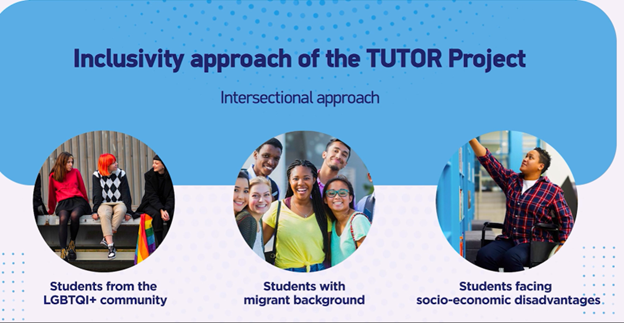
TUTOR aims to create partnerships between teacher education and training providers to set up Teacher Academies developing a European and international outlook on inclusion in teacher education. These Academies will embrace inclusivity in education and contribute to achieving the objectives of the European Education Area. In particular, the project will address the need for educators to develop their capacities to understand, analyse and develop strategic responses to the diversity in their classroom and to promote a more inclusive learning environment. TUTOR project intends to foster a more inclusive environment in education, that is open to students from migrant, LGBTQI+, and socioeconomically disadvantaged backgrounds, with a particular focus on safeguarding the elements of tolerance, acceptance, and inclusion.
The TUTOR objectives
To contribute to the improvement of teacher education policies and practices in Europe by creating networks and communities that bring together providers of secondary teacher education and providers of continuing professional development, and other relevant actors (such as ministries) and stakeholders to develop a Train the Trainers approach, focused on inclusivity in learning,
To define a forward-looking strategy upskilling strategy for secondary school teachers,
To enhance the European dimension and internationalization of teacher education through innovative and practical collaboration and by sharing experiences for the further development of teacher education in Europe,
To foster holistic inclusivity in the learning environment, covering all its aspects such as tolerance, non-discrimination, flexibility, etc,
To assess current and future skill mismatches in the targeted (teaching) profession,
To disseminate widely all project products & maintain them in future communications.
Who is the TUTOR project for?
It is for teachers, students and policy makers who have an interest in inclusive education
Educators/Teachers/ Trainers from the four participating countries of Greece, Ireland, Austria and Turkey
Reasons for engagement:
To update inclusivity skills of secondary education teachers in inclusive education.
To raise awareness with regards to the inclusivity needs of students being discriminated because they are part of the LGBTQI+ community, have migrant background and they face socioeconomic difficulties.
The TUTOR Consortium will
1) conduct desk and field research on the inclusivity skills needs of teachers, exploring both the desired status of inclusive education and the actual status within the partner countries, and at European level.
2) design a training program to match country-specific needs
3) promote and provide access to TUTOR e-learning platform – access to training materials and a network of professionals within their sector.
4) support teachers to develop skills to enable a more inclusive teaching experience for students from LGBTQI+ community, migrant backgrounds, and socioeconomically disadvantage to ensure that they are being equally treated.
5) work with policy-makers including ministries, local & regional authorities, EU bodies, (and other officials with the ability to influence policies) to make changes at a European and national level regarding transitions to a more inclusive teaching environment.
What has the TUTOR project achieved so far?
We commenced in June 2022 with a meeting of all partners in Athens, Greece, where the consortium partners developed an overall strategy including an assessment methodology, a Project Management Handbook and Financial Plan, a Dissemination Plan and a project website. Desk research was undertaken across the four countries and at EU level. Partners produced country specific literature reviewson inclusive education, and an overarching Transnational Literature Review.
The Department of Adult and Community Education, Maynooth University is the lead partner for Work Package 2 (WP2) Definition of a forward looking upskilling strategy for teachers. Partners have conducted focus group meetings with teachers and stakeholders in Ireland, Austria, Turkey and Greece.
What is currently happening in TUTOR?
TUTOR’s Transnational Partner Meeting (TPM) is being hosted by the Department of Adult and Community Education, Maynooth University on 1st and 2nd February 2023, where we welcome partners from Greece, Turkey, Austria and Belgium. All partners are advocates for and are specialists in inclusive education. We will discuss the implications of the key findings of desk and field research to date and plan our strategy for defining a future looking upskilling strategy for teachers across Europe. For further information,
Large scale research activity and needs analysis on upskilling of teachers on inclusive education for students from LGBTQI+, migrants, ethnic minorities, and socio economically disadvantaged contexts.
TUTOR partners are exploring National-level and EU-level research on the current skills levels of secondary education and VET (Vocational Education and Training) teachers on inclusivity. As part of that process we will be conducting surveys and interviews with 800 teachers, engaging with 500 stakeholders and policy makers. We are developing a professional network of teachers, and developing opportunities for training and mobilities for teachers across the consortium partnership.
Dr. Margaret Nugent is an academic and researcher with the Department of Adult and Community Education. Her professional experience and research interests extends to international peace building, conflict intervention, reconciliation in post conflict contexts and inclusive education. She specialises in qualitative, engaged and participatory research methodologies, and is an experienced practitioner and innovator in developing peacebuilding pedagogies. Margaret has delivered a very extensive portfolio of consultancy work with the adult, rural and community development sector, within further and higher education.
Bernie Grummell is Associate Professor in the Department of Adult and Community Education. She is co director of the Centre for Research in Adult Learning and Education and is the lead researcher for the TUTOR project in Maynooth University.